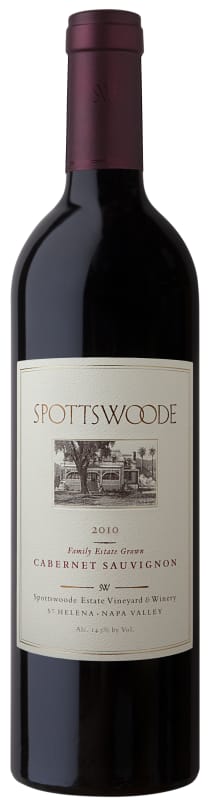


Winemaker Notes
Professional Ratings
-
Robert Parker's Wine Advocate
Mature now, yet seemingly capable of continuing on in this vein for at least another decade, Spottswoode's 2010 Cabernet Sauvignon is a terrific example of the sort of wine this picture-book estate can turn out. Always stylish and elegant, with terrific integration of fruit and oak, this vintage is lightening in color a bit, but it's so complete, offering complex aromas of cedar and vanilla that have indelibly melded with the black cherries, cassis and loam notes characteristic of the property. Medium to full-bodied on the palate, it finishes long, with softly dusty tannins that will serve it well at the table the next time you can find a worthy piece of lamb or beef. Best After 2015
-
Wine Spectator
Notably rich and generous, with a complex array of dark berry, currant and cassis flavors, delivering subtle herb, spice and cedar notes and ending with a dash of loamy earth. Most impressive on the finish, which sails on and on. Best from 2014 through 2024.





Spottswoode is an historic, family-owned estate vineyard and winery located on the western edge of St. Helena in Napa Valley. The estate was established in 1882 by George Schonewald, whose historic Victorian home is depicted on the label. Spottswoode was christened by Mrs. Albert Spotts, whose family owned the property from 1910 until its purchase in 1972 by Mary Weber Novak and her husband, Dr. Jack Novak. After Jack died unexpectedly in 1977, Mary carried out their shared dream, and Spottswoode’s debut Cabernet Sauvignon was produced in 1982, exactly one hundred years after the estate’s founding.
To ensure the highest quality, Spottswoode is dedicated to producing a handful of wines in very limited quantities: Spottswoode Estate Cabernet Sauvignon, Sauvignon Blanc, Lyndenhurst, and Field Book. The winery's goal is to produce exceptional, well-balanced, structured wines that exhibit texture, elegance, consistency and the ability to age well.
The 40-acre Spottswoode Estate Vineyard is an ideal terroir for growing wine grapes. Situated on the apex of the Sulphur Creek fan, the alluvial soils comprised primarily of sandy clay loam provide superb drainage. The gap between the Mayacamas Range and Spring Mountain admits cooling maritime breezes that temper the sun’s heat, creating an ideal microclimate for winegrowing. Among the first to introduce organic farming practices in the Napa Valley in 1985, Spottswoode is proud to have enjoyed the California Certified Organic Farmers (CCOF) certification since 1992 and Demeter Biodynamic Certification since 2020. Spottswoode is also Napa Valley’s first Certified B-Corp winery.

A noble variety bestowed with both power and concentration, Cabernet Sauvignon enjoys success all over the globe, its best examples showing potential to age beautifully for decades. Cabernet Sauvignon flourishes in Bordeaux's Medoc where it is often blended with Merlot and smaller amounts of some combination of Cabernet Franc, Malbecand Petit Verdot. In the Napa Valley, ‘Cab’ is responsible for some of the world’s most prestigious, age-worthy and sought-after “cult” wines. Somm Secret—DNA profiling in 1997 revealed that Cabernet Sauvignon was born from a spontaneous crossing of Cabernet Franc and Sauvignon Blanc in 17th century southwest France.

St. Helena is in the heart of the Napa Valley, nestled between Calistoga to the north and Rutherford on its southern border. On its western side, the Mayacamas Mountains guard it from the cooling effects of the Pacific Ocean; to its east stand the Vaca Mountains. In conjunction, these mountain ranges serve to lock in summer daytime heat. But in the evening, cool air from the San Pablo Bay funnels up through the valley, creating very chilly nights. It isn’t uncommon for temperatures to drop 50 degrees, a shift that promotes a balance of sugar ripeness and acidity in wine grapes.
St. Helena contains a plethora of different soil types in a small area, which have been enhanced over centuries by rain runoff from both mountain ranges. Its vineyards cover a variety of terrain, spreading across the bucolic valley floor and its benchlands.
These ideal topographic and climatic growing conditions easily caught the attention of early winemaking pioneers. In fact, St. Helena is the birthplace of Napa Valley’s commercial wine industry. Dr. Crane founded his cellar in 1859, David Fulton in 1860 and Charles Krug in 1861.
Today there are no less than 400 separate vineyards planted within the 12,000 acres that make up the St. Helena appellation.
Revered most for its red wines based on Bordeaux varieties, namely Cabernet Sauvignon, the St. Helena appellation is also a source of superior Syrah, Zinfandel and Sauvignon blanc.