

Winemaker Notes
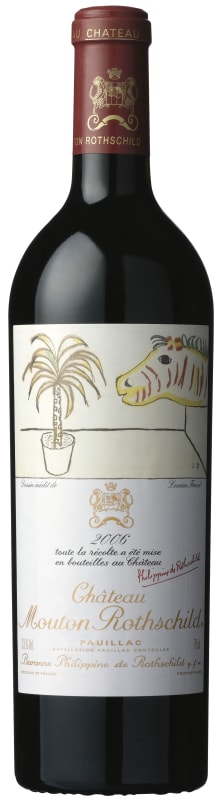
About the Label Artwork
Born in Berlin in 1922, the famous English portrait painter Lucian Freud is the grandson of the founder of psychoanalysis. Fleeing Nazi Germany, his father brought him to London in 1933 and he became a British citizen in 1939. His vocation became apparent on leaving school. He studied painting at the Central School of Art and Design and then at Goldsmiths College in London. He then had a brief flirtation with surrealism. Initial recognition came quickly in 1951 when he was awarded the Arts Council Prize for the Festival of Britain. In 1987-88, a travelling exhibition of his works in Washington, Paris, London and Berlin confirmed his place at the forefront of contemporary figurative realism and, in 1995, the exhibition devoted to him and his friend and fellow-painter Francis Bacon at the Fondation Maeght in Saint-Paul de Vence underlined his provocative power and his vision of the human body marked by time and the world's violence. His surprising depiction of Queen Elizabeth II in 2001 scorned the conventions of ceremonial portraiture. In 2008, one of his works was sold for the highest price ever attained by a living artist.
Lucian Freud is first and foremost a painter of flesh. Nacreous, marbled, disposed in precise and vigorous volumes, it gives their expressive power to nudes and battered faces, at once alive and set in an almost corpse-like stiffness.
Far from the tormented portraits and nudes for which he is renowned, for Mouton 2006 Lucian Freud has chosen a joyously exotic transposition of the pleasure of drinking, in which the vinestock is transformed into a springing palm tree and the winelover into a happily anticipatory zebra.
Professional Ratings
-
Wine Enthusiast
At the time it was shown as a barrel sample in early 2007, this was the best wine of 2006. That accolade remains. It has all the power of the Cabernet Sauvignon in Pauillac, which was the greatest success of the vintage. That power comes from the dense tannins as well as the black plum and spice flavors and minerality. The texture becomes velvet, giving a final richness, but never losing its long aging potential. In a year that is good, but not at the top, Mouton has made a great wine.
Cellar Selection -
Jeb Dunnuck
I loved the 2006 Château Mouton Rothschild, a complex, nuanced, flawlessly balanced Mouton based on 87% Cabernet Sauvignon and 13% Merlot. Tobacco, cedarwood, lead pencil shavings, and both red and black fruits define the bouquet, and this is clearly in its prime drink window, with a terrific mix of ripe fruit and just developing secondary aromas. Full-bodied and concentrated, with sweet tannins, this elegant, layered, silky 2006 has another 20 years of prime drinking. The label comes from the famed English portrait painter Lucien Freud (1922-2011). Drinking window: 2023-2043.
-
Robert Parker's Wine Advocate
Tasted at the Mouton-Rothschild vertical in London, the 2006 Mouton-Rothschild was really the wine that put winemaker Philippe Dhalluin on the map, in the sense that unlike the 2005 born in a great vintage, this 2006 had to transcend it. It remains one of the standouts of the growing season and actually replicates previous showings just the week earlier and in January. As expected, the nose has quite brilliant delineation with blackberry, graphite, here an almost cold slate-like scent. The palate is harmonious with the carefully judged acidity, fine-grain tannin and immense detail on the finish. Recent bottles suggest that it may close up for several years, in which case, either enjoy this in the next few months or cellar this for a few years and receive vinous dividends down the line.
-
Vinous
Bright ruby-red. Vibrant aromas of cassis, blueberry, cedar and graphite. Wonderfully pure and silky in the mouth, with great subtle, slow-building intensity and superb energy and thrust. A real essence of cabernet sauvignon and Mouton terroir This one really rattled my brain-in the gentlest way. As silky as it is, it possesses bottomless depths. Finishes with big but noble tannins and outstanding length. I loved this wine the spring after the harvest, and it's even more impressive today. This should go on for decades, but today it's hard to imagine this wine going through an extended sullen stage. By the way, I'm a great fan of Lucien Freud's work, but his label for this wine does not do justice to the juice inside the bottle.
Rating: 96+ -
Decanter
The breadth and depth of this wine is impossible to ignore. Tobacco notes blend with cappuccino, cedar and grilled almonds. This is classy, with just the right amount of abandon. Grilled black fruits are very Mouton, but with the touch of austerity and pulled-in, pared-down tannins that tell you it’s 2006. Complex and complete.
-
James Suckling
This is an eye-opener with a tight core of complex fruit character as well as subtle chocolate and spices. Full body, firm tannins and a classy finish. Holding back. Much better than expected. A vintage forgotten.
-
Wine Spectator
This is in an interesting spot right now, still sporting some youthful blackberry, cassis and plum fruit, with only secondary hints starting to emerge. Yet those secondary hints are very tantalizing, with well-worn cedar, tobacco and sanguine notes adding range and cut. There's a freshness throughout, yet also a supple edge, which allows the fruit to drape prettily on the finish.


One of the world’s most classic and popular styles of red wine, Bordeaux-inspired blends have spread from their homeland in France to nearly every corner of the New World. Typically based on either Cabernet Sauvignon or Merlot and supported by Cabernet Franc, Malbec and Petit Verdot, the best of these are densely hued, fragrant, full of fruit and boast a structure that begs for cellar time. Somm Secret—Blends from Bordeaux are generally earthier compared to those from the New World, which tend to be fruit-dominant.

The leader on the Left Bank in number of first growth classified producers within its boundaries, Pauillac has more than any of the other appellations, at three of the five. Chateau Lafite Rothschild and Mouton Rothschild border St. Estephe on its northern end and Chateau Latour is at Pauillac’s southern end, bordering St. Julien.
While the first growths are certainly some of the better producers of the Left Bank, today they often compete with some of the “lower ranked” producers (second, third, fourth, fifth growth) in quality and value. The Left Bank of Bordeaux subscribes to an arguably outdated method of classification that goes back to 1855. The finest chateaux in that year were judged on the basis of reputation and trading price; changes in rank since then have been miniscule at best. Today producers such as Chateau Pontet-Canet, Chateau Grand Puy-Lacoste, Chateau Lynch-Bages, among others (all fifth growth) offer some of the most outstanding wines in all of Bordeaux.
Defining characteristics of fine wines from Pauillac (i.e. Cabernet-based Bordeaux Blends) include inky and juicy blackcurrant, cedar or cigar box and plush or chalky tannins.
Layers of gravel in the Pauillac region are key to its wines’ character and quality. The layers offer excellent drainage in the relatively flat topography of the region allowing water to run off into “jalles” or streams, which subsequently flow off into the Gironde.