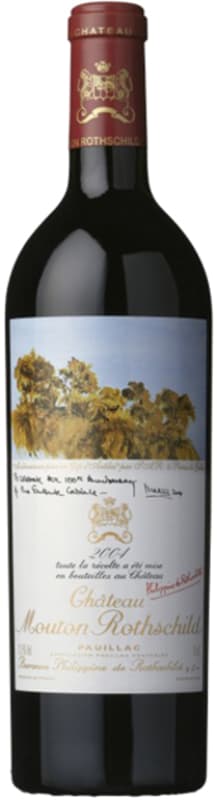


Winemaker Notes
The wine has a strong, dark and deep color, while the nose displays subtle complexity on fruity notes of black cherry, candied quince and licorice with touches of cold smoke, revealing very well-integrated oak. The attack is rich and full, with precise, refined tannins that elegantly enfold mocha flavors and toasted notes, leading into a close-knit and flavorful finish with attractive, very fresh length. A distinctive and stylish wine.
Blend: 69% Cabernet Sauvignon, 15% Merlot, 13% Cabernet Franc, 3% Petit Verdot 3%
About the Label Artwork
2004 occupies a special place in our memories since it marks the Centenary of the Entente Cordiale, concluded by Britain and France on 8 April 1904. King Edward VII is known to have played a prominent part in the agreement, which would herald a genuine alliance during the First World War and forever transform two rival powers into sisters by choice.
The commemoration of such an important milestone in Franco-British relations was the occasion for many celebrations in 2004, culminating in official visits by both Heads of State. That is the spirit in which Baroness Philippine de Rothschild approached HRH The Prince of Wales, a talented artist and a direct descendant of Edward VII. The Prince agreed that the label for Mouton Rothschild 2004 could be illustrated with one of his watercolours, inspired by a French landscape, in celebration of the Entente Cordiale. He has added in his own hand: «To celebrate the 100th Anniversary of the Entente Cordiale - Charles, 2004».
Standing out against an azure sky, rooted in the depths of the soil, the pines depicted by the artist are in the image of the vine, fruit of the ever bountiful union of the sun and the earth.
Professional Ratings
-
Wine Spectator
This shows lots of mulled spice, warm tobacco leaf and well-roasted cedar accents, but isn't short on fruit, offering enticing layers of red currant, plum and blackberry confiture. The long finish is riddled with sweet smoke, black tea and iron notes. A gorgeous wine from an overlooked vintage.
-
Wine & Spirits
Supple and grand, Mouton has a heavenly richness in 2004...
-
Robert Parker's Wine Advocate
Deep garnet colour. Aromas of warm cassis, dried plum, cloves and pencil shavings. Medium+ acidity and medium to firm, fine tannins. Long finish. Tasted August 2009.


One of the world’s most classic and popular styles of red wine, Bordeaux-inspired blends have spread from their homeland in France to nearly every corner of the New World. Typically based on either Cabernet Sauvignon or Merlot and supported by Cabernet Franc, Malbec and Petit Verdot, the best of these are densely hued, fragrant, full of fruit and boast a structure that begs for cellar time. Somm Secret—Blends from Bordeaux are generally earthier compared to those from the New World, which tend to be fruit-dominant.

The leader on the Left Bank in number of first growth classified producers within its boundaries, Pauillac has more than any of the other appellations, at three of the five. Chateau Lafite Rothschild and Mouton Rothschild border St. Estephe on its northern end and Chateau Latour is at Pauillac’s southern end, bordering St. Julien.
While the first growths are certainly some of the better producers of the Left Bank, today they often compete with some of the “lower ranked” producers (second, third, fourth, fifth growth) in quality and value. The Left Bank of Bordeaux subscribes to an arguably outdated method of classification that goes back to 1855. The finest chateaux in that year were judged on the basis of reputation and trading price; changes in rank since then have been miniscule at best. Today producers such as Chateau Pontet-Canet, Chateau Grand Puy-Lacoste, Chateau Lynch-Bages, among others (all fifth growth) offer some of the most outstanding wines in all of Bordeaux.
Defining characteristics of fine wines from Pauillac (i.e. Cabernet-based Bordeaux Blends) include inky and juicy blackcurrant, cedar or cigar box and plush or chalky tannins.
Layers of gravel in the Pauillac region are key to its wines’ character and quality. The layers offer excellent drainage in the relatively flat topography of the region allowing water to run off into “jalles” or streams, which subsequently flow off into the Gironde.