

Winemaker Notes
The wine has an attractively deep color with a garnet hue and an open, complex nose dominated by notes of humus and fern along with jammy fruit and prunes. Full on the attack, it shows opulence and attractive substance over close-knit, caressing tannins, developing intense roast coffee notes set off by a lovely reminder of the humus aromas on the nose. The powerful, full-bodied finish lingers long on the palate, revealing the expression and sheer class of great Mouton vintages, reminiscent in its richness and harmony of the very fine 1986.
Blend: 86% Cabernet Sauvignon, 14% Merlot
About the Artwork
Each year since 1945, the Château Mouton Rothschild label has been illustrated with an artwork by a leading painter, specially created for the vintage. Thus, the most famous names in contemporary painting have been brought together in a collection to which a new work is added each year.
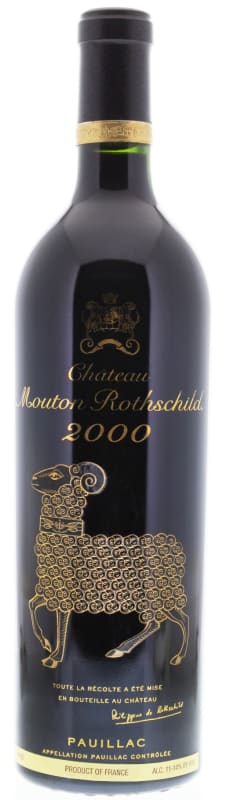
For 2000, in an exceptional departure from this tradition, Baroness Philippine de Rothschild has not commissioned a painter. The bottle "in person" has become a collector's item, its very glass adorned with a treasure from the Museum of Wine in Art at Mouton: the little "Augsburg Ram", a chased silver-gilt drinking vessel created around 1590 by Jakob Schenauer, a German master goldsmith.
In order to reproduce all the refinement and lustre of the original work, after four months of research, the glassmaker B.S.N. came up with a new technique for enamelling in relief, calling for custom-made tools and work of the utmost precision. The particularly complex method for firing the gold and enamel has produced a scintillating texture and an incomparable capacity to catch the light.
A golden ring around the black foil reproduces the design engraved on the ram's collar and recalls the chased volutes of its body. The arms, the name, the vintage and the owner's signature have been screen-printed in gold. The bottle, of high-quality, heavy glass, has been slightly remodelled at the shoulder in the shape of a truncated cone. As proof of its authenticity, the Château Mouton Rothschild name is engraved in the base.
Professional Ratings
-
Jeb Dunnuck
A ripe, gorgeous wine, the 2000 Château Mouton Rothschild is based on 86% Cabernet Sauvignon and 14% Merlot that was raised in 85% new French oak. Blackcurrants, smoky tobacco, chocolate, and graphite all emerge on the nose, and on the palate, it's full-bodied, with a deep, layered mid-palate, ripe, velvety tannins, and a great finish. The volume, richness, and depth here are all classic Mouton, yet it nevertheless stays in the focused, more structured style of the vintage.
-
Robert Parker's Wine Advocate
Deep garnet colored with a touch of brick, the 2000 Mouton Rothschild (composed of 86% Cabernet Sauvignon and 14% Merlot) boldly bursts from the glass with tantalizing Black Forest cake, dried mulberries, kirsch and blackcurrant pastilles notes plus wafts of iodine, incense, potpourri and cinnamon stick with a hint of cigar boxes. Medium to full-bodied, the palate packs in the muscular fruit, framed by firm, ripe, grainy tannins and seamless freshness, finishing with phenomenal length. This is an incredibly complex and multifaceted wine, and it's drinking deliciously now. This said, I can’t help but feel that it is holding something back, that it still has another layer of opulence and seduction to reveal in its tight-knit fruit and solid structure. I personally can’t wait to see how this beauty will continue to unfold over the years to come. Rating: 97+
-
Wine Enthusiast
With its distinctive antique bottle and gold etched label dominated by a sheep, this is definitely a move away from classic Bordeaux bottling. It is good that the wine can support the presentation. The fruit is so ripe, it almost tastes of raisins, but that sweetness is finely balanced by the dry tannins and concentrated texture. To finish, there are exotic spices, giving an almost oriental character to the long aftertaste.
-
James Suckling
The nose is very intense, super-ripe and rich, verging on jammy. Notes of leather, spices and prunes. Full-bodied, soft and beautiful with ripe tannins and a long finish. This is soft and yummy right now. Drink or hold.
-
Wine Spectator
Rounded, fleshy and a bit extracted in feel, with dark plum, blackberry and fig jam flavors that flirt with a pruny edge, picking up lots of warm mocha, singed vanilla bean and ganache notes through the finish. This relies more on easy opulence than on depth or purity on the end.—2000 Bordeaux blind retrospective (December 2015). Drink now through 2023.


One of the world’s most classic and popular styles of red wine, Bordeaux-inspired blends have spread from their homeland in France to nearly every corner of the New World. Typically based on either Cabernet Sauvignon or Merlot and supported by Cabernet Franc, Malbec and Petit Verdot, the best of these are densely hued, fragrant, full of fruit and boast a structure that begs for cellar time. Somm Secret—Blends from Bordeaux are generally earthier compared to those from the New World, which tend to be fruit-dominant.

The leader on the Left Bank in number of first growth classified producers within its boundaries, Pauillac has more than any of the other appellations, at three of the five. Chateau Lafite Rothschild and Mouton Rothschild border St. Estephe on its northern end and Chateau Latour is at Pauillac’s southern end, bordering St. Julien.
While the first growths are certainly some of the better producers of the Left Bank, today they often compete with some of the “lower ranked” producers (second, third, fourth, fifth growth) in quality and value. The Left Bank of Bordeaux subscribes to an arguably outdated method of classification that goes back to 1855. The finest chateaux in that year were judged on the basis of reputation and trading price; changes in rank since then have been miniscule at best. Today producers such as Chateau Pontet-Canet, Chateau Grand Puy-Lacoste, Chateau Lynch-Bages, among others (all fifth growth) offer some of the most outstanding wines in all of Bordeaux.
Defining characteristics of fine wines from Pauillac (i.e. Cabernet-based Bordeaux Blends) include inky and juicy blackcurrant, cedar or cigar box and plush or chalky tannins.
Layers of gravel in the Pauillac region are key to its wines’ character and quality. The layers offer excellent drainage in the relatively flat topography of the region allowing water to run off into “jalles” or streams, which subsequently flow off into the Gironde.