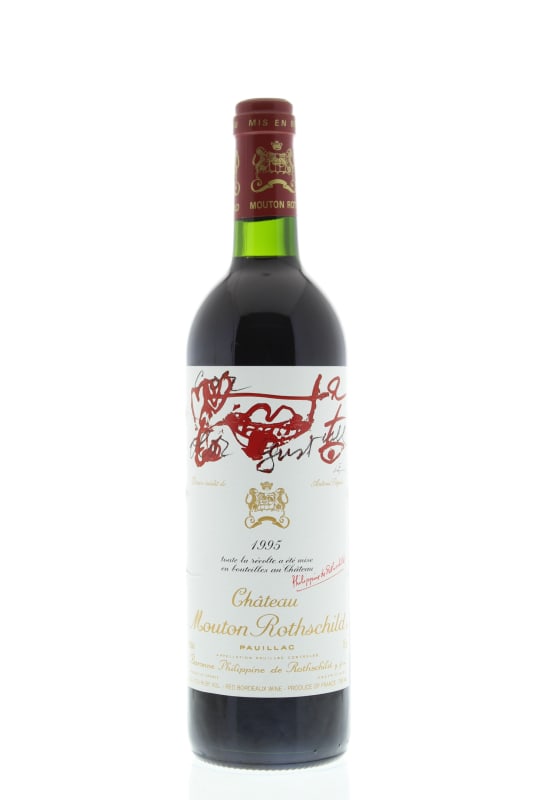


Winemaker Notes
The wine has a fine, deep red color with a slightly brickish tint and a subtle nose, a lovely marriage of jammy fruit, black cherry, some toasty, roasted notes and a pleasant touch of mint that brings freshness and refinement. Seductive on the palate, it has compact, well-balanced tannins in a nicely rounded structure enhanced by rich and complex flavors of blackcurrant liqueur, with powerful mineral notes. The finish is full and dense, long, stylish and generous, entirely typical of the vintage.
Blend: 72% Cabernet Sauvignon, 19% Merlot, 9% Cabernet Franc
About the Label Artwork
The Catalan painter and sculptor Antoni Tàpies was born in Barcelona in 1923, where he was brought up in an intellectual environment. His life and work are firmly rooted in his native city.
It was in Barcelona that he completed his studies, in law as well as drawing, and founded in 1948, the art review, Dau al Set; there also that he met the painter Miro, who played an influential part in his brief flirtation with Surrealism. More important, however, in his development as an artist was his discovery of Eastern philosophies and, during his stay in Paris, of
"Art Informel" with Dubuffet, Fautrier and others. After his first one-man exhibition in Barcelona in 1950 he soon achieved international recognition and his work was shown all over the world
He won prestigious awards: the Venice Biennale in 1958 and 1993, the Picasso Medal in 1993, and France's National Painting Prize in 1985. In 1083 Barcelona not only commissioned a monumental sculpture entitled
"Homage to Picasso", but also gave him a building in which to house the Antoni Tàpies Foundation, inaugurated in 1990. Tàpies is now considered one of the leading contemporary artists and his works are found in all the great museums.
Through his fusion of Eastern and Western influences, Tàpies develops a distinctive style which provokes a disturbing, unspoken dialogue between man and matter, where the spiritual struggles with stark reality.
Rough earth-coloured backgrounds where paint is mixed with various substances (sand, fabric, marble, plaster, wire, rope) appear to be "walls" which have been slashed, cut and inscribed with hieroglyphics of a primordial language. Tapies' art is impossible to place within a particular movement, reflecting as it does an image of chaos tamed, which powerfully expresses the preoccupations of the world we live in. He himself defines his works as "battlefields where wounds are multiplied to infinity".
A nose, two hearts, a mouth, an eye: the scarlet design, conceived and annotated by Tàpies for the Mouton Rothschild 1995 label, proclaims, with a smile, that feast of the senses which promises a great wine.
Professional Ratings
-
James Suckling
This explodes on the nose with prunes, blackberries, mushrooms and fresh tobacco. Full body, ripe tannins and a juicy finish. Big and powerful. Still could do with a decade or more of aging.
-
Robert Parker's Wine Advocate
Bottled in June, 1997, this profound Mouton is more accessible than the more muscular 1996. A blend of 72% Cabernet Sauvignon, 9% Cabernet Franc, and 19% Merlot, it reveals an opaque purple color, and reluctant aromas of cassis, truffles, coffee, licorice, and spice. In the mouth, the wine is "great stuff," with superb density, a full-bodied personality, rich mid-palate, and a layered, profound finish that lasts for 40+ seconds. There is outstanding purity and high tannin, but my instincts suggest this wine is lower in acidity and slightly fleshier than the brawnier, bigger 1996. Both are great efforts from Mouton-Rothschild. Anticipated maturity: 2004-2030.
-
Wine Spectator
Aromas of ripe fruit and grilled meat follow through to a full-bodied palate, with velvety tannins and a long caressing finish. Very beautiful wine. Mouton shows finesse yet richness in this vintage.
-
Vinous
The 1995 Mouton Rothschild was tasted from ex-château bottles, and I had not tasted this vintage for a number of years. This puts in a very good performance given that it was not an auspicious decade for the First Growth. A mélange of red and black fruit gradually gives way to cassis on the nose, lending it a rather ostentatious bouquet that was synonymous with Mouton at the time. The palate offers precocious black fruit fused with graphite and prominent cedar aromas. The finish is luscious, maybe too luscious for some, though personally I would be inclined to afford it more time in bottle.


One of the world’s most classic and popular styles of red wine, Bordeaux-inspired blends have spread from their homeland in France to nearly every corner of the New World. Typically based on either Cabernet Sauvignon or Merlot and supported by Cabernet Franc, Malbec and Petit Verdot, the best of these are densely hued, fragrant, full of fruit and boast a structure that begs for cellar time. Somm Secret—Blends from Bordeaux are generally earthier compared to those from the New World, which tend to be fruit-dominant.

The leader on the Left Bank in number of first growth classified producers within its boundaries, Pauillac has more than any of the other appellations, at three of the five. Chateau Lafite Rothschild and Mouton Rothschild border St. Estephe on its northern end and Chateau Latour is at Pauillac’s southern end, bordering St. Julien.
While the first growths are certainly some of the better producers of the Left Bank, today they often compete with some of the “lower ranked” producers (second, third, fourth, fifth growth) in quality and value. The Left Bank of Bordeaux subscribes to an arguably outdated method of classification that goes back to 1855. The finest chateaux in that year were judged on the basis of reputation and trading price; changes in rank since then have been miniscule at best. Today producers such as Chateau Pontet-Canet, Chateau Grand Puy-Lacoste, Chateau Lynch-Bages, among others (all fifth growth) offer some of the most outstanding wines in all of Bordeaux.
Defining characteristics of fine wines from Pauillac (i.e. Cabernet-based Bordeaux Blends) include inky and juicy blackcurrant, cedar or cigar box and plush or chalky tannins.
Layers of gravel in the Pauillac region are key to its wines’ character and quality. The layers offer excellent drainage in the relatively flat topography of the region allowing water to run off into “jalles” or streams, which subsequently flow off into the Gironde.