

Winemaker Notes
An attractive red, shading slightly to orange at the rim, the wine has an open and intense nose on black fruit aromas like cherry and blackberry, along with cedarwood, fresh mint, some more floral notes and perfectly integrated oak.
From the outset, the full palate offers opulence and an attractive density, with remarkable depth of flavor. A rigorous mid-palate offers a texture of refined and silky tannins in a display of controlled power before a more tender finish.
Blend: 77% Cabernet Sauvignon, 13% Merlot, 10% Cabernet Franc
About the Label Artwork
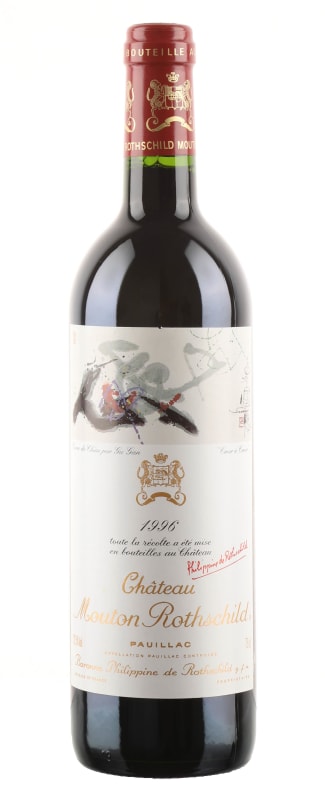
The Chinese painter and calligrapher Gu Gan was born in Changsha, the capital of Hunan province, in 1942. His imagination was fired in 1970s by his discovery of the work of Kandinsky, Klee and Miró, then virtually unknown in China. Several exhibitions since then have made him better known in the West. He now lives in Bejing and is president of the Association of Chinese Modern Painters and Calligraphers.
Chinese calligraphy, unchanged since the second millennium BCE, is both language and art. Gu Gan seeks to remain true to tradition while at the same time taking a profoundly innovative approach. Thus, he has brought color to calligraphy, shaking off traditional restraints and the insistence on balance, and adding ornamental seals to the actual drawing. Regarded as a leading theorist of his art, Gu Gan makes calligraphy a link between his own culture and Western abstract art.
For Mouton Rothschild 1996, Gu Gan has brought together in a single drawing five ideograms, all of which signify the heart, varying the color and stroke of each. This composition, which he has called “Heart to Heart”, is intended as an act of faith in universal harmony.
Professional Ratings
-
Decanter
A Mouton of absolutely outstanding perfume, in which the 10% Cabernet Franc really shines cocoa, white pepper, strawberry, simply one of the most aromatically interesting Mouton's ever. The 13% Merlot and only 77% Cabernet Sauvignon in this blend have made for a suppler, more open knit Mouton than usual. Knockout wine.
-
Robert Parker's Wine Advocate
The last time I tasted the 1996 Mouton Rothschild (maybe a couple of years ago?), I recall it was a bit broody and closed. This showing was anything but! Deep garnet in color, it sashays out of the glass with lavishly dressed, gregarious crème de cassis, baked blackberries and plum pudding scents plus touches of menthol, fenugreek, star anise and sandalwood with fleeting glimpses at dried rose petals and oolong tea. The full-bodied palate is richly fruited, opulent and oh-so seductive, with bags of youthful black fruit and lovely finely grained tannins, finishing with fantastic freshness and length.
Rating: 97+
-
Wine Spectator
Incredible nose of ultraripe fruit, it's yet subtle and complex. Full-bodied, with very ripe, almost sweet fruit and a long, long caressing finish. Superb. This is edging out the 1995.--'95/'96 Bordeaux retrospective. Best after 2010.
-
James Suckling
The bottle I opened was fabulous on the nose with aromas of currants, cedar, sweet tobacco, incense, and flowers. It was full-bodied, with very fine silky tannins and similar flavors as the aromas. However, a slightly green undertone came thorough on the palate. It didn’t bother me, but the Italians seemed annoyed with it – even disappointed. Regardless, I scored the wine.


One of the world’s most classic and popular styles of red wine, Bordeaux-inspired blends have spread from their homeland in France to nearly every corner of the New World. Typically based on either Cabernet Sauvignon or Merlot and supported by Cabernet Franc, Malbec and Petit Verdot, the best of these are densely hued, fragrant, full of fruit and boast a structure that begs for cellar time. Somm Secret—Blends from Bordeaux are generally earthier compared to those from the New World, which tend to be fruit-dominant.

The leader on the Left Bank in number of first growth classified producers within its boundaries, Pauillac has more than any of the other appellations, at three of the five. Chateau Lafite Rothschild and Mouton Rothschild border St. Estephe on its northern end and Chateau Latour is at Pauillac’s southern end, bordering St. Julien.
While the first growths are certainly some of the better producers of the Left Bank, today they often compete with some of the “lower ranked” producers (second, third, fourth, fifth growth) in quality and value. The Left Bank of Bordeaux subscribes to an arguably outdated method of classification that goes back to 1855. The finest chateaux in that year were judged on the basis of reputation and trading price; changes in rank since then have been miniscule at best. Today producers such as Chateau Pontet-Canet, Chateau Grand Puy-Lacoste, Chateau Lynch-Bages, among others (all fifth growth) offer some of the most outstanding wines in all of Bordeaux.
Defining characteristics of fine wines from Pauillac (i.e. Cabernet-based Bordeaux Blends) include inky and juicy blackcurrant, cedar or cigar box and plush or chalky tannins.
Layers of gravel in the Pauillac region are key to its wines’ character and quality. The layers offer excellent drainage in the relatively flat topography of the region allowing water to run off into “jalles” or streams, which subsequently flow off into the Gironde.