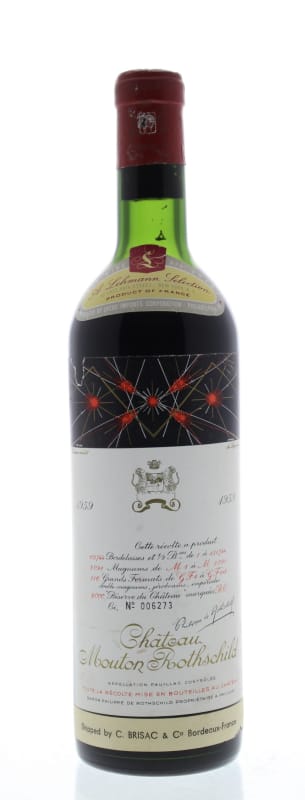


Winemaker Notes
Professional Ratings
-
James Suckling
Another perfect bottle. This has been a long-time favorite with mint and fresh basil, as well as currants and dried fruits on the nose. It turns to dried flowers. Full-bodied with spices, berries, and light eucalyptus character. Christmas cake too. Full body with velvety tannins. This bottle was almost mid-shoulder height, but it was a perfect wine.
-
Robert Parker's Wine Advocate
I am always blown away by the 1959 Mouton, one of the greatest Moutons made in the last thirty-five years. Every time I have this wine it is undeniable that Mouton made a richer, more persuasive wine in 1959 than in 1961. Astonishingly young and unevolved, with a black/purple color, the wine exhibits a youthful nose of cassis, minerals, and new oak. It is exceptionally powerful and super-extracted, with the fruit supported by high levels of tannin and some lusty quantities of alcohol. This mammoth, full-bodied Mouton-Rothschild should continue to evolve for another 20-30 years. It may well be a 100-year wine! Last tasted 3/97.
-
Wine Spectator
A poetic wine that will enthrall any wine lover. Dark garnet in color, it offers an unbelievable nose, with stylish, minty cassis aromas that keep developing in the glass and supple, minty eucalyptus flavors that are beautifully integrated. Powerful yet seductive; this great wine should hold for years, but why wait to drink something that's already perfect?
-
Jeb Dunnuck
Reminding me of the 1986, the 1959 Château Mouton Rothschild is deep plum-hued and reveals a masculine, deep, powerful bouquet of mature black fruits, graphite, woodsmoke, espresso roast, and lead pencil that opens up nicely with time in the glass. This carries to a medium to full-bodied, dense Pauillac with plenty of mid-palate heft, resolved tannins, and outstanding length.


One of the world’s most classic and popular styles of red wine, Bordeaux-inspired blends have spread from their homeland in France to nearly every corner of the New World. Typically based on either Cabernet Sauvignon or Merlot and supported by Cabernet Franc, Malbec and Petit Verdot, the best of these are densely hued, fragrant, full of fruit and boast a structure that begs for cellar time. Somm Secret—Blends from Bordeaux are generally earthier compared to those from the New World, which tend to be fruit-dominant.

The leader on the Left Bank in number of first growth classified producers within its boundaries, Pauillac has more than any of the other appellations, at three of the five. Chateau Lafite Rothschild and Mouton Rothschild border St. Estephe on its northern end and Chateau Latour is at Pauillac’s southern end, bordering St. Julien.
While the first growths are certainly some of the better producers of the Left Bank, today they often compete with some of the “lower ranked” producers (second, third, fourth, fifth growth) in quality and value. The Left Bank of Bordeaux subscribes to an arguably outdated method of classification that goes back to 1855. The finest chateaux in that year were judged on the basis of reputation and trading price; changes in rank since then have been miniscule at best. Today producers such as Chateau Pontet-Canet, Chateau Grand Puy-Lacoste, Chateau Lynch-Bages, among others (all fifth growth) offer some of the most outstanding wines in all of Bordeaux.
Defining characteristics of fine wines from Pauillac (i.e. Cabernet-based Bordeaux Blends) include inky and juicy blackcurrant, cedar or cigar box and plush or chalky tannins.
Layers of gravel in the Pauillac region are key to its wines’ character and quality. The layers offer excellent drainage in the relatively flat topography of the region allowing water to run off into “jalles” or streams, which subsequently flow off into the Gironde.