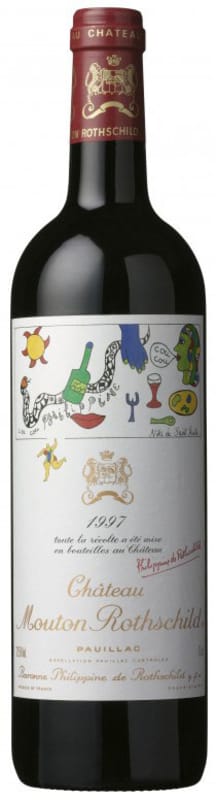


Winemaker Notes
The 1997 Rothschild is an evolved, brickish color with a slightly orange tint. The wine has an intense nose on aromas of leather, hyacinth and tobacco. On the palate, it is round and fruity along with persisting and fine tannins. The fruit, with spicy and smoky notes, offer a long-lasting finish. A particularly successful vintage.
Blend: 82% Cabernet Sauvignon, 13% Merlot, 3% Cabernet Franc, 2% Petit Verdot
About the Label Artwork
Niki de Saint Phalle (1930-2002), born at Neuilly-sur-Seine in France, grew up in New York, where her parents lived. While still very young she worked as a model for leading American magazines and began to study music.
In 1952, she moved to Paris with Harry Matthews, her husband and the father of her two children, and began to paint. During a visit to Barcelona she discovered Gaudi's architecture, which was to have a lasting influence on her art. In 1956, she held her first exhibition of paintings at St Gall in Switzerland. In 1960, she met the sculptor Jean Tinguely, with whom she maintained a close personal and professional relationship until his death in 1991.
She acquired early fame in the years that followed for provocative works like her "surprise paintings", made of plaster blisters full of vivid colours which she burst by firing at them with a rifle. During the same period she joined the New Realists, a group of artists whose other members included Yves Klein, Arman, Christo and Tinguely.
Between 1965 and 1970 she created and exhibited her first "Nanas", opulent, polychrome female shapes whose curves challenged the fashion for beanpole women. Exhibited in New York, Stockholm and Montreal among other places, they became the emblems of her powerfully original work as a sculptor.
Between 1965 and 1970 she created and exhibited her first "Nanas", opulent, polychrome female shapes whose curves challenged the fashion for beanpole women. Exhibited in New York, Stockholm and Montreal among other places, they became the emblems of her powerfully original work as a sculptor.
Over time these buxom "Nanas", genesis of her future work, gave birth to a fascinating array of extravagantly fanciful creatures, sometimes anthropomorphic, often gigantic and always violently coloured, including the Cyclop at Milly-la-Forêt, the Golem in Jerusalem and the Tarot Garden in Tuscany. In 1982, with Jean Tinguely, she created the celebrated Stravinsky Fountain near the Pompidou Centre in Paris, which two years earlier had hosted a retrospective of her work.
The world-famous artist now lives in San Diego (USA) and, with the architect Mario Botta, has conceived a monumental Noah's Ark for the vear 2000.
From the sun to the plate, taking in a sensual mouth and an outstretched hand, Niki de Saint Phalle's composition for Mouton is a sparkling, festive allegory of the pleasures of the table. And then, running across the painting, there is the "Niki-object", springing from a story as old as the world itself: the serpent tempter. But instead of the traditional apple, this serpent, more wine-loving than malign, is offering Eve a bottle ... of Mouton Rothschild 1997 no doubt!
Professional Ratings
-
Robert Parker's Wine Advocate
Only 55% of the harvest was utilized for the 1997 Mouton-Rothschild. One of the most forward and developed Moutons over recent years, it possesses all the charm and fleshiness this vintage can provide. A blend of 82% Cabernet Sauvignon, 13% Merlot, 3% Cabernet Franc, and 2% Petit Verdot, the wine exhibits a dense ruby/purple color, and an open-knit nose of cedar wood, blackberry liqueur, cassis, and coffee. Fleshy, ripe, and mouth-filling, with low acidity, soft tannin, and admirable concentration and length.



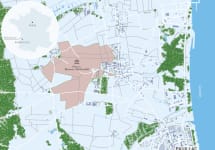
A First Classified Growth, Château Mouton Rothschild spans 82 hectares (202 acres) of vines at Pauillac in the Médoc, planted with the classic varieties of the region: Cabernet Sauvignon (79%), Merlot (17%), Cabernet Franc (3 %), Petit Verdot (1 %). The average age of the vines is 50 years.
The estate benefits from exceptionally favourable natural conditions, in the quality of the soil, the position of its vines and their exposure to the sun. Combining respect for tradition with the latest technology, it receives meticulous attention from grape to bottle. The wine is matured in new French oak barrels.
Le Petit Mouton de Mouton Rothschild is the second wine of Château Mouton Rothschild.
The estate also comprises 6 hectares (15 acres) of sandy, gravelly soil planted with Sauvignon Blanc (51%), Semillon (40%) and Sauvignon Gris (9%), used to make its white wine, Aile d’Argent.
Brought to the pinnacle by two exceptional people, Baron Philippe de Rothschild (1902-1988) then his daughter Baroness Philippine (1933-2014), its destiny has now been taken in hand by her three children: Camille and Philippe Sereys de Rothschild, and Julien de Beaumarchais de Rothschild. True to their grandfather’s and mother’s work, all three are committed, with the same enthusiasm and determination, to perpetuating Baron Philippe’s dictum: “Live for the vine”. Almost a command, it means being there for the vineyard in good times and in hardship, serving it with skill and honouring it with art.
Château Mouton Rothschild is a place of art and beauty, famous for the spectacular vista of its great barrel hall, its remarkable vat room and its Museum of Wine in Art. Every year since 1945, the Château Mouton Rothschild label has been illustrated with an original artwork by a great contemporary artist. Dalí, César, Miró, Chagall, Warhol, Soulages, Bacon, Balthus, Tàpies, Koons and Doig are only some of the artists featured in a fascinating collection to which a new work is added each year and which makes up the Paintings for the Labels exhibition.

One of the world’s most classic and popular styles of red wine, Bordeaux-inspired blends have spread from their homeland in France to nearly every corner of the New World. Typically based on either Cabernet Sauvignon or Merlot and supported by Cabernet Franc, Malbec and Petit Verdot, the best of these are densely hued, fragrant, full of fruit and boast a structure that begs for cellar time. Somm Secret—Blends from Bordeaux are generally earthier compared to those from the New World, which tend to be fruit-dominant.

The leader on the Left Bank in number of first growth classified producers within its boundaries, Pauillac has more than any of the other appellations, at three of the five. Chateau Lafite Rothschild and Mouton Rothschild border St. Estephe on its northern end and Chateau Latour is at Pauillac’s southern end, bordering St. Julien.
While the first growths are certainly some of the better producers of the Left Bank, today they often compete with some of the “lower ranked” producers (second, third, fourth, fifth growth) in quality and value. The Left Bank of Bordeaux subscribes to an arguably outdated method of classification that goes back to 1855. The finest chateaux in that year were judged on the basis of reputation and trading price; changes in rank since then have been miniscule at best. Today producers such as Chateau Pontet-Canet, Chateau Grand Puy-Lacoste, Chateau Lynch-Bages, among others (all fifth growth) offer some of the most outstanding wines in all of Bordeaux.
Defining characteristics of fine wines from Pauillac (i.e. Cabernet-based Bordeaux Blends) include inky and juicy blackcurrant, cedar or cigar box and plush or chalky tannins.
Layers of gravel in the Pauillac region are key to its wines’ character and quality. The layers offer excellent drainage in the relatively flat topography of the region allowing water to run off into “jalles” or streams, which subsequently flow off into the Gironde.