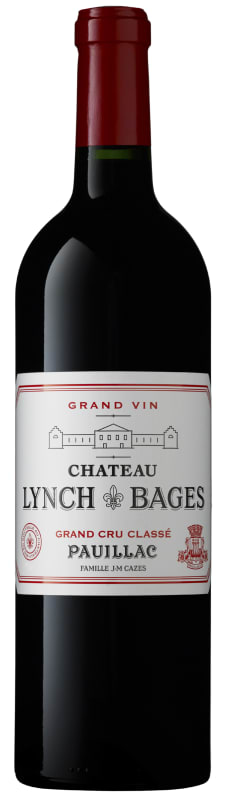


Winemaker Notes
Château Lynch-Bages 2023 has a dense, deep color. Aromas of cedar and black fruit give it a racy character. Its balance and silky tannic structure are remarkably harmonious. The velvety finish reveals great aromatic purity. An undeniable elegance characterizes this vintage.
Blend: 71% Cabernet Sauvignon, 24% Merlot, 3% Cabernet Franc, 2% Petit Verdot
Professional Ratings
-
James Suckling
The nose of this Paulliac shows mint, asphalt, black currants and orange peel, following through to a full body with a compressed palate and a fine tannin backbone that gives this classic tension. Flavors of dried fruit, walnuts, plums, currants and tar. Classic Lynch character. A blend of 71% cabernet sauvignon, 24% merlot, 3% cabernet franc and 2% petit verdot.
-
Vinous
The 2023 Lynch-Bages is a dark, brooding wine. In so many vintages, Lynch-Bages is a wine of sensuality, but in 2023, it is quite the powerhouse. Formidable tannins wrap around a core of black fruit, spice, menthol, licorice and gravel. This is a somber, introspective Lynch-Bages with a ton of Cabernet Sauvignon character. I can't wait to taste this from bottle. –Antonio Galloni
Barrel Sample: 94-97 -
Decanter
Weighty and ripe, but high toned and sharp, a real push pull of tannins, concentrated fruit and acidity. Feels very complete, not necessarily all in harmony right now, this is quite intense, but there’s a statuesque element which is impressive. Both rich and cool with liquorice, graphite, plum, cherry and cranberry. Layers of freshness and a real sense of classicism makes you want to go back for more. More lean and streamlined than 2022, this is focussed and there is bite and edge to the tannins that will settle, but this is very good. 65% grand vin, 25% second wine, 10% third wine. 6% press wine. 2% Petit Verdot completes the blend.
Barrel Sample: 96 -
Jeb Dunnuck
Deep purple-hued, the 2023 Château Lynch-Bages reminds me slightly of the 2019 with its elegance as well as its classic Pauillac aromatics of ripe, smoky red and black currants, freshly sharpened pencil, graphite, and stony minerality. Based on 71% Cabernet Sauvignon, 24% Merlot, 3% Cabernet Franc, and 2% Petit Verdot and aged 18 months in French oak barrels (75% new), it's medium to full-bodied and has a concentrated, layered, rich mouthfeel, beautiful, building tannins, and outstanding length. It's a classy, impressive 2023 that warrants 5-7 years of bottle age and will see its 30th birthday in fine form. Rating: 96+
-
Wilfred Wong of Wine.com
When I first tasted Lynch-Bages decades ago, the wine struck me as all structure—almost skin and bones. Over time, however, I grew increasingly fond of the château’s style. Through numerous trips to Bordeaux during my years as Cellarmaster at BevMo!, I developed a far deeper appreciation for these wines and their unmistakable Pauillac identity. At the recent UGC Bordeaux tasting, the 2023 vintage shone—bright, focused, and persistent. This newly released wine offers an outstanding interplay of black fruits and classic pencil-shaving notes, leading me to imagine it alongside a racy pork adobo, where spice, savor, and structure meet in harmony. (Tasted: January 22, 2026, San Francisco, CA)
-
Robert Parker's Wine Advocate
The 2023 Lynch-Bages remains broad-shouldered in style, yet the élevage confers a more accessible profile than in some past vintages. It opens with aromas of spices, cedar, dark berries, creamy new oak and pipe tobacco. Medium- to full-bodied, rich and muscular, it is built around a dense, generously extracted core of fruit, framed by chunky tannins and balanced by well-integrated acidity, extending into a long, expansive finish. A blend of 71% Cabernet Sauvignon, 24% Merlot, 3% Cabernet Franc and 2% Petit Verdot, matured in 75% new oak, it reflects the character of the vintage, with a mid-palate that is straighter and more tensile than usual at this address.
-
Wine Spectator
This extracts a bit more from the vintage, with a supple plum skin note wrapped around flavors of dark cherry and black currant preserves. Charcoal, ink and roasted apple wood add depth and drive as the fruit pumps through the finish. Muscular for the vintage. Cabernet Sauvignon, Merlot, Cabernet Franc and Petit Verdot.


One of the world’s most classic and popular styles of red wine, Bordeaux-inspired blends have spread from their homeland in France to nearly every corner of the New World. Typically based on either Cabernet Sauvignon or Merlot and supported by Cabernet Franc, Malbec and Petit Verdot, the best of these are densely hued, fragrant, full of fruit and boast a structure that begs for cellar time. Somm Secret—Blends from Bordeaux are generally earthier compared to those from the New World, which tend to be fruit-dominant.

The leader on the Left Bank in number of first growth classified producers within its boundaries, Pauillac has more than any of the other appellations, at three of the five. Chateau Lafite Rothschild and Mouton Rothschild border St. Estephe on its northern end and Chateau Latour is at Pauillac’s southern end, bordering St. Julien.
While the first growths are certainly some of the better producers of the Left Bank, today they often compete with some of the “lower ranked” producers (second, third, fourth, fifth growth) in quality and value. The Left Bank of Bordeaux subscribes to an arguably outdated method of classification that goes back to 1855. The finest chateaux in that year were judged on the basis of reputation and trading price; changes in rank since then have been miniscule at best. Today producers such as Chateau Pontet-Canet, Chateau Grand Puy-Lacoste, Chateau Lynch-Bages, among others (all fifth growth) offer some of the most outstanding wines in all of Bordeaux.
Defining characteristics of fine wines from Pauillac (i.e. Cabernet-based Bordeaux Blends) include inky and juicy blackcurrant, cedar or cigar box and plush or chalky tannins.
Layers of gravel in the Pauillac region are key to its wines’ character and quality. The layers offer excellent drainage in the relatively flat topography of the region allowing water to run off into “jalles” or streams, which subsequently flow off into the Gironde.