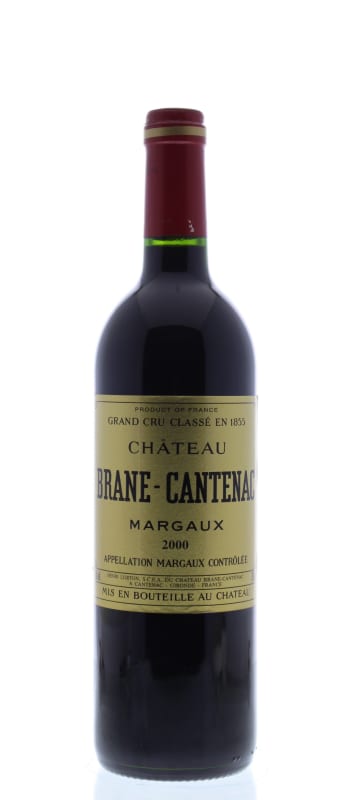


Winemaker Notes
Professional Ratings
-
Jeb Dunnuck
Based on 42% Cabernet Sauvignon, 55% Merlot, and 3% Cabernet Franc and aged 18 months in 70% new French oak, the 2000 Château Brane-Cantenac offers brilliant aromatics of ripe currants, sappy spring flowers, and spicy wood in just a complex, nuanced, floral profile. Medium-bodied on the palate, it has a pure, layered mouthfeel, beautiful tannins, and outstanding length. It's drinking brilliantly today, with tons of character and charm, yet clearly has another 15+ of prime drinking.
-
James Suckling
Fine cassis, olives, spices, citrus, minerals and a touch of savoriness on the nose. Very good succulence and balance, with a medium body and fine tannins. Long and refined finish. 55% merlot, 42% cabernet sauvignon and 3% cabernet franc. The only year that Brane-Cantenac didn’t include press wine.
-
Robert Parker's Wine Advocate
The 2000 Brane-Cantenac is a blend of 42% Cabernet Sauvignon, 55% Merlot and 3% Cabernet Franc. It has a really wonderful bouquet that is coming into its own: potent with black truffle and gravel infusing the red berry fruit. The palate is medium-bodied with a saline tang on the entry. It is not a powerful or huge wine, but there is impressive length here and genuine complexity on the finish, with black truffle, cedar and tobacco notes vying for attention. Henri Lurton oversaw a really quite fabulous, almost aristocratic Brane-Cantenac in this millennial year. Tasted April 2015.
-
Vinous
The 2000 Brane-Cantenac represents the only vintage that eschewed any vin de presse due to a meticulous selection. This has a gorgeous bouquet that blossoms in the glass: a mélange of red and black fruit vie for attention as an underlying mineralité lends more dimension that previous vintages. The palate is medium-bodied with finely sculpted tannins, perhaps just a little spicier than previous vintage. Cohesive with decent body on the finish, this has mellowed in recent years and attained more sophistication. The 2000 is classic in style and approaching its peak. Excellent.
-
Wine Spectator
Subtle aromas of blackberry and vanilla. Medium- to full-bodied, with a solid core of silky tannins. Long and caressing. Very fresh, almost tart. An estate going places.
-
Wine Enthusiast
A solid, chunky structure is the hallmark of this big wine. The fruit is black, full of dark tannins. Perhaps it lacks subtlety, but that is replaced with great power and potential.


One of the world’s most classic and popular styles of red wine, Bordeaux-inspired blends have spread from their homeland in France to nearly every corner of the New World. Typically based on either Cabernet Sauvignon or Merlot and supported by Cabernet Franc, Malbec and Petit Verdot, the best of these are densely hued, fragrant, full of fruit and boast a structure that begs for cellar time. Somm Secret—Blends from Bordeaux are generally earthier compared to those from the New World, which tend to be fruit-dominant.

Silky, seductive and polished are the words that characterize the best wines from Margaux, the most inland appellation of the Médoc on the Left Bank of Bordeaux.
Margaux’s gravel soils are the thinnest of the Médoc, making them most penetrable by vine roots—some reaching down over 23 feet for water. The best sites are said to be on gentle outcrops, or croupes, where more gravel facilitates good drainage.
The Left Bank of Bordeaux subscribes to an arguably outdated method of classification but it is nonetheless important in regards to history of the area. In 1855 the finest chateaux were deemed on the basis of reputation and trading price—at that time. In 1855, Chateau Margaux achieved first growth status, yet it has been Chateau Palmer (officially third growth from the 1855 classification) that has consistently outperformed others throughout the 20th century.
Chateau Margaux in top vintages is capable of producing red Cabernet Sauvignon based wines described as pure, intense, spell-binding, refined and profound with flavors and aromas of black currant, violets, roses, orange peel, black tea and incense.
Other top producers worthy of noting include Chateau Rauzan-Ségla, Lascombes, Brane-Cantenac, and d’Issan, among others.
The best wines of Margaux combine a deep ruby color with a polished structure, concentration and an unrivaled elegance.