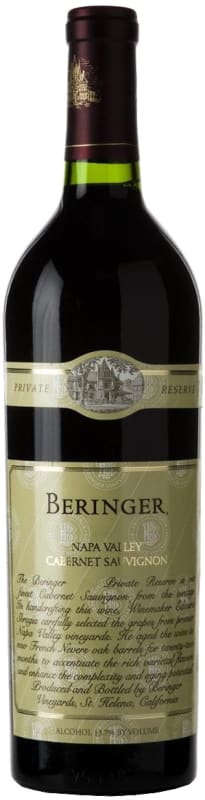


Winemaker Notes
Lots of cocoa, cedar, brown sugar, blackberry & sweet spices. Sweet tobacco and mint, with candied violets, vanilla. Luscious, long, rich finish. Pretty fruit and elegant.
Professional Ratings
-
Wine Enthusiast
This wine is still young and precocious, but don’t judge it too quickly. Let it air in your glass, and watch how it changes. One minute it’s all cherries and smoke; the next it heaves up a great draught of currants, cocoa and cedar. It’s a big wine but deceptive; the tannins are airy and lilting, there’s charm and underneath, enormous complexity. It’s best left alone for a few more years, but it’s really very lovely now.
-
Robert Parker's Wine Advocate
The 1996 Cabernet Sauvignon Private Reserve reveals more concentration as well as higher tannin than the 1995. I know it is a trade-off, but I suspect this vintage will not be as sexy in its youthfulness as the 1995. The black ruby/purple-colored 1996 offers more licorice, in addition to the obvious levels of pain grille, jammy black currant fruit, and spice notes. Structured, full-bodied, and powerful, this may be a Private Reserve to cellar for several years, and consume over the subsequent 15-18.
-
Wine Spectator
Complex aromas of dried currant, anise, herb and tar are rich and elegant on the palate, with the tannins softening. Has excellent structure. The best of two bottles.--1996 California Cabernet retrospective. Drink now through 2009.



As California's longest continuously operating winery, Beringer has been defining Napa Valley winemaking since it was founded by Jacob and Frederick Beringer in 1876. By continuing that pioneering spirit, Beringer established many 'firsts' as leaders in the wine industry. They were one of the first gravity fed facilities and among the first to operate using hand dug caves and cellars. Beringer were the first to give public tours in 1934, starting a Napa Valley hospitality tradition. They are the first and only winery to have both a red and a white wine named #1 Wine of the Year by Wine Spectator Magazine. Today, they proudly celebrate and remain true to their pioneering legacy.

One of the most prestigious wines of the world capable of great power and grace, Napa Valley Cabernet is a leading force in the world of fine, famous, collectible red wine. Today the Napa Valley and Cabernet Sauvignon are so intrinsically linked that it is difficult to discuss one without the other. But it wasn’t until the 1970s that this marriage came to light; sudden international recognition rained upon Napa with the victory of the Stag’s Leap Wine Cellars 1973 Cabernet Sauvignon in the 1976 Judgement of Paris.
Cabernet Sauvignon undoubtedly dominates Napa Valley today, covering half of the land under vine, commanding the highest prices per ton and earning the most critical acclaim. Cabernet Sauvignon’s structure, acidity, capacity to thrive in multiple environs and ability to express nuances of vintage make it perfect for Napa Valley where incredible soil and geographical diversity are found and the climate is perfect for grape growing. Within the Napa Valley lie many smaller sub-AVAs that express specific characteristics based on situation, slope and soil—as a perfect example, Rutherford’s famous dust or Stags Leap District's tart cherry flavors.