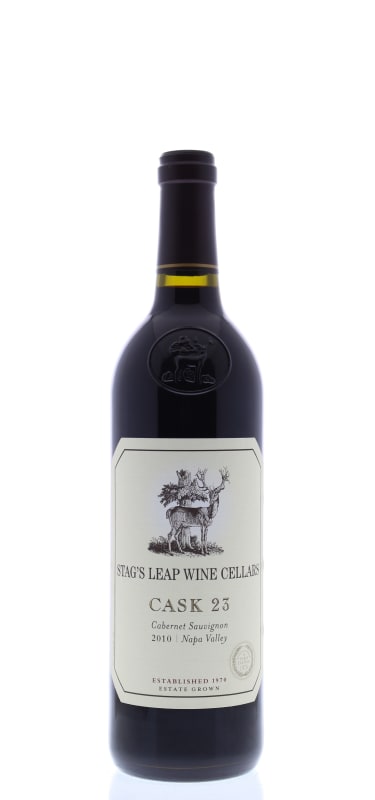


Winemaker Notes
Serve CASK 23 with filet mignon with blue cheese crumbles, grilled venison with a red wine reduction or black pepper-crusted Ahi tuna steaks.
Professional Ratings
-
Robert Parker's Wine Advocate
In a vintage such as 2010 where individual terroirs are so clearly marked, the Cabernet Sauvignon Estate Cask 23 – a blend of the SLV and Fay – is at a distinct disadvantage because it naturally lacks the character and personality of those two wines. I must also note that the SLV and Fay have improved dramatically on their own terms, so the rationale of blending them is further diminished. To be sure the Cask 23 is an excellent representation of the vintage. There is plenty of 2010 fruit, structure and tannin, along with attractive hints of smoke, tar and incense, but at the end of the day, I find the Cask 23 less satisfying than Stags’ Leap Wine Cellars’ very best wines. Anticipated maturity: 2016-2030.
-
Decanter
Menthol and blackberry aromas dominate this bold, forward, very developed wine. Round, smooth, polished palate with a compact structure and medium length. Moderate and chocolaty finish.
Drink 2014–2028





Considered one of the "first growths" of Napa Valley, Stag's Leap Wine Cellars produces renowned Cabernet Sauvignon from its historic Stags Leap District estate vineyards. Learn about Stags Leap history and estate-grown wines.
History of Stag’s Leap Wine Cellars
Stag’s Leap Wine Cellars was founded in 1970 with the purchase of a 40 acre property in the now famed Stag’s Leap District AVA in Napa Valley. The winery brought international recognition to California winemaking and the Napa Valley region when their 1973 S.L.V. Cabernet Sauvignon won the 1976 Paris Tasting, also known as the "Judgement of Paris."
Stag’s Leap Wine Cellars Estate-Grown Cabernet Sauvignon
Stag's Leap Wine Cellars' three estate-grown Cabernet Sauvignons - CASK 23, S.L.V. and Fay - are among the most highly regarded and collected Cabernet Sauvignons worldwide. The Cabernet wines are fashioned to express richness balanced by elegant restraint, an approach often described as "an iron fist in a velvet glove."

One of the most prestigious wines of the world capable of great power and grace, Napa Valley Cabernet is a leading force in the world of fine, famous, collectible red wine. Today the Napa Valley and Cabernet Sauvignon are so intrinsically linked that it is difficult to discuss one without the other. But it wasn’t until the 1970s that this marriage came to light; sudden international recognition rained upon Napa with the victory of the Stag’s Leap Wine Cellars 1973 Cabernet Sauvignon in the 1976 Judgement of Paris.
Cabernet Sauvignon undoubtedly dominates Napa Valley today, covering half of the land under vine, commanding the highest prices per ton and earning the most critical acclaim. Cabernet Sauvignon’s structure, acidity, capacity to thrive in multiple environs and ability to express nuances of vintage make it perfect for Napa Valley where incredible soil and geographical diversity are found and the climate is perfect for grape growing. Within the Napa Valley lie many smaller sub-AVAs that express specific characteristics based on situation, slope and soil—as a perfect example, Rutherford’s famous dust or Stags Leap District's tart cherry flavors.