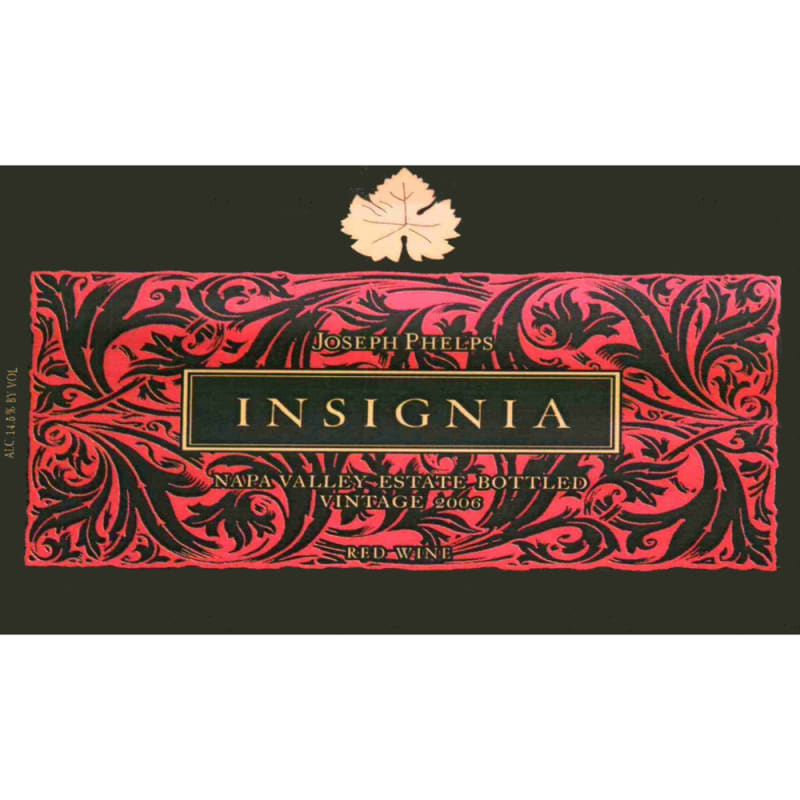

Winemaker Notes
Blend:
92% Cabernet Sauvignon, 7% Petit Verdot, and 1% Merlot sourced estate-owned vineyards in Rutherford (30%), South Napa (22%), the St. Helena home ranch (17%), and Stag's Leap District (Barboza Vineyard, 17% and Las Rocas Vineyard, 14%).
Professional Ratings
-
Connoisseurs' Guide
Already amazingly seductive with wonderfully rich aromas of sweet oak, cocoa and fully expressed fruit making a first-rate introduction, this riveting young wine in no way lets up on the palate and delivers deep, multi-faceted flavors that combine ripeness, sweet oak and very precise fruit in near-perfect proportion. As is often the case with Insignia bottlings, it is so beautifully balanced that it invites early drinking, and, while we do not condemn giving in to its charms, we also would lobby strongly for patience as its best lies years down the line.
-
Robert Parker's Wine Advocate
The 2006 Insignia (95% Cabernet Sauvignon and 5% Petit Verdot; 16,000 cases produced) is a superb effort in this vintage. Another 30+ year wine, it boasts a dense plum/purple color as well as abundant notes of licorice, black currants, charcoal, black olives, and graphite. Full-bodied, pure, and rich with moderately high tannins, it represents a California version of a Bordeaux from Pauillac or St.-Julien. Anticipated maturity: 2014-2045.
In case you think the aging curves I have described are unrealistically long, I have the Joseph Phelps regular Cabernets from the mid-seventies as well as the Insignias in my cellar, and those wines are still drinking beautifully at 30+ years of age. Today's wines are better made.
Rating: 95+ -
Wine Enthusiast
This is so strong and fruity, so oaky, so tannic, it just overwhelms the palate in its extreme youth. Just massive in blackberries, black currants, coffee, cocoa, dried herbs and 100% new, smoky-sweet French oak.
-
Wine Spectator
Teasing with its floral, spicy cherry, wild berry and currant aromas, this is full-bodied, firm and structured, tight and focused, offering glimpses of what lies ahead with its complex mix of flavors and tightly wound tannins. Yet its finesse and refinement are apparent on the finish. Needs time. Cabernet Sauvignon and Petit Verdot.





Joseph Phelps Vineyards is a family-owned winery committed to crafting world class, estate-grown wines. Founded in 1973 when Joe Phelps purchased a former cattle ranch near St. Helena in the Napa Valley, the winery now controls and farms nearly 375 acres of vines on eight estate vineyards in St. Helena, the Stags Leap District, Oakville, Rutherford, Oak Knoll District, Carneros and South Napa Valley. In 1999, the Phelps family added 100 acres of vineyard property near the town of Freestone on the Sonoma Coast, where Phelps now grows Pinot Noir and Chardonnay.
Phelps is best known for its flagship Napa Valley blend of red Bordeaux varietals, Insignia, first produced in 1974. Awarded Wine Spectator's "Wine of the Year" in 2005, Insignia is widely regarded as a qualitative benchmark for California winemaking.

Undoubtedly proving its merit over and over, Napa Valley is a now a leading force in the world of prestigious red wine regions. Though Cabernet Sauvignon dominates Napa Valley, other red varieties certainly thrive here. Important but often overlooked include Merlot and other Bordeaux varieties well-regarded on their own as well as for their blending capacities. Very old vine Zinfandel represents an important historical stronghold for the region and Pinot noir is produced in the cooler southern parts, close to the San Pablo Bay.
Perfectly situated running north to south, the valley acts as a corridor, pulling cool, moist air up from the San Pablo Bay in the evenings during the hot days of the growing season, which leads to even and slow grape ripening. Furthermore the valley claims over 100 soil variations including layers of volcanic, gravel, sand and silt—a combination excellent for world-class red wine production.