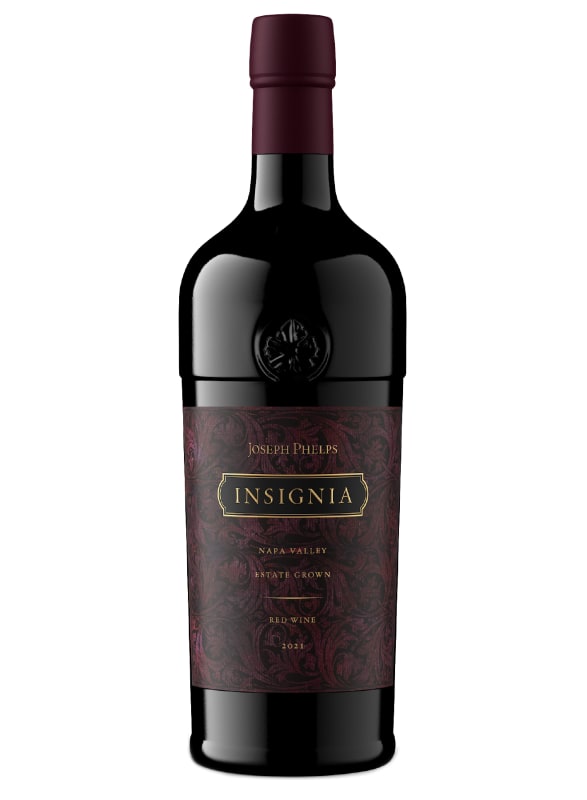


Winemaker Notes
The 2021 Insignia captivates the senses with vibrant aromas of black cherry, hibiscus, and wild blackberry, subtly accented by fresh earth and a hint of Tahitian vanilla. On the palate, these dark fruit characteristics are harmonized with warm tones of redwood bark and baking spices. Plush, soft tannins and bright acidity enhance the length, complementing the rich fruit and savory undertones. A compelling tension infuses the wine with focused energy, promising it will express beautifully for years to come.
Blend: 93% Cabernet Sauvignon, 3% Petit Verdot, 2% Cabernet Franc, 2% Malbec
Professional Ratings
-
Jeb Dunnuck
Not yet bottled, the 2021 Insignia has a pure, concentrated, medium to full-bodied style that shows the vintage beautifully. Cassis, blue fruits, graphite, lead pencil shavings, and floral notes all define the bouquet, and it has beautiful tannins, a great mid-palate, and outstanding length.
Barrel Sample: 96-98 -
James Suckling
A standout vintage for one of California’s most collectible cabernet sauvignons. The color is black throughout, but with a dark garnet rim. Gorgeous aromatics of spearmint, pencil shavings, toasted oak and dark plums, before a silky, fresh but firm texture takes over the palate and dusky blackcurrant, tobacco-leaf, rose-petal and cedar notes emerge and linger. Full-bodied and saturated with rounded, well-integrated tannins that emerge on the lingering finish and keep melting in the glass.
-
Vinous
The 2021 Insignia is gorgeous. Dark, fresh and vibrant, the 2021 impresses with its purity of fruit and fine balance. Readers will find an understated Insignia built on finesse and nuance more than size.
-
Robert Parker's Wine Advocate
A Napa stalwart, the 2021 Insignia is a blend of 93% Cabernet Sauvignon, 3% Petit Verdot, 2% Cabernet Franc and 2% Malbec, aged in 100% new French oak. Cedar and vanilla scents accent black cherries and a hint of redcurrants on the nose, while the medium to full-bodied palate is soft and plush, easy to enjoy now but with the requisite concentration to age for up to two decades. Long, silky and tart on the finish.
-
Wine Spectator
Singed alder and sweet tobacco lead off, backed by waves of lush warmed cassis and plum reduction. Chestnut and warm earth notes help drive the finish. Burly and muscular now, but the core of fruit shows inner purity. This will need some time. Cabernet Sauvignon, Petit Verdot, Malbec and Cabernet Franc.





Joseph Phelps Vineyards is a family-owned winery committed to crafting world class, estate-grown wines. Founded in 1973 when Joe Phelps purchased a former cattle ranch near St. Helena in the Napa Valley, the winery now controls and farms nearly 375 acres of vines on eight estate vineyards in St. Helena, the Stags Leap District, Oakville, Rutherford, Oak Knoll District, Carneros and South Napa Valley. In 1999, the Phelps family added 100 acres of vineyard property near the town of Freestone on the Sonoma Coast, where Phelps now grows Pinot Noir and Chardonnay.
Phelps is best known for its flagship Napa Valley blend of red Bordeaux varietals, Insignia, first produced in 1974. Awarded Wine Spectator's "Wine of the Year" in 2005, Insignia is widely regarded as a qualitative benchmark for California winemaking.

Undoubtedly proving its merit over and over, Napa Valley is a now a leading force in the world of prestigious red wine regions. Though Cabernet Sauvignon dominates Napa Valley, other red varieties certainly thrive here. Important but often overlooked include Merlot and other Bordeaux varieties well-regarded on their own as well as for their blending capacities. Very old vine Zinfandel represents an important historical stronghold for the region and Pinot noir is produced in the cooler southern parts, close to the San Pablo Bay.
Perfectly situated running north to south, the valley acts as a corridor, pulling cool, moist air up from the San Pablo Bay in the evenings during the hot days of the growing season, which leads to even and slow grape ripening. Furthermore the valley claims over 100 soil variations including layers of volcanic, gravel, sand and silt—a combination excellent for world-class red wine production.