

Winemaker Notes
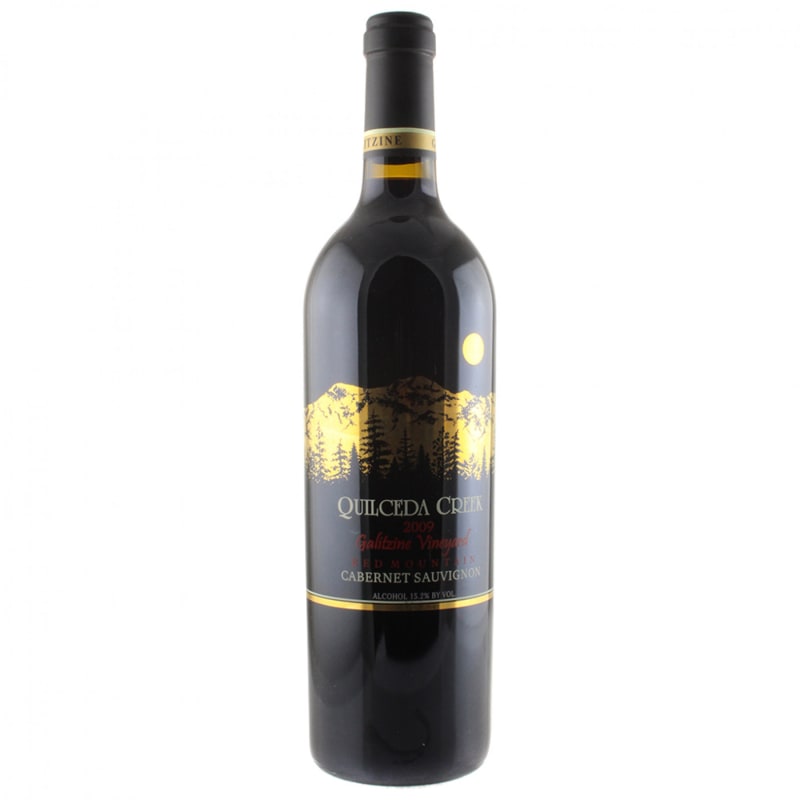
Aged in 100% new French Oak for 22 months, it is a blend of 99% Cabernet Sauvignon and 1% Merlot. This wine is a wonderful example of the Galitzine terroir and showcases what can be accomplished within the Red Mountain A.V.A. Drink now - 2029.
Blend: 99% Cabernet Sauvignon, 1% Merlot
Professional Ratings
-
Robert Parker's Wine Advocate
Also incredibly concentrated, with burly structure and a mountain of tannin, the 2009 Cabernet Sauvignon Galitzine Vineyard (99% Cabernet Sauvignon and 1% Merlot) delivers a seriously intense array of blackberry and kirsch-styled fruit, licorice, charcoal and spice box on both the nose and palate. Aged for 22 months in 100% new French oak and a big, broad shouldered, full-bodied Cabernet Sauvignon, it possesses a rocking mid-palate and fabulous length on the finish. Really showing the power of its Red Mountain terroir, it needs 4-5 years of bottle age to become civilized and will have decades of evolution. Drink 2017-2034
-
Wine Enthusiast
Quilceda Creek's Red Mountain Cabernet Sauvignon opens with a dense, exotic and luxurious nose: a mix of roasted coffee, dark fruit and Asian spice. At first it's quite dense and unyielding, but it opens slowly over a period of days - not hours - remaining dense and compact, with a remarkable array of dark fruits and barrel flavors. As with its companion reds from Quilceda Creek, this is a wine to cellar for decades.


A noble variety bestowed with both power and concentration, Cabernet Sauvignon enjoys success all over the globe, its best examples showing potential to age beautifully for decades. Cabernet Sauvignon flourishes in Bordeaux's Medoc where it is often blended with Merlot and smaller amounts of some combination of Cabernet Franc, Malbecand Petit Verdot. In the Napa Valley, ‘Cab’ is responsible for some of the world’s most prestigious, age-worthy and sought-after “cult” wines. Somm Secret—DNA profiling in 1997 revealed that Cabernet Sauvignon was born from a spontaneous crossing of Cabernet Franc and Sauvignon Blanc in 17th century southwest France.

As the first recognized wine-growing region in the Pacific Northwest, Yakima Valley is centrally located within Washington’s vast Columbia Valley. The region also includes Washington’s oldest Cabernet Sauvignon vines, Otis Vineyard, planted in 1957, and Harrison Hill Vineyard, planted in 1963. Yakima Valley contains three smaller sub-regions: Rattlesnake Hills, Red Mountain, and Snipes Mountain and is ideal for both red and white wine production. In fact, Yakima Valley is Washington’s most diverse region, boasting more than 40 different grape varieties over about one hundred miles.
The cooler parts of the valley are home to almost half of the Chardonnay and Riesling produced in the state! Both are made in a wide range of styles depending on the conditions of the vineyard site.
But its warmer locations yield a large proportion of Washington’s best Merlot, Syrah and Cabernet Sauvignon. The finest Yakima Valley reds are jam-packed full of red cherry, currant, raspberry or blackberry fruit, as well as cocoa, herb, spice and savory notes, and exhibit a supple texture, great body, focus and length.