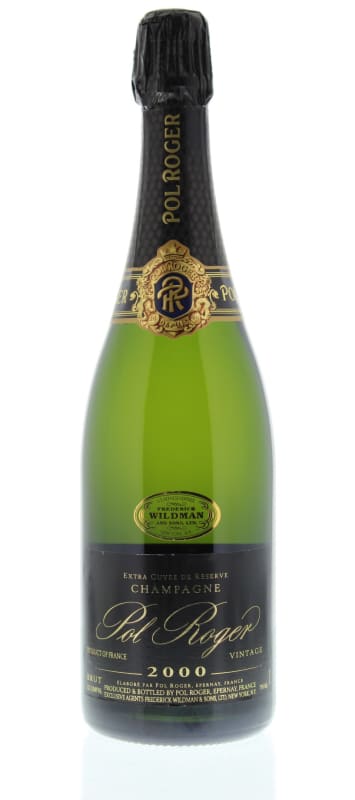


Winemaker Notes
The aromas are floral, sweet and fresh, with toasted brioche notes. In the mouth, the texture is at once velvety and dense, with developing flavors of candied yellow fruits, quince and marzipan, with notes of flowers and pepper. There's an overall character of precision and finesse.
Food Match: sushi, salmon, pate, lobster, fish, crab.
Professional Ratings
-
Wine Enthusiast
A serious, considered wine with its full, ripe and soft flavors tempered with a complex structure. It will not age as impressively as other Pol Roger vintages, and already the yeast and toast element is creeping in. But the weight of Pinot Noir is there, leaving a powerful, creamy mousse finish.
-
Wine & Spirits
Ripe in tone, with a honeyed scent and hints of candied lemon, this wine retains a refreshing fruit character, clean, pute and zesty. There's a bright kiwi note to contrast the chalky minerality, the flavors lasting with finesse. For whole fish roasted in salt.
-
Robert Parker's Wine Advocate
The 2000 Brut Extra Cuvee de Reserve is a warm, inviting Champagne that impresses for its soft, textured fruit, open personality and creamy finish. Brioche, toast, light honey and flowers linger on the close. This is a delicious vintage Champagne to drink now and over the next few years. This is Lot L02001710A, disgorged July, 2009. Anticipated maturity: 2010-2018.
-
Wine Spectator
Floral and poached pear flavors are supported by fine texture and vibrant acidity, layered with hints of toasted almond, graphite, cream and lemon curd, with a mouthwatering finish. Drink now through 2020. 200 cases imported.


Pol Roger is one of the few remaining family-owned grande marque Champagne houses. Their grande marque status was guaranteed at the turn of the century when about 20 producers banded together to establish exacting quality controls for Champagne. The annual production at Pol Roger - less than 120,000 cases - is found in the best restaurants of France, England, and the USA, and is exported to over 30 countries. Pol Roger also was the Champagne of choice of British dignitary Sir Winston Churchill, who once said of Champagne, "...In victory I deserve it, and in defeat I need it!".

Representing the topmost expression of a Champagne house, a vintage Champagne is one made from the produce of a single, superior harvest year. Vintage Champagnes account for a mere 5% of total Champagne production and are produced about three times in a decade. Champagne is typically made as a blend of multiple years in order to preserve the house style; these will have non-vintage, or simply, NV on the label. The term, "vintage," as it applies to all wine, simply means a single harvest year.

Associated with luxury, celebration, and romance, the region, Champagne, is home to the world’s most prized sparkling wine. In order to bear the label, ‘Champagne’, a sparkling wine must originate from this northeastern region of France—called Champagne—and adhere to strict quality standards. Made up of the three towns Reims, Épernay, and Aÿ, it was here that the traditional method of sparkling wine production was both invented and perfected, birthing a winemaking technique as well as a flavor profile that is now emulated worldwide.
Well-drained, limestone and chalky soil defines much of the region, which lend a mineral component to its wines. Champagne’s cold, continental climate promotes ample acidity in its grapes but weather differences from year to year can create significant variation between vintages. While vintage Champagnes are produced in exceptional years, non-vintage cuvées are produced annually from a blend of several years in order to produce Champagnes that maintain a consistent house style.
With nearly negligible exceptions, . These can be blended together or bottled as individual varietal Champagnes, depending on the final style of wine desired. Chardonnay, the only white variety, contributes freshness, elegance, lively acidity and notes of citrus, orchard fruit and white flowers. Pinot Noir and its relative Pinot Meunier, provide the backbone to many blends, adding structure, body and supple red fruit flavors. Wines with a large proportion of Pinot Meunier will be ready to drink earlier, while Pinot Noir contributes to longevity. Whether it is white or rosé, most Champagne is made from a blend of red and white grapes—and uniquely, rosé is often produce by blending together red and white wine. A Champagne made exclusively from Chardonnay will be labeled as ‘blanc de blancs,’ while ones comprised of only red grapes are called ‘blanc de noirs.’