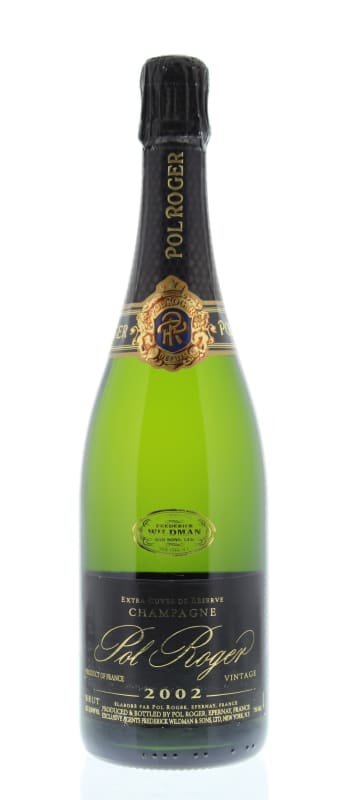


Winemaker Notes
The Brut Vintage 2002 enhances dishes of distinctive character, like chicken with a foie gras stuffing, capon with morel mushrooms and chicken supreme.
Professional Ratings
-
James Suckling
This is a deep and profound 2002 with such fine bubbles that have the texture of fine silk. Full body. Extremely dense and compact. Just rolls over your palate. Superb quality and satisfaction, after all this time. Drink now.
-
Robert Parker's Wine Advocate
Pol Roger's 2002 Brut Vintage is showing beautifully, bursting from the glass with an expressive bouquet of confit lemon and pear mingled with nuances of brioche, wheat toast, honeycomb and dried white flowers. Full-bodied, broad and textural, this is a rich, vinous Champagne that's ample and complex, underpinned by lively acids and concluding with a long, saline finish.


Pol Roger is one of the few remaining family-owned grande marque Champagne houses. Their grande marque status was guaranteed at the turn of the century when about 20 producers banded together to establish exacting quality controls for Champagne. The annual production at Pol Roger - less than 120,000 cases - is found in the best restaurants of France, England, and the USA, and is exported to over 30 countries. Pol Roger also was the Champagne of choice of British dignitary Sir Winston Churchill, who once said of Champagne, "...In victory I deserve it, and in defeat I need it!".

Representing the topmost expression of a Champagne house, a vintage Champagne is one made from the produce of a single, superior harvest year. Vintage Champagnes account for a mere 5% of total Champagne production and are produced about three times in a decade. Champagne is typically made as a blend of multiple years in order to preserve the house style; these will have non-vintage, or simply, NV on the label. The term, "vintage," as it applies to all wine, simply means a single harvest year.

Associated with luxury, celebration, and romance, the region, Champagne, is home to the world’s most prized sparkling wine. In order to bear the label, ‘Champagne’, a sparkling wine must originate from this northeastern region of France—called Champagne—and adhere to strict quality standards. Made up of the three towns Reims, Épernay, and Aÿ, it was here that the traditional method of sparkling wine production was both invented and perfected, birthing a winemaking technique as well as a flavor profile that is now emulated worldwide.
Well-drained, limestone and chalky soil defines much of the region, which lend a mineral component to its wines. Champagne’s cold, continental climate promotes ample acidity in its grapes but weather differences from year to year can create significant variation between vintages. While vintage Champagnes are produced in exceptional years, non-vintage cuvées are produced annually from a blend of several years in order to produce Champagnes that maintain a consistent house style.
With nearly negligible exceptions, . These can be blended together or bottled as individual varietal Champagnes, depending on the final style of wine desired. Chardonnay, the only white variety, contributes freshness, elegance, lively acidity and notes of citrus, orchard fruit and white flowers. Pinot Noir and its relative Pinot Meunier, provide the backbone to many blends, adding structure, body and supple red fruit flavors. Wines with a large proportion of Pinot Meunier will be ready to drink earlier, while Pinot Noir contributes to longevity. Whether it is white or rosé, most Champagne is made from a blend of red and white grapes—and uniquely, rosé is often produce by blending together red and white wine. A Champagne made exclusively from Chardonnay will be labeled as ‘blanc de blancs,’ while ones comprised of only red grapes are called ‘blanc de noirs.’