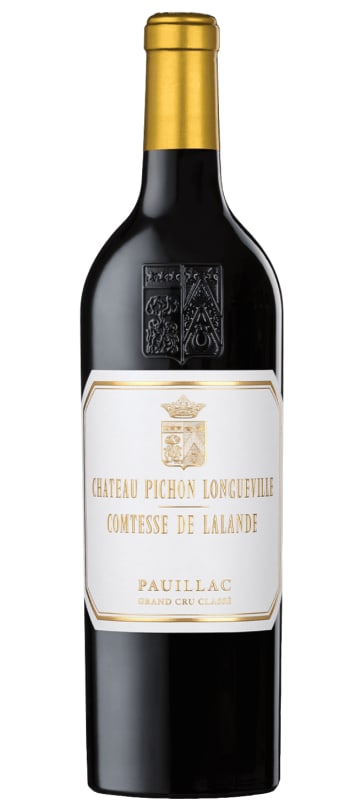


Winemaker Notes
Blend: 5% Cabernet Franc, 78% Cabernet Sauvignon, 17% Merlot
Professional Ratings
-
Robert Parker's Wine Advocate
The 2022 Pichon Longueville Comtesse de Lalande has turned out even better in bottle than I anticipated, bursting from the glass with aromas of cassis and blackberries mingled with scents of licorice, violets and pencil shavings. Full-bodied, layered and enveloping, it's suave, seamless and complete, with faultless precision, pristine integration of tannin, controlled sweetness and a long, expansive finish. The 2022 manages to unite the sensuality that's the estate's calling card and the ripeness of the vintage on the one hand, with a sense of Pauillac classicism on the other, threading the needle to deliver one of the finest wines of the vintage and a benchmark Pichon Comtesse. It's a blend of 78% Cabernet Sauvignon, 17% Merlot and 5% Cabernet Franc.
-
James Suckling
What perfect aromas of blackcurrants, lead pencil, violets, blood oranges and blood. Some iron. Medium- to full-bodied, this has incredible tannins that are completely loaded and integrated, melting into the wine with such a glorious mouthfeel. The finish goes on and on, lightly austere in the most sophisticated way. Racy and rigorously focused. 78% cabernet sauvignon, 17% merlot and 5% cabernet franc.
-
Decanter
One of my favourite wines from 2022, utterly seductive from the first sip, this is a stunning effort that shows the power of Pauillac in 2022 delivered with elegance and class. Heavily scented on the nose, full of dark fruits, savoury notes of salty chocolate and floral scents. Smooth and so appealing in the mouth, the texture stands out, deep and rich but soft and chalky, tannins have a subtle powderiness that spreads the mouth, cooling and refreshing giving the minerality while the cool black and blue fruits linger in layers expanding vertically. This is so refined and polished - it's serious no doubt, not super fun, but it doesn’t need to be, it’s rich and sumptuous with sweet blue fruits balanced by high acidity that keeps the focus and energy. Bright, bold, well worked, clean, crystalline and pure. Somehow delicate and punchy at the same time. A mind-blowing wine that you just have to marvel at with intensity, brightness and vibrancy, building as it goes. A long, clean finish leaves you wanting more, salivating for that next sip.
-
Jeb Dunnuck
Looking at the flagship 2022 Château Pichon Longueville Comtesse De Lalande, it's based on 78% Cabernet Sauvignon, 16% Merlot, and the balance Cabernet Franc that spent 19 months in two-thirds new oak and one-third in once-used barrels. Its similarly deep purple hue is followed by a magical, heavenly 2022 that has a layered, full-bodied profile that brings an incredibly floral character as well as a huge core of darker currant fruits, ripe, polished, velvety tennis, no hard edges, and a thrilling finish. It’s a quintessential Comtesse that brings the forward, supple elegance of the château while still offering plenty of classic Pauillac depth, structure, and character.
-
Wine Spectator
This brims with notes of dark currant, blackberry and black cherry preserves that sparkle subtly with reserved energy, while sweet tobacco, licorice snap, chestnut, violet and ink notes work harmoniously through the long, crumpled velvet finish. A late humus echo provides a beautiful counterpoint, which just makes you want to go right back and start the experience all over with another sip. A total stunner. Cabernet Sauvignon, Merlot and Cabernet Franc.


One of the world’s most classic and popular styles of red wine, Bordeaux-inspired blends have spread from their homeland in France to nearly every corner of the New World. Typically based on either Cabernet Sauvignon or Merlot and supported by Cabernet Franc, Malbec and Petit Verdot, the best of these are densely hued, fragrant, full of fruit and boast a structure that begs for cellar time. Somm Secret—Blends from Bordeaux are generally earthier compared to those from the New World, which tend to be fruit-dominant.

The leader on the Left Bank in number of first growth classified producers within its boundaries, Pauillac has more than any of the other appellations, at three of the five. Chateau Lafite Rothschild and Mouton Rothschild border St. Estephe on its northern end and Chateau Latour is at Pauillac’s southern end, bordering St. Julien.
While the first growths are certainly some of the better producers of the Left Bank, today they often compete with some of the “lower ranked” producers (second, third, fourth, fifth growth) in quality and value. The Left Bank of Bordeaux subscribes to an arguably outdated method of classification that goes back to 1855. The finest chateaux in that year were judged on the basis of reputation and trading price; changes in rank since then have been miniscule at best. Today producers such as Chateau Pontet-Canet, Chateau Grand Puy-Lacoste, Chateau Lynch-Bages, among others (all fifth growth) offer some of the most outstanding wines in all of Bordeaux.
Defining characteristics of fine wines from Pauillac (i.e. Cabernet-based Bordeaux Blends) include inky and juicy blackcurrant, cedar or cigar box and plush or chalky tannins.
Layers of gravel in the Pauillac region are key to its wines’ character and quality. The layers offer excellent drainage in the relatively flat topography of the region allowing water to run off into “jalles” or streams, which subsequently flow off into the Gironde.