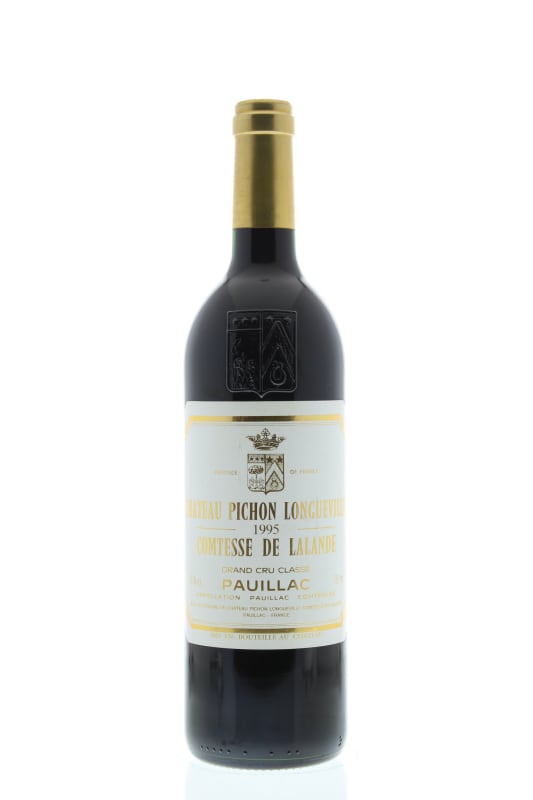


Winemaker Notes
Professional Ratings
-
Robert Parker's Wine Advocate
What sumptuous pleasures await those who purchase either the 1996 or 1995 Pichon-Lalande. It is hard to choose a favorite, although the 1995 is a smoother, more immediately sexy and accessible wine. It is an exquisite example of Pichon-Lalande with the Merlot component giving the wine a coffee/chocolatey/cherry component to go along with the Cabernet Sauvignon's and Cabernet Franc's complex blackberry/cassis fruit. The wine possesses an opaque black/ruby/purple color, and sexy, flamboyant aromatics of pain grille, black fruits, and cedar. Exquisite on the palate, this full-bodied, layered, multidimensional wine should prove to be one of the vintage's most extraordinary success stories.
-
Vinous
The 1995 Pichon-Longueville Comtesse de Lalande is now 30 years old. It has a fully mature bouquet of leather and loamy red berry fruit, with more Merlot clearly evident (40% of the blend). Touches of wild mint develop with time. The palate is medium-bodied with a fleshy opening, and again, the Merlot sways this Pauillac. Chinese five-spice, dried herbs and a dash of white pepper emerge towards the finish.


One of the world’s most classic and popular styles of red wine, Bordeaux-inspired blends have spread from their homeland in France to nearly every corner of the New World. Typically based on either Cabernet Sauvignon or Merlot and supported by Cabernet Franc, Malbec and Petit Verdot, the best of these are densely hued, fragrant, full of fruit and boast a structure that begs for cellar time. Somm Secret—Blends from Bordeaux are generally earthier compared to those from the New World, which tend to be fruit-dominant.

The leader on the Left Bank in number of first growth classified producers within its boundaries, Pauillac has more than any of the other appellations, at three of the five. Chateau Lafite Rothschild and Mouton Rothschild border St. Estephe on its northern end and Chateau Latour is at Pauillac’s southern end, bordering St. Julien.
While the first growths are certainly some of the better producers of the Left Bank, today they often compete with some of the “lower ranked” producers (second, third, fourth, fifth growth) in quality and value. The Left Bank of Bordeaux subscribes to an arguably outdated method of classification that goes back to 1855. The finest chateaux in that year were judged on the basis of reputation and trading price; changes in rank since then have been miniscule at best. Today producers such as Chateau Pontet-Canet, Chateau Grand Puy-Lacoste, Chateau Lynch-Bages, among others (all fifth growth) offer some of the most outstanding wines in all of Bordeaux.
Defining characteristics of fine wines from Pauillac (i.e. Cabernet-based Bordeaux Blends) include inky and juicy blackcurrant, cedar or cigar box and plush or chalky tannins.
Layers of gravel in the Pauillac region are key to its wines’ character and quality. The layers offer excellent drainage in the relatively flat topography of the region allowing water to run off into “jalles” or streams, which subsequently flow off into the Gironde.