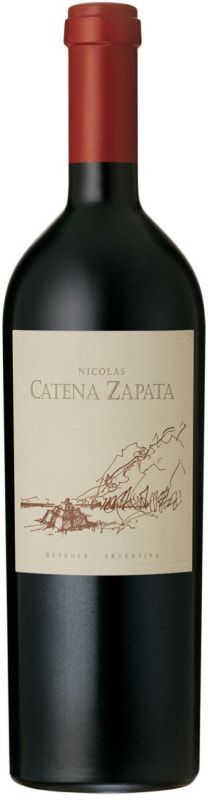


Winemaker Notes
Let the Nicolás Catena Zapata open in a decanter while you grill a Bone-in Ribeye Steak to perfection. Pour yourself a glass. Bliss.
Blend: 72% Cabernet Sauvignon, 28% Malbec
Professional Ratings
-
Robert Parker's Wine Advocate
The 2013 Nicolás Catena Zapata is a blend of 72% Cabernet Sauvignon and 28% Malbec from the La Pirámide, Adrianna and Nicasia vineyards. It is perfectly clean and focused, a noticeable improvement over the 2012 vintage. The Cabernet Sauvignon from this cool vintage seems to have a more restrained character that made me think of Cabernet Franc, very classical and serious. They have been harvesting earlier and earlier in search of balance and freshness, and the strategy has definitely worked. It has great freshness and focus, and the lower alcohol and acidity seem to make the wine integrate the oak very nicely. This has to be one of the finest vintages of Nicolás Catena Zapata.
-
Decanter
Founded in 1902, Bodega Catena Zapata has become revered by many as the pioneer of high-altitude wines and the re-emergence of the Malbec grape in Argentina. The Mayan-styled winery nestles in the foothills of the Andes at Agrelo. The Nicolás Catena Zapata is a blend of 75% Cabernet Sauvignon and 25% Malbec, sourced from La Pirámide (950m), Nicasia (1,095m) and Adrianna vineyards (1,450m), in Agrelo, Altamira and Gualtallary. It's aged for 18 months in French oak barrels. Paz Levinson: This has elegant aromas of cedar box, tobacco and earthy nuances. The wine has a medium body; it’s elegant, evident from its ageing. The Cabernet gives length and good acidity to the wine whilst the Malbec offers juicy plummy fruit. Peter Richards MW: There’s toasty aromas of roasted pepper and red and dark fruit. It has a lovely leafy complexity! Real freshness and lift here. The palate is fresh but tense, with lovely savoury complexity. It’s fundamentally a mid-weight wine - and so much the better for it: Long, precise, savoury and complex. This is not typically Argentina but brilliant stuff nonetheless, a lighter mezzo forte style. Love it! Dirceu Vianna Junior MW: There’s buckets of red and dark fruit still apparent despite its age. It also displays notes of dried herbs, chocolate, sweet spices and beautifully leafy notes. On the palate it combines ripe juicy and cedar with beautiful savoury notes finishing savoury and persistent.
-
Wine Enthusiast
Generous oak is reflected via aromas of hickory and smoke on the nose of this lusty but refined blend of Cabernet and Malbec. In the mouth, rugged tannins and high acidity suggest further cellaring. Flavors of plum, berry, chocolate and tomato sauce finish with dry, pulling tannins and a sense of acidic freshness. Drink through 2027.
Cellar Selection -
James Suckling
Lots of bright fruit with crushed strawberry and floral character. Medium body, silky tannins and a dleicious finish A blend of Cabernet Sauvignon and Malbec.





Bodega Catena Zapata is one of Argentina's high-altitude Malbec pioneers. The Catena family began making wine in Mendoza in 1902. Nicolas Catena, third generation family vintner, was one of the first to see the potential of Mendoza's mountain vineyards for producing high quality Malbec. In 1994, he became the first Argentine to export a world-class bottling of Malbec under the Catena label. Nicolas is joined by his daughter, Dr. Laura Catena, in their relentless pursuit of world-class quality from the family's high-altitude vineyards. Laura has done extensive work in introducing Malbec and other varietal plant selections, soil and climate analysis, and sustainable practices throughout Mendoza. Head winemaker, Alejandro Vigil, has been at Catena Zapata since 2002 and works with Laura and Nicolas to make wines that express the family's vineyards and palate.

One of the world’s most classic and popular styles of red wine, Bordeaux-inspired blends have spread from their homeland in France to nearly every corner of the New World. Typically based on either Cabernet Sauvignon or Merlot and supported by Cabernet Franc, Malbec and Petit Verdot, the best of these are densely hued, fragrant, full of fruit and boast a structure that begs for cellar time. Somm Secret—Blends from Bordeaux are generally earthier compared to those from the New World, which tend to be fruit-dominant.

By far the largest and best-known winemaking province in Argentina, Mendoza is responsible for over 70% of the country’s enological output. Set in the eastern foothills of the Andes Mountains, the climate is dry and continental, presenting relatively few challenges for viticulturists during the growing season. Mendoza, divided into several distinctive sub-regions, including Luján de Cuyo and the Uco Valley, is the source of some of the country’s finest wines.
For many wine lovers, Mendoza is practically synonymous with Malbec. Originally a Bordelaise variety brought to Argentina by the French in the mid-1800s, here it found success and renown that it never knew in its homeland where a finicky climate gives mixed results. Cabernet Sauvignon, Syrah, Merlot and Pinot Noir are all widely planted here as well (and sometimes even blended with each other or Malbec). Mendoza's main white varieties include Chardonnay, Torrontés, Sauvignon Blanc and Sémillon.