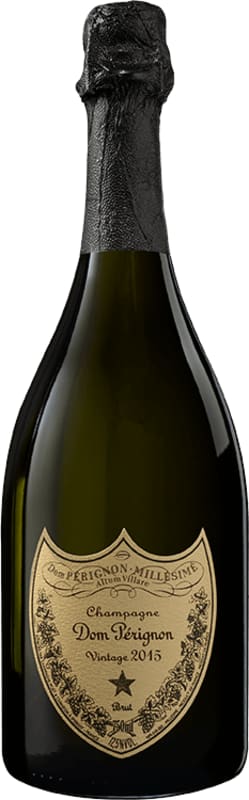


Winemaker Notes
Explore Dom Pérignon Vintage 2015, featuring refined notes of roasted cocoa, lime blossom, jasmine, and peony, subtly accented with aniseed and cardamom. This champagne harmonizes the crispness of orange and green papaya with a soft, full-bodied palate rich in peach, nectarine, and citrus flavors.
Blend: 51% Pinot Noir, 49% Chardonnay
Professional Ratings
-
James Suckling
A super-complex Champagne with chewy tension. Aromas of coffee beans, lemon peel, burnt sugar, chalky minerality, barley candy and tarte tatin. Fine pinprick bubbles with flavors of lemon leaves, aspirin and Mirabelle plums, plus a touch of grapefruit bitterness keeping the tension. Zesty yet integrated chewy acidity and a medium body with a toasted finish.
-
Jeb Dunnuck
The 2015 Dom Perignon pours a bright straw/yellow color and is expressive and layered on the nose with a tropical profile in its notes of cantaloupe, peach, fresh pastry, smokey wet stones, and orange blossoms. Medium to full-bodied, it offers a rounded and ripe but very well-detailed feel, with a soft, chalky texture. This was a very successful vintage for Dom Perignon, producing wines that retain a great deal of clarity and detail in this warm vintage. Drink over the coming 20 years.
-
Vinous
The 2015 Dom Pérignon is terrific. Bright and poised, the 2015 shows terrific energy. Citrus peel, white flowers, mint, white pepper and slate all race across the palate. There's gorgeous tension and backbone here, with bright saline notes that extend the mid-palate and finish. This is a fine showing in a vintage that has proven to be tricky. I am intrigued to see how the 2015 develops in the coming years.
-
Robert Parker's Wine Advocate
Disgorged in January 2023, the 2015 Dom Pérignon shows a singular, ethereal profile with aromas of white pepper, iodine, ripe orchard fruits, toast, smoke, herbs and spices. Medium to full-bodied, layered, and structured, it’s enveloping and round with a delicate phenolic mid-palate that underlines chalky dry extracts, concluding with a sapid, penetrating finish with gastronomic bitterness. This iteration of Dom Pérignon, though replete with the customary charm and vinous generosity that typify the label, distinguishes itself by its structural delicate austerity and a notably phenolic profile, giving rise to a remarkably linear and well-defined style that diverges markedly from the more familiar expressions of Dom Pérignon. This is a blend of 51% Pinot Noir and 49% Chardonnay with a dosage of 4.5 grams per liter; it will age wonderfully and can be enjoyed now or over the next 20 years.
-
Wine Spectator
There's a well-spiced, zesty edge to the flavors of glazed apple, mandarin orange peel, pink grapefruit pith and crème de cassis as they ride the finely detailed mousse of this fresh, focused Champagne. This vivid display is enriched by notes of canelé pastry, chopped almond, pastry cream, smoke and vanilla, all coming to the forefront through the midpalate and chiming on the lasting finish. Drink now through 2035.
-
Wilfred Wong of Wine.com
It would be easy to give Dom Pérignon a free pass every time a glass is placed before me—but I don’t. After more than fifty years of tasting professionally, I owe every wine the same scrutiny. The 2015 earns its praise. From the first aromatic lift to its resonant finish, it is stunning and complete. Seamless and expansive across the palate, it performs with virtuoso precision. A vintage that began cold, moved through extended heat, and concluded with dry harvest conditions, it delivers beautifully choreographed notes of apple, citrus, and delicate floral accents. This one doesn’t demand admiration—it simply deserves it. Salud to all. (Tasted: February 2, 2026, San Francisco, CA)
-
Decanter
2015 is unusually giving and luscious at this early stage, full of apricot pastry, bittersweet orange citrus and bitter almond, brightened by some pithy herbal characters that signal the year’s singular growing season yet also leaning deliciously into toasted bread, honey-nut and a little umami savour from lees ageing. It plays a deep, fruit-saturated and slightly grippy angle on Dom Pérignon’s often svelte style, less reductive than usual and much more immediate than the previous release (2013). This is a vintage perfectly placed for relatively youthful drinking, although Dom Pérignon’s record will mean this is likely to have a rewarding decade ahead.
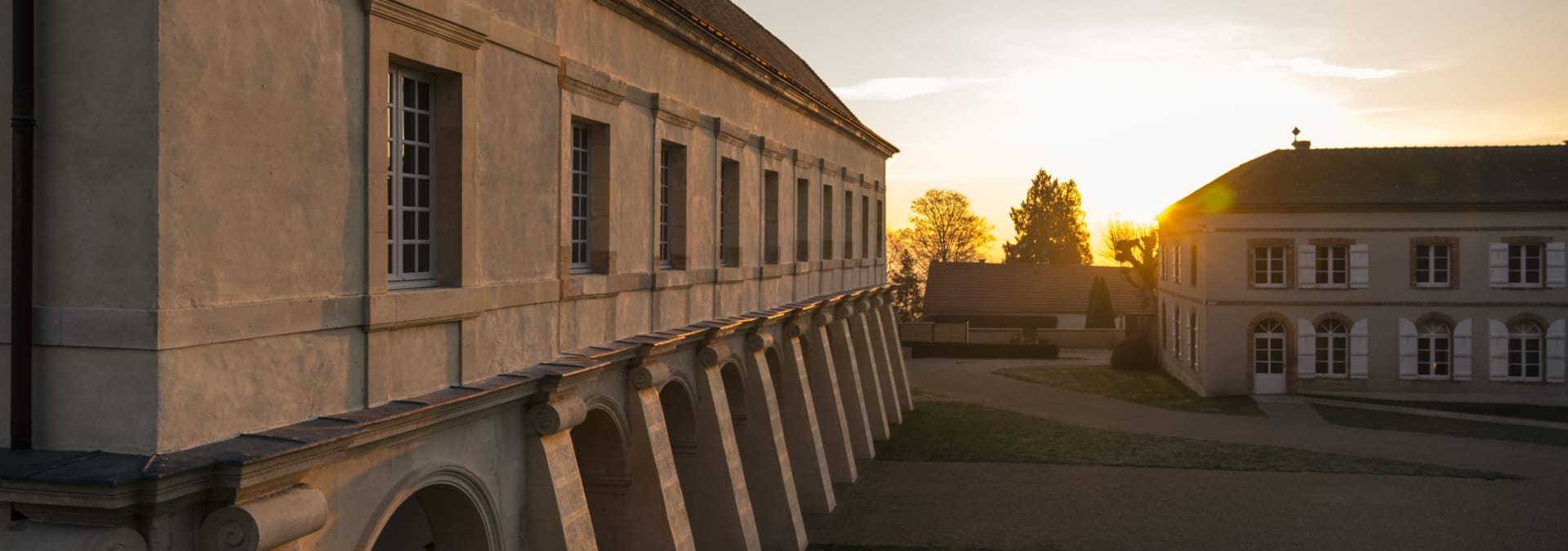



Dom Pérignon: an absolute commitment to Vintage
Dom Pérignon's commitment to vintage is absolute. Each Dom Pérignon is a true act of creation, made from only the best grapes. The champagne's intensity is based in precision, so inviting, so mysterious. Each Vintage has three Plénitudes, and embodies the total faith in the creation that is constantly renewed by Chef de Cave Vincent Chaperon. Coupled with a bold sense of playfulness, Dom Pérignon inspires the greatest creators in the world.Made only from the best grapes grown in one single year, each Dom Perignon's Vintage represents a harmonic balance between the nature of the year and the signature of Dom Pérignon. After no fewer than 8 years of elaboration, each vintage emerges complete, seamless and tactile. Dom Pérignon Champagne is made through an assemblage of Pinot Noir and Chardonnay, created by using only the best grapes harvested from the 17 Grands Crus in Champagne and the Premier Cru of Hautvillers.

Representing the topmost expression of a Champagne house, a vintage Champagne is one made from the produce of a single, superior harvest year. Vintage Champagnes account for a mere 5% of total Champagne production and are produced about three times in a decade. Champagne is typically made as a blend of multiple years in order to preserve the house style; these will have non-vintage, or simply, NV on the label. The term, "vintage," as it applies to all wine, simply means a single harvest year.

Associated with luxury, celebration, and romance, the region, Champagne, is home to the world’s most prized sparkling wine. In order to bear the label, ‘Champagne’, a sparkling wine must originate from this northeastern region of France—called Champagne—and adhere to strict quality standards. Made up of the three towns Reims, Épernay, and Aÿ, it was here that the traditional method of sparkling wine production was both invented and perfected, birthing a winemaking technique as well as a flavor profile that is now emulated worldwide.
Well-drained, limestone and chalky soil defines much of the region, which lend a mineral component to its wines. Champagne’s cold, continental climate promotes ample acidity in its grapes but weather differences from year to year can create significant variation between vintages. While vintage Champagnes are produced in exceptional years, non-vintage cuvées are produced annually from a blend of several years in order to produce Champagnes that maintain a consistent house style.
With nearly negligible exceptions, . These can be blended together or bottled as individual varietal Champagnes, depending on the final style of wine desired. Chardonnay, the only white variety, contributes freshness, elegance, lively acidity and notes of citrus, orchard fruit and white flowers. Pinot Noir and its relative Pinot Meunier, provide the backbone to many blends, adding structure, body and supple red fruit flavors. Wines with a large proportion of Pinot Meunier will be ready to drink earlier, while Pinot Noir contributes to longevity. Whether it is white or rosé, most Champagne is made from a blend of red and white grapes—and uniquely, rosé is often produce by blending together red and white wine. A Champagne made exclusively from Chardonnay will be labeled as ‘blanc de blancs,’ while ones comprised of only red grapes are called ‘blanc de noirs.’