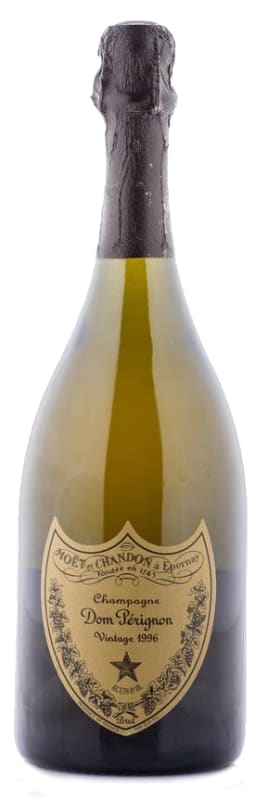


Winemaker Notes
To taste Dom Perignon is to discover the unique spirit and style of a truly great wine of Champagne. Every stage of vineyard selection, winemaking and slow cellar aging is, in itself, a quest for perfection.
Professional Ratings
-
Robert Parker's Wine Advocate
I have had a lot of great vintages of Dom Perignon, but I do not remember any as impressive as the 1996. Even richer than the brilliant 1990, the 1996 is still tightly wound, but reveals tremendous aromatic intensity, offering hints of bread dough, Wheat Thins, tropical fruits, and roasted hazelnuts. Medium to full-bodied, with crisp acidity buttressing the wines wealth of fruit and intensity, it comes across as extraordinarly zesty, well-delineated, and incredibly long on the palate. Moet-Chandon deserves considerable accolades for this prodigious example of Dom Perignon. Anticipated maturity: now-2020+.
-
Jasper Morris
The much-hyped 1996 vintage has proven less consistent than the original hype suggested. Pinot Noir didn't have enough phenolic and aromatic ripeness (many were too excited by the 10g/l malic acidity and 10 degrees potential ABV combination to notice). A great vintage for Blanc de Blancs then, yet the winemaking team delivered a thrilling edition of this wine for 1996. A higher dosage and that lovely acidity gave birth to a rich, complex champagne with lovely freshness and fruit. The lime blossom and lemony toast of youth are beginning to fade a little as the wine strides into its final drinking window. Supremely balanced, with elegant aromas of coffee, toast with a peppering of walnut. Mouthwatering fruit and long angular finish.
-
Wine Enthusiast
This minerally. toasty wine has flavors of almonds and white stone fruits, and a long, finish. It is still young, and is just coming into great balance. Elegant and ethereal.
-
Wine Spectator
This features floral, candied citrus, pencil shaving and hazelnut aromas and flavors. It's fresh and focused, with a firm structure offset by a mouthfilling richness and a lacy texture. Not a blockbuster, but seamless and seductive in its approach.




Dom Pérignon: an absolute commitment to Vintage
Dom Pérignon's commitment to vintage is absolute. Each Dom Pérignon is a true act of creation, made from only the best grapes. The champagne's intensity is based in precision, so inviting, so mysterious. Each Vintage has three Plénitudes, and embodies the total faith in the creation that is constantly renewed by Chef de Cave Vincent Chaperon. Coupled with a bold sense of playfulness, Dom Pérignon inspires the greatest creators in the world.Made only from the best grapes grown in one single year, each Dom Perignon's Vintage represents a harmonic balance between the nature of the year and the signature of Dom Pérignon. After no fewer than 8 years of elaboration, each vintage emerges complete, seamless and tactile. Dom Pérignon Champagne is made through an assemblage of Pinot Noir and Chardonnay, created by using only the best grapes harvested from the 17 Grands Crus in Champagne and the Premier Cru of Hautvillers.

Representing the topmost expression of a Champagne house, a vintage Champagne is one made from the produce of a single, superior harvest year. Vintage Champagnes account for a mere 5% of total Champagne production and are produced about three times in a decade. Champagne is typically made as a blend of multiple years in order to preserve the house style; these will have non-vintage, or simply, NV on the label. The term, "vintage," as it applies to all wine, simply means a single harvest year.

Associated with luxury, celebration, and romance, the region, Champagne, is home to the world’s most prized sparkling wine. In order to bear the label, ‘Champagne’, a sparkling wine must originate from this northeastern region of France—called Champagne—and adhere to strict quality standards. Made up of the three towns Reims, Épernay, and Aÿ, it was here that the traditional method of sparkling wine production was both invented and perfected, birthing a winemaking technique as well as a flavor profile that is now emulated worldwide.
Well-drained, limestone and chalky soil defines much of the region, which lend a mineral component to its wines. Champagne’s cold, continental climate promotes ample acidity in its grapes but weather differences from year to year can create significant variation between vintages. While vintage Champagnes are produced in exceptional years, non-vintage cuvées are produced annually from a blend of several years in order to produce Champagnes that maintain a consistent house style.
With nearly negligible exceptions, . These can be blended together or bottled as individual varietal Champagnes, depending on the final style of wine desired. Chardonnay, the only white variety, contributes freshness, elegance, lively acidity and notes of citrus, orchard fruit and white flowers. Pinot Noir and its relative Pinot Meunier, provide the backbone to many blends, adding structure, body and supple red fruit flavors. Wines with a large proportion of Pinot Meunier will be ready to drink earlier, while Pinot Noir contributes to longevity. Whether it is white or rosé, most Champagne is made from a blend of red and white grapes—and uniquely, rosé is often produce by blending together red and white wine. A Champagne made exclusively from Chardonnay will be labeled as ‘blanc de blancs,’ while ones comprised of only red grapes are called ‘blanc de noirs.’