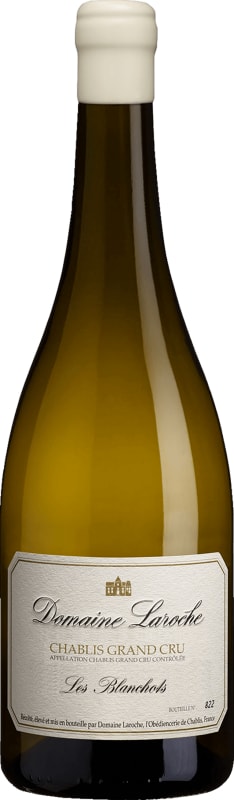


Winemaker Notes
A real elegance appears in this grand cru, with a typical spring blossom aromas and a delicate mineral finish. On the palate, it offers a silky mouthfeel supported by a lively, racy acidity. Blanchots is delicate, silky and shows its charm after five years in bottle and at peak after 10 to 12 years
Professional Ratings
-
Wine Enthusiast
Creaminess on the nose of this wine comes with the richness of crème fraiche edged with lemon. A velvety palate enforces this bright, mellow creaminess, layering it with chalky coolness pervaded with zesty lemon. The roundness of 2018 is conserved in refreshing smoothness. Depth is already hinted at on the long, smooth and chalky finish.
Cellar Selection -
Decanter
Domaine Laroche are the dominant vineyard owner in this Grand Cru, with 4.56 out of a total of 12ha, spread over eight different parcels. Early picked to retain focus and salinity, this is one of a series of impressive wines in 2018, showing praiseworthy mastery of the vintage conditions. Sappy, pithy and stony, this carries its 90% wood very lightly, showing a long, refreshing, sea breeze finish.
-
Robert Parker's Wine Advocate
Notes of fresh bread, orange oil, crisp orchard fruit, apricot and almond paste introduce the 2018 Chablis Grand Cru Les Blanchots, a medium to full-bodied, satiny and layered wine that's ample and nicely concentrated for the vintage, with chalky grip and a saline finish.
-
Wine Spectator
Flavors of peach, melon, apple and mineral are embedded in the creamy texture of this complex and expressive white, which is balanced and stays in bounds, with good underlying cut and a long, vanilla bean finish.





The history of Laroche dates to 1850, when Jean Victor Laroche purchased his first parcel of land in Chablis. Since then, Domaine Laroche has led movements to raise the quality of the appellation with the creation of a charter of excellence for the Grand Cru producers. One of the most respected and largest landholders of premier and grand cru vineyards, the winery owns 90 hectares situated among the best crus. Its headquarters, the Obédiencerie of Chablis, reveals a heritage dating back to the Middle Ages when the Canons of St. Martin of Tours were making wine. St. Martin’s relics were hidden in the Obédiencerie for a decade. Domaine Laroche still produces and ages its premiers and grands crus in these historical cellars. Under the direction of Gregory Viennois, the winemaking team designate one team member to each plot who is wholly responsible for the management of that vineyard from pruning and health of the soil to the quality and quantity of fruit yields. It is this philosophy that makes the expression of each Domaine Laroche wine individual and unparalleled in quality and style. The importance of the ecological balance is crucial to maintain the vineyard heritage and to favor its durability. The respect of the soil, the vine workers and the environment are the center Domaine Laroche’s philosophy.

One of the most popular and versatile white wine grapes, Chardonnay offers a wide range of flavors and styles depending on where it is grown and how it is made. While it tends to flourish in most environments, Chardonnay from its Burgundian homeland produces some of the most remarkable and longest lived examples. California produces both oaky, buttery styles and leaner, European-inspired wines. Somm Secret—The Burgundian subregion of Chablis, while typically using older oak barrels, produces a bright style similar to the unoaked style. Anyone who doesn't like oaky Chardonnay would likely enjoy Chablis.

The source of the most racy, light and tactile, yet uniquely complex Chardonnay, Chablis, while considered part of Burgundy, actually reaches far past the most northern stretch of the Côte d’Or proper. Its vineyards cover hillsides surrounding the small village of Chablis about 100 miles north of Dijon, making it actually closer to Champagne than to Burgundy. Champagne and Chablis have a unique soil type in common called Kimmeridgian, which isn’t found anywhere else in the world except southern England. A 180 million year-old geologic formation of decomposed clay and limestone, containing tiny fossilized oyster shells, spans from the Dorset village of Kimmeridge in southern England all the way down through Champagne, and to the soils of Chablis. This soil type produces wines full of structure, austerity, minerality, salinity and finesse.
Chablis Grands Crus vineyards are all located at ideal elevations and exposition on the acclaimed Kimmeridgian soil, an ancient clay-limestone soil that lends intensity and finesse to its wines. The vineyards outside of Grands Crus are Premiers Crus, and outlying from those is Petit Chablis. Chablis Grand Cru, as well as most Premier Cru Chablis, can age for many years.