
Winemaker Notes
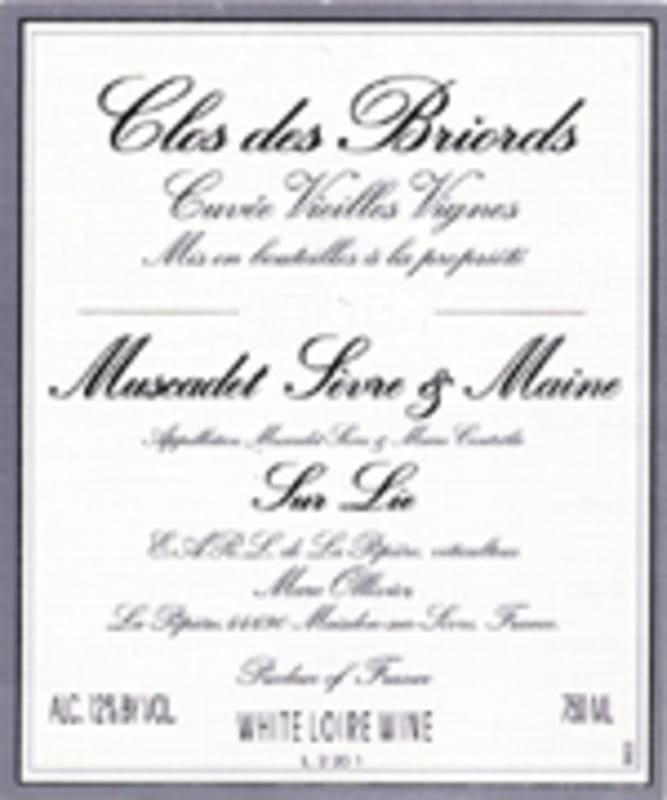
Clos des Briords is Marc's finest Muscadet. It comes from a single plot of 50-year old vines planted in schist (shale). Marc is the only grower in Muscadet who does not have a single clonal selection vine (commonly used to increase yield) in his vineyards. He propagates vines from the bud wood of the existing ones. His wines are kept on the yeast twice as long as those of his neighbors. The resulting wine is an extraordinary Muscadet. This wine has citrus-lime and wet stone aromas. On the palate it has bracing lemon mineral flavors that keep on going.
Professional Ratings
-
Wine Spectator
Focused and taut, with a bony texture carrying lemon, lime and salt notes through the refreshing crunchy finish.


Made famous in Muscadet, a gently rolling, Atlantic-dominated countryside on the eastern edge of the Loire, Melon de Bourgogne is actually the most planted grape variety in the Loire Valley. But the best comes from Muscadet Sèvre et Maine, a subzone of Pays Nantais. Somm Secret—The wine called Muscadet may sound suggestive of “muscat,” but Melon de Bourgogne is not related. Its name also suggests origins in Burgundy, which it has, but was continuously outlawed there, like Gamay, during the 16th and 17th centuries.

Praised for its stately Renaissance-era chateaux, the picturesque Loire valley produces pleasant wines of just about every style. Just south of Paris, the appellation lies along the river of the same name and stretches from the Atlantic coast to the center of France.
The Loire can be divided into three main growing areas, from west to east: the Lower Loire, Middle Loire, and Upper/Central Loire. The Pay Nantais region of the Lower Loire—farthest west and closest to the Atlantic—has a maritime climate and focuses on the Melon de Bourgogne variety, which makes refreshing, crisp, aromatic whites.
The Middle Loire contains Anjou, Saumur and Touraine. In Anjou, Chenin Blanc produces some of, if not the most, outstanding dry and sweet wines with a sleek, mineral edge and characteristics of crisp apple, pear and honeysuckle. Cabernet Franc dominates red and rosé production here, supported often by Grolleau and Cabernet Sauvignon. Sparkling Crémant de Loire is a specialty of Saumur. Chenin Blanc and Cabernet Franc are common in Touraine as well, along with Sauvignon Blanc, Gamay and Malbec (known locally as Côt).
The Upper Loire, with a warm, continental climate, is Sauvignon Blanc country, home to the world-renowned appellations of Sancerre and Pouilly-Fumé. Pinot Noir and Gamay produce bright, easy-drinking red wines here.