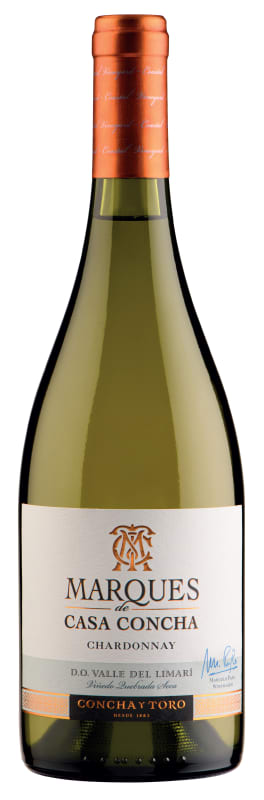


Winemaker Notes
Light and bright yellow. It has aromas of ripe white fruit such as pear, accompanied by white flowers, toasted hazelnut and mineral notes. It is moderately concentrated with a silky texture and layers of ripe, fig, pear and mineral flavors. Finishes with a long and vibrant character.
Professional Ratings
-
Robert Parker's Wine Advocate
The varietal 2021 Marques de Casa Concha Chardonnay was produced with 100% fruit from Quebrada Seca in Limarí, the coastal part of the appellation on red clay and limestone soils, where they can pick ripe grapes with 13.8% alcohol and 6.58 grams of acidity with a pH of 3.33. It fermented after a direct pressing of the clusters in oak barrel with selected yeasts and matured in those barrels, 18% of them new, for 12 months. It's a textbook varietal with the nutty and spicy aromas, flowers and white fruit, very clean. It has a medium-bodied palate with very good freshness, balance and a salty twist in the finish. They look for a Burgundian profile, and they get it!
-
Vinous
The 2021 Chardonnay Marques de Casa Concha hails from Quebrada Seca, Limarí, and was aged for 12 months in 18% new French oak barrels. Yellow with a golden sheen. The nose presents stewed apple and quince notes over layers of creamed corn and hazelnut. Creamy and intense in the mouth. The palate is straightened by the chalky texture, tart acidity and saline quality before the lingering finish of fruit and oak. A textbook Chard from Limarí.





Founded in 1883, Vina Concha y Toro is Latin America's leading producer and occupies an outstanding position among the world’s most important wine companies, currently exporting to 135 countries worldwide. Uniquely, it owns around 9,500 hectares of prime vineyards, which allows the company to secure the highest quality grapes for its wine production. Concha y Toro's portfolio includes a wide range of successful brands at every price point, from the top of the range Don Melchor and Almaviva to the flagship brand Casillero del Diablo and innovative stand-alone brands such as Palo Alto and Maycas del Limarí. The company has 3,162 employees and is headquartered in Santiago, Chile.

One of the most popular and versatile white wine grapes, Chardonnay offers a wide range of flavors and styles depending on where it is grown and how it is made. While it tends to flourish in most environments, Chardonnay from its Burgundian homeland produces some of the most remarkable and longest lived examples. California produces both oaky, buttery styles and leaner, European-inspired wines. Somm Secret—The Burgundian subregion of Chablis, while typically using older oak barrels, produces a bright style similar to the unoaked style. Anyone who doesn't like oaky Chardonnay would likely enjoy Chablis.

Part of the Coquimbo region and a key location for pisco production, the Limari Valley is one of the northern most wine producing regions of Chile. The other two, also part of Coquimbo, are the Elqui and less-developed Choapa Valleys. While more vineyard area is dedicated to pisco production (via the grapes of Muscat of Alexandria, Pedro Jimenez, Moscatel de Asturia and Torontel), the acreage under vine for still wine production has increased. The intense sunlight in the Limari Valley, coupled with little rainfall as well as the cooling effect of the Humboldt Current from the Pacifc Ocean, all make the area ideal for cool climate grapes like Chardonnay and Pinot noir.