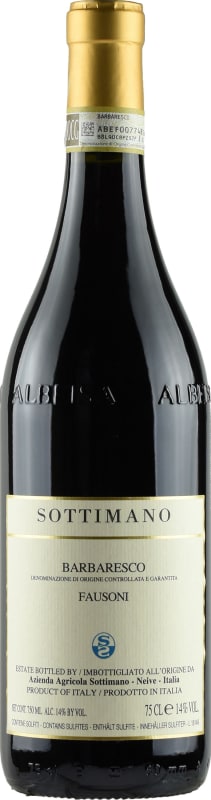


Winemaker Notes
The nose reveals a concentration of aromas of fruits of the forest, red and black berries, enveloped in balsamic and menthol notes. These expressions are echoed on the palate, wrapped in thick tannins and characterized by a delicious youthful finish. Elegant and classic, with a good tannic structure that merges well with its delicate fruitiness. It is a wine with a strong presence in the mouth, with a concentration that reveals density and structure.
Professional Ratings
-
Jeb Dunnuck
The 2021 Barbaresco Fausoni is a bright red color and leads with a detailed and elegant bouquet of dried roses, pomegranate, toasted incense, and dusty earth. It’s bright and medium-bodied, with focused acidity, finely coiled and nervous tannins, and a clean, savory finish. Rating: 96+
-
Robert Parker's Wine Advocate
Fausoni is a 1.5-hectare plot with old vines up to 70 years old in age. The Sottimano 2021 Barbaresco Fausoni delivers more oomph and texture thanks to clay and sandy soils that definitely make the difference. In terms of aromas, this wine is quite floral and delicate with citrusy oils, dates, tamarind and lavender. The tannins are elegant and chalky.
-
Vinous
The 2021 Barbaresco Fausoni is bright, nervy and finely cut. Crushed rocks, white pepper, incense, red fruit, pink grapefruit and orange peel all scream out of the glass. Nervy and sinewy, with tons of top-end brightness, the Fausoni is a rock star. But it's also a wine for readers who appreciated the more linear, classically austere style of Barbaresco. Rating: 96+
-
Wine Spectator
Offering macerated cherry and kirsch notes, this effusive red features plenty of red fruit, rose hip, eucalyptus and light tar flavors. Firms up nicely, leaving a chalky feel on the long finish. Offers a refined texture, with great harmony and intensity.
-
Wine Enthusiast
Incense, warmed spices, and licorice root dance with savory herbs and dried rose, compelling a double take of this Barbaresco. High-toned red berry fruits play a supporting role to the alluring savory and spice aromas that lend a mysterious accent. Mouthfilling richness unveils macerated black cherries, cracked pepper, crushed bay leaf, and dried porcini. Initially assertive tannins soften, enhancing the wine's elegance.


Responsible for some of the most elegant and age-worthy wines in the world, Nebbiolo, named for the ubiquitous autumnal fog (called nebbia in Italian), is the star variety of northern Italy’s Piedmont region. Grown throughout the area, as well as in the neighboring Valle d’Aosta and Valtellina, it reaches its highest potential in the Piedmontese villages of Barolo, Barbaresco and Roero. Outside of Italy, growers are still very much in the experimentation stage but some success has been achieved in parts of California. Somm Secret—If you’re new to Nebbiolo, start with a charming, wallet-friendly, early-drinking Langhe Nebbiolo or Nebbiolo d'Alba.

A wine that most perfectly conveys the spirit and essence of its place, Barbaresco is true reflection of terroir. Its star grape, like that in the neighboring Barolo region, is Nebbiolo. Four townships within the Barbaresco zone can produce Barbaresco: the actual village of Barbaresco, as well as Neive, Treiso and San Rocco Seno d'Elvio.
Broadly speaking there are more similarities in the soils of Barbaresco and Barolo than there are differences. Barbaresco’s soils are approximately of the same two major soil types as Barolo: blue-grey marl of the Tortonion epoch, producing more fragile and aromatic characteristics, and Helvetian white yellow marl, which produces wines with more structure and tannins.
Nebbiolo ripens earlier in Barbaresco than in Barolo, primarily due to the vineyards’ proximity to the Tanaro River and lower elevations. While the wines here are still powerful, Barbaresco expresses a more feminine side of Nebbiolo, often with softer tannins, delicate fruit and an elegant perfume. Typical in a well-made Barbaresco are expressions of rose petal, cherry, strawberry, violets, smoke and spice. These wines need a few years before they reach their peak, the best of which need over a decade or longer. Bottle aging adds more savory characteristics, such as earth, iron and dried fruit.