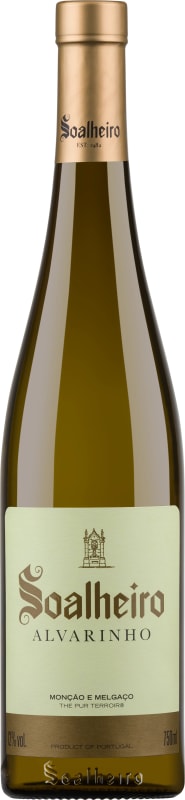


Winemaker Notes
Soalheiro Alvarinho has a bright, lemon-yellow colour. This wine is distinguished by its fresh and elegant fragrance, revealing the aromatic complexity of Alvarinho variety. The flavor has intense tropical and mineral notes that balance perfectly with the acidity and moderate alcohol content.
‘Clássico’ has the elegance to make an excellent aperitif or complement
lighter-flavored dishes. It pairs well with foods such as seafood, grilled fish, white meats, matured cheeses, smoked meats, or Asian and Mediterranean gastronomies.
Professional Ratings
-
Decanter
Our Portuguese panel has been alive to the vibe from Moncão et Melgaço in Vinho Verde for some years now (with a Best in Show in our 2021 competition), so it was gratifying to see this benchmark example cruise its way back into this year’s selection. ‘Green’ is often an insult in winemaking terms, but in Portugal’s granite-soiled Vinho Verde (‘green wine’) region, it’s a prerequisite. The joy of Alvarinho, of course, is that it adds an extra aromatic note of floral charm here (apricots are more typical in Galicia), so your journey into the wine is as much journey into flower garden as it is forest glade. The palate is impressive: there’s nothing slender or shivering about it, nor does it rely on sweet tweaks. Instead it’s svelte and textured, with density to match the wine’s natural drive and freshness. Its 12.5% is low enough to make it a white to drink, not to sip … with or without food: this wine would make both a quenching aperitif and a perfect summer-salad white.
-
Robert Parker's Wine Advocate
The extremely young classical 2024 Alvarinho felt very reductive after the very recent bottling, and it remained difficult to read even after a couple of hours in the glass. This was the first wine produced by the family back in 1982, a varietal with floral aromas and good ripeness and freshness, noted by 12.5% alcohol and a pH of 3.17 coupled with 6.4 grams of acidity. Here, they don't do skin contact or malolactic, as they're trying to keep the purity and freshness, and they ferment it with neutral yeasts and keep it unoaked with lees for at least two months. All their wines have the dry granite finish, even the entry-level ones. 385,000 bottles produced. It was bottled in January 2025. In my experience, this wine is much better with a little time in bottle. I'd wait at least until next year to pull the cork.
-
Wine Enthusiast
This estate, whose winery faces Spain across the Minho river, is devoted to Alvarinho. This is an intense wine, rich with white and citrus fruits and a fine, creamy character. It is likely to age further, drink from 2025. Suitable for vegans.


Bright and aromatic with distinctive floral and fruity characteristics, Albariño has enjoyed a surge in popularity and an increase in plantings over the last couple of decades. Thick skins allow it to withstand the humid conditions of its homeland, Rías Baixas, Spain, free of malady, and produce a weighty but fresh white. Somm Secret—Albariño claims dual citizenship in Spain and Portugal. Under the name Alvarinho, it thrives in Portugal’s northwestern Vinho Verde region, which predictably, borders part of Spain’s Rías Baixas.

A cheerful, translucid, lemon-yellow and slightly pétillant white wine, Vinho Verde literally means ‘green wine’ and is named after the northwest Portugese region from which it originates. The ‘green’ in the name refers to the youthful state in which the wines are customarily released and consumed, not the color of the wine.
It is typically a blend of various percentages of Alvarinho, Loureiro, Trajadura, and Pedernã (Arinto). Following initial alcoholic fermentation, a natural, secondary malolactic conversion in cask produces carbon dioxide, giving Vinho Verde its charmingly light sparkle.