
Winemaker Notes
Raspberry, vanilla and licorice on the nose. Palate of focused black cherry, nutmeg, subtle tannins, balanced acidity and a long finish.
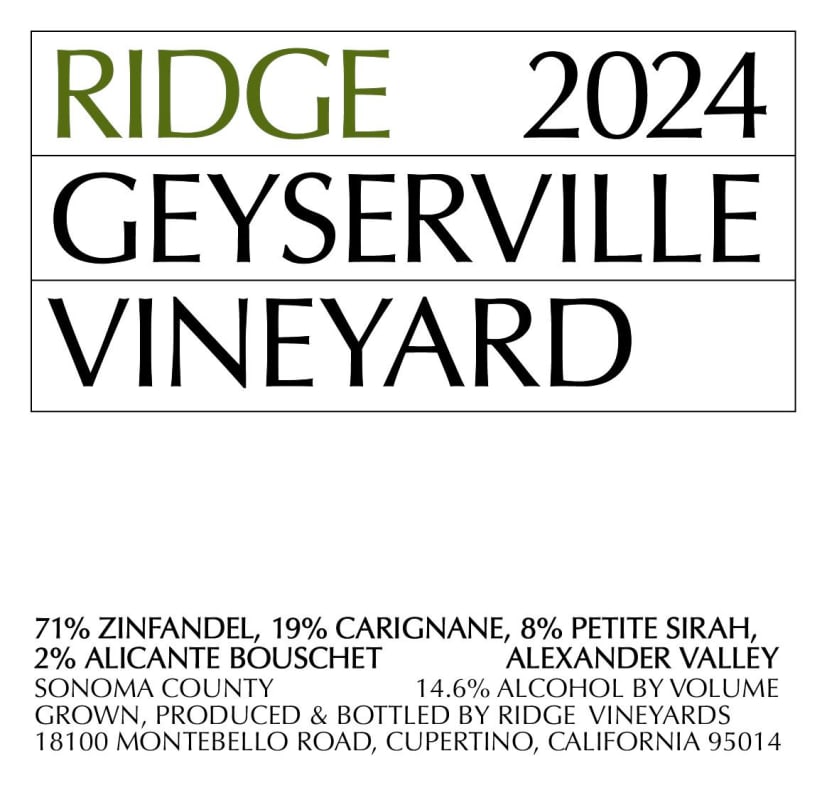
Blend: 71% Zinfandel, 19% Carignane, 8% Petite Sirah, 2% Alicante Bouschet
Professional Ratings
-
Wilfred Wong of Wine.com
The 2024 Ridge Geyserville Vineyard Alexander Valley — Deep ruby-purple color. Dried spice aromas introduce a full-bodied, lush wine with bold blackberry fruit, fine acidity, and beautifully integrated oak. Dry, well balanced, and polished, it finishes firm and satisfying. My history with Ridge Geyserville goes back to tasting the 1972 vintage in mid-1970s San Francisco—an absolute “wow” moment that stayed with me. Not long after, we offered the 1973s, including Geyserville, at Ashbury Market during the early stages of our family’s store's transformation. A wine—and a story—that has come full circle, and one that pairs brilliantly with Northern Chinese Szechuan classics like má pó tofu, twice-cooked pork, or cumin lamb, where the wine’s ripe fruit and plush texture tame the heat while its spice and structure echo the dish’s bold, savory intensity. (Tasted: March 17, 2026, San Francisco)
-
Vinous
Tasted from tank just prior to bottling, the 2024 Geyserville is one of the very best Geyservilles I’ve ever tasted. It's weightless and elegant but supremely concentrated and packed to the gills with intense flavor. Rich blue fruit, incense, crushed rocks and deeply pitched spice tones march with gravitas from open to close. What a sensational edition of this wine. I can't wait to taste it from bottle.
Barrel Sample: 95-97
-
Wine Spectator
Densely structured yet retains a sense of style and finesse, with deep flavors of black cherry and raspberry accented by dark chocolate, orange peel and dark Asian spices. Finishes with big but refined tannins. Zinfandel, Carignane, Petite Sirah and Alicante Bouschet.
-
Jeb Dunnuck
Zinfandel-dominant, the 2024 Geyserville leads with 71% Zin followed by 19% Carignane, 8% Petite Sirah, and 2% Alicante Bouschet, spending 13 months in American oak. Sticky tannins wrap around full-bodied, concentrated layers of plummy black fruit, dried herb, and dusty tannins, textured but still young.




RIDGE's history begins in 1885, when Osea Perrone, a doctor and prominent member of San Francisco's Italian community, bought 180 acres near the top of Monte Bello Ridge in the Santa Cruz Mountains. He planted vineyards and constructed a winery of redwood and native limestone in time to produce the first vintage of Monte Bello in 1892. The historic building now serves as the RIDGE production facility.
In 1962, Ridge Vineyards made its first Monte Bello, and two years later its first zinfandel. The RIDGE approach is straightforward: find the most intense and flavorful grapes, guide the natural process, draw all the fruit's richness into the wine. Decisions on when to pick, when to press, when to rack, what varietals and what parcels to include and when to bottle, are based on taste. To retain the nuances that increase complexity, Ridge winemakers handle the grapes and wine as gently as possible. There are no recipes, only attention and sensitivity.
In August 2021, Ridge Vineyards joined International Wineries for Climate Action (IWCA), a group of like-minded wineries that are dedicated to decarbonizing the global wine industry. RIDGE is committed to achieving Net Zero by 2050 and completes a biannual greenhouse gas audit utilizing the World Resources Institute Greenhouse Gas (GHG) Protocol methodology and be verified by an internationally accredited, third-party auditor.

With hundreds of red grape varieties to choose from, winemakers have the freedom to create a virtually endless assortment of blended red wines. In many European regions, strict laws are in place determining the set of varieties that may be used, but in the New World, experimentation is permitted and encouraged resulting in a wide variety of red wine styles. Blending can be utilized to enhance balance or create complexity, lending different layers of flavors and aromas. For example, a red wine blend variety that creates a fruity and full-bodied wine would do well combined with one that is naturally high in acidity and tannins. Sometimes small amounts of a particular variety are added to boost color or aromatics. Blending can take place before or after fermentation, with the latter, more popular option giving more control to the winemaker over the final qualities of the wine.
How to Serve Red Wine
A common piece of advice is to serve red wine at “room temperature,” but this suggestion is imprecise. After all, room temperature in January is likely to be quite different than in August, even considering the possible effect of central heating and air conditioning systems. The proper temperature to aim for is 55° F to 60° F for lighter-bodied reds and 60° F to 65° F for fuller-bodied wines.
How Long Does Red Wine Last?
Once opened and re-corked, a bottle stored in a cool, dark environment (like your fridge) will stay fresh and nicely drinkable for a day or two. There are products available that can extend that period by a couple of days. As for unopened bottles, optimal storage means keeping them on their sides in a moderately humid environment at about 57° F. Red wines stored in this manner will stay good – and possibly improve – for anywhere from one year to multiple decades. Assessing how long to hold on to a bottle is a complicated science. If you are planning long-term storage of your reds, seek the advice of a wine professional.

Nearly a northern extension of Napa Valley, Alexander Valley starts just north of the small, Knights Valley, and is just a few minutes drive from the Napa town of Calistoga. It is Sonoma County’s hottest AVA. But the Russian River, which runs through the valley, creates cooler pockets and its soft, alluvial soil is ideal for grape growing, especially Cabernet Sauvignon. In fact, some believe that Alexander Valley Cabernets truly rival the best from Napa Valley and many of the heavy-hitter producers have largely invested here.
In addition to Cabernet Sauvignon, which makes up over 50% of plantings, Merlot and old vine Zinfandel thrive here. Ample, fleshy Chardonnay and Sauvignon Blanc dominate white wine production. Some old-vine plantings of Grenache have also been discovered and more recent experiments with Sangiovese and Barbera show great promise.