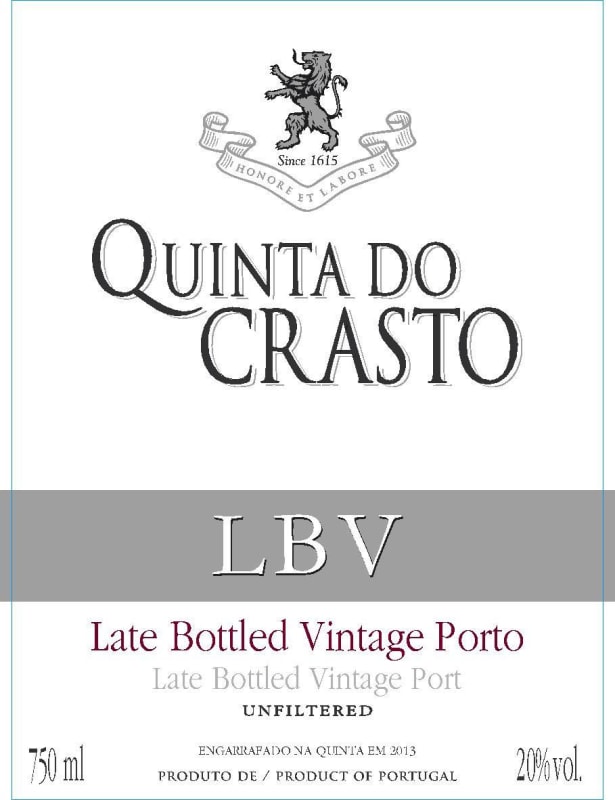

Winemaker Notes
Professional Ratings
-
Robert Parker's Wine Advocate
The 2010 Late Bottled Vintage Port is an old-vines field blend aged in used Portuguese 9,000-liter tanks. It was bottled in November 2014. Perhaps due to the recent bottling here, this has a certain, fresh-squeezed fruit juice note that is completely enticing plus unbelievably and astonishingly delicious. Soft at first and increasingly tight as it airs out, it is luscious and well structured with a fine and boldly flavorful finish. A lot of 2010s are a bit compact and I suspect when this calms down, it will wind up that way too, which is all that constrains my current scoring. It has all the other pieces in place, though. It fills the mouth nicely at the moment and drinks beautifully. I'm not convinced it is a superstar, but I do wish everyone could taste it at this age–given its fabulous freshness and pure, young fruit. It's a fine performance in this vintage. Indeed, so many "off-vintage" LBVs demonstrate how feasible it is to make fine Port in those years. It also is a fine value that may yet improve.



Nestled on a privileged location in the Douro, Quinta do Crasto is one of the oldest winemaking estates in the region – the name ‘Crasto’ is derived from the Latin word ‘castrum’, which means ‘Roman fort’. The first known references to Quinta do Crasto can be traced back to 1615, long before the Douro became the world’s first Demarcated Wine Region in 1756. In the early 1900s, Quinta do Crasto was purchased by Constantino de Almeida, the founder of the famous Constantino Port house. Today, his granddaughter, Leonor Roquette, and her husband Jorge Roquette own and manage the estate, together with their sons, Miguel and Tomás. The Roquette family has invested tremendous time, attention, and resources to rebuild and expand the vineyards and facilities to produce top quality Port and Douro table wines. Vineyard mapping, DNA-matched replanting, a new state-of-the-art wine cellar and centuries of tradition mean that no detail in the winemaking and vineyard management is overlooked.
Quinta do Crasto produces different styles of port and table wines each year. Together with their winemakers and their entire team, they seek to produce year after year wines that display the unique and beautiful characteristics of the Douro, through a tireless devotion to tradition, integrity and excellence.

Port is a sweet, fortified wine with numerous styles: Ruby, Tawny, Vintage, Late Bottled Vintage (LBV), White, Colheita, and a few unusual others. It is blended from from the most important red grapes of the Douro Valley, based primarily on Touriga Nacional with over 80 other varieties approved for use. Most Ports are best served slightly chilled at around 55-65°F. To learn more, see our full Port Wine Guide

The home of Port—perhaps the most internationally acclaimed beverage—the Douro region of Portugal is one of the world’s oldest delimited wine regions, established in 1756. The vineyards of the Douro, set on the slopes surrounding the Douro River (known as the Duero in Spain), are incredibly steep, necessitating the use of terracing and thus, manual vineyard management as well as harvesting. The Douro's best sites, rare outcroppings of Cambrian schist, are reserved for vineyards that yield high quality Port.
While more than 100 indigenous varieties are approved for wine production in the Douro, there are five primary grapes that make up most Port and the region's excellent, though less known, red table wines. Touriga Nacional is the finest of these, prized for its deep color, tannins and floral aromatics. Tinta Roriz (Spain's Tempranillo) adds bright acidity and red fruit flavors. Touriga Franca shows great persistence of fruit and Tinta Barroca helps round out the blend with its supple texture. Tinta Cão, a fine but low-yielding variety, is now rarely planted but still highly valued for its ability to produce excellent, complex wines.
White wines, generally crisp, mineral-driven blends of Arinto, Viosinho, Gouveio, Malvasia Fina and an assortment of other rare but local varieties, are produced in small quantities but worth noting.
With hot summers and cool, wet winters, the Duoro has a maritime climate.