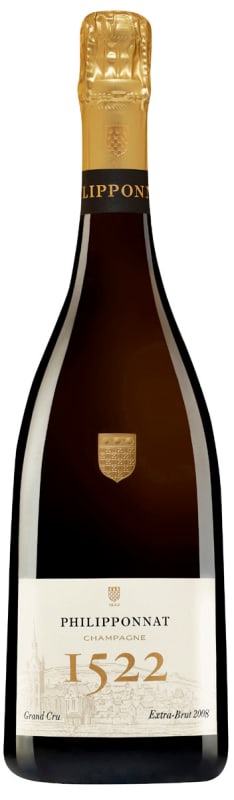


Winemaker Notes
A superb accompaniment to seafood and poached or grilled fish due to the very dry character of this extra brut cuvée. Its dryness contrasts well with the fattiness of poultry such as capon. An even bolder match can be made with caviar or very spicy dishes such as an Indian tandoori. Cuvée 1552 is wonderfully full-bodied, making it an excellent champagne to accompany meals. Sweet or sweet and sour dishes should, however, be avoided.
Blend: 58% Pinot Noir, 42% Chardonnay
Professional Ratings
-
James Suckling
The slightly dominant pinot-noir component (58 per cent) is outgunned by chardonnay’s grapefruit and lemons on the nose. Chalky, fresh and zesty, stony minerals here, too. The palate is dry, crisp and even with gently nutty warmth through the restrained, long and compact finish. Excellent.
-
Robert Parker's Wine Advocate
The 2008 Extra Brut Grand Cru 1522 is also showing very well, offering up aromas of citrus, confit citrus, blackcurrants, marzipan and spice. On the palate, it's medium to full-bodied, deep and concentrated, with a layered and multidimensional core that marries the tangy acidic spine of the vintage with plenty of flesh and fruit, concluding with a long and chalky finish. While it's in a very different stylistic register to the 2009, the two are on a similar qualitative plane.
-
Wine Spectator
An elegant Champagne, dry and lacy in texture, with a crisp, delicate range of green pear, kiwi fruit, lemon pith, picked ginger and chalky mineral notes that linger on the clean-cut finish. Disgorged July 2018.
-
Wine & Spirits
Philipponnat farms the pinot noir for this wine at Le Léon, a parcel between the villages of Aÿ and Dizy where April le Philipponnat purchased vines in 1522. The balance is chardonnay (42 percent) from Le Mesnilsur-Oger. A portion of the blend ferments and ages in barrels, without malolactic, and you might still find some apple-like malic acidity in the wine’s muscular structure. That acidity is mouthwatering and tastes like fruit even as it’s youthful and tense. There’s plenty of richness to fill out that structure, giving the wine a sense of restrained power.



The Philipponnat family have been growing grapes in Champagne since 1522. The House was founded in 1910 by Pierre Philipponnat. Charles Philipponnat took over as CEO in 1999 and has improved the quality and production vastly by implementing smaller oak barrels, keeping different vineyard plots separate and utilizing only the first press. The jewel in the crown of the House is the historic and iconic 5.5 hectares 'Clos des Goisses' vineyard that sits on a steep, south-facing 45° slope starting at the Marne River. This is one of the warmest vineyard sites in all of Champagne and is planted to Pinot Noir and Chardonnay. In 1935 'Clos des Goisses' was the first single vineyard Champagne produced and it would take over 50 years for other Houses to start producing serious Champagne just from a single Clos.
Philipponnat applies natural methods to work the soil, hoeing by hand and plowing with horses. The House's expertise is particularly apparent in its use of the solera process. This technique is a very longstanding House tradition; it consists of keeping reserve wines in oak barrels and including them in non-vintage blends (in a proportion of one quarter to one third) and using this blend as a reserve wine for the following blend.
This progressive dilution allows every bottle to retain a trace of previous years' wines blended since the very beginning. Successive Cellar Masters have attached great importance to handing down this expertise. Philipponnat was the first Champagne House to indicate the main year used in its non-vintage blends, the dosage, and the date of disgorgement on back labels, informing consumers and wine experts of the characteristics of each cuvée.

Representing the topmost expression of a Champagne house, a vintage Champagne is one made from the produce of a single, superior harvest year. Vintage Champagnes account for a mere 5% of total Champagne production and are produced about three times in a decade. Champagne is typically made as a blend of multiple years in order to preserve the house style; these will have non-vintage, or simply, NV on the label. The term, "vintage," as it applies to all wine, simply means a single harvest year.

Associated with luxury, celebration, and romance, the region, Champagne, is home to the world’s most prized sparkling wine. In order to bear the label, ‘Champagne’, a sparkling wine must originate from this northeastern region of France—called Champagne—and adhere to strict quality standards. Made up of the three towns Reims, Épernay, and Aÿ, it was here that the traditional method of sparkling wine production was both invented and perfected, birthing a winemaking technique as well as a flavor profile that is now emulated worldwide.
Well-drained, limestone and chalky soil defines much of the region, which lend a mineral component to its wines. Champagne’s cold, continental climate promotes ample acidity in its grapes but weather differences from year to year can create significant variation between vintages. While vintage Champagnes are produced in exceptional years, non-vintage cuvées are produced annually from a blend of several years in order to produce Champagnes that maintain a consistent house style.
With nearly negligible exceptions, . These can be blended together or bottled as individual varietal Champagnes, depending on the final style of wine desired. Chardonnay, the only white variety, contributes freshness, elegance, lively acidity and notes of citrus, orchard fruit and white flowers. Pinot Noir and its relative Pinot Meunier, provide the backbone to many blends, adding structure, body and supple red fruit flavors. Wines with a large proportion of Pinot Meunier will be ready to drink earlier, while Pinot Noir contributes to longevity. Whether it is white or rosé, most Champagne is made from a blend of red and white grapes—and uniquely, rosé is often produce by blending together red and white wine. A Champagne made exclusively from Chardonnay will be labeled as ‘blanc de blancs,’ while ones comprised of only red grapes are called ‘blanc de noirs.’