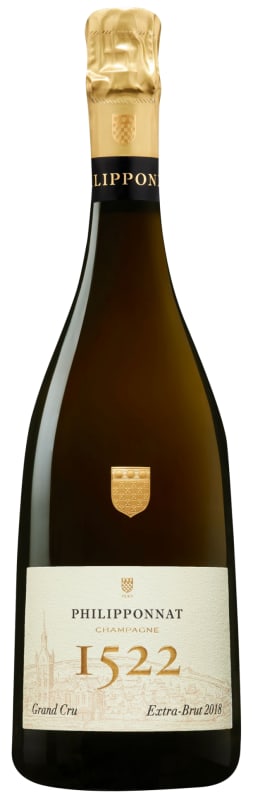


Winemaker Notes
A captivating nose of toasted brioche, vanilla, and crème brûlée lead to a generous palate with patisserie notes and candied citrus leading to a persistent finish.
Pairs well with aged Comté or Gruyère, tuna tartare, grilled or poached seafood, mushroom risotto and roasted duck or quail.
Blend: 72% Pinot Noir, 28% Chardonnay
Professional Ratings
-
James Suckling
Sliced almonds, wild red berries, biscuits, apricots and hints of tobacco and walnuts on the nose. Some white chocolate, too. It’s complex and layered, with a sharp backbone of acidity giving plenty of structure, yet it’s generous. 72% pinot noir from Ay and 28%chardonnay from Oger. 4.5 g/L dosage.
-
Decanter
In a year when some vintage Champagnes are almost too easy-going, Philipponnat has captured some serious complexity and drive in this fine 1522 in one of the top releases of the vintage so far. Opening with bright, spicy ginger and pepper top notes, the ripe Pinot from Aÿ unfolds with generous raspberry and strawberry fragrance and dried pear maturity. The Chardonnay from Oger pulls the wine forward with salted lemon intensity. It's a fulsome, relatively structured 2018 displaying some ageworthiness; two or three years in bottle will yield even more aromatic generosity.
-
Jeb Dunnuck
A quarter of the wine for the 2018 Champagne Grand Cru 1522 Extra Brut was barrel fermented (72% of the wine was done without malo to retain tension in the wine). In the glass, it pours a straw/light copper-toned color, and the nose is very pretty and well-detailed, with wonderfully pure notes of beeswax, fresh peach, almond pastry, delicate spice, and raspberries. Medium to full-bodied, it’s elegant and graceful in this vintage, with a refined, pillowy mousse, a slowly tapering finish, and a chalky texture. It is a lovely wine now, but it will benefit from several years in the cellar. 9000 bottles were produced, and it was disgorged in October of 2023. Drink 2025-2040.
-
Robert Parker's Wine Advocate
Philipponnat’s 2018 Extra-Brut 1522 Grand Cru is a great success—not just in the context of the vintage. Comprising 72% Pinot Noir from the Le Léon vineyard in Aÿ and 28% Chardonnay from Oger, it wafts from the glass with a deep bouquet of orange peel, crisp apple, peach and gooseberry mingling with bread. On the palate, it is full-bodied, elegantly muscular and impeccably balanced, with a deep core of crisp fruit, tangy acidity and a long, sapid finish. Disgorged in October 2023 with a dosage of 4.5 grams per liter, this is a wine of real character.
-
Vinous
The 2018 Extra Brut 1522 is a blend of 72% Pinot Noir from Aÿ and 28% from Oger. Ample and resonant in the glass, the 2018 is a wine of notable stature. Pinot is very much front and center in both the wine's flavor profile and structural feel. Red plum, kirsch, spice, chamomile, leather and dried flowers build into the huge, palate-staining finish. Dosage is 4.5 grams per liter. Disgorged: October 2023.


Representing the topmost expression of a Champagne house, a vintage Champagne is one made from the produce of a single, superior harvest year. Vintage Champagnes account for a mere 5% of total Champagne production and are produced about three times in a decade. Champagne is typically made as a blend of multiple years in order to preserve the house style; these will have non-vintage, or simply, NV on the label. The term, "vintage," as it applies to all wine, simply means a single harvest year.

Associated with luxury, celebration, and romance, the region, Champagne, is home to the world’s most prized sparkling wine. In order to bear the label, ‘Champagne’, a sparkling wine must originate from this northeastern region of France—called Champagne—and adhere to strict quality standards. Made up of the three towns Reims, Épernay, and Aÿ, it was here that the traditional method of sparkling wine production was both invented and perfected, birthing a winemaking technique as well as a flavor profile that is now emulated worldwide.
Well-drained, limestone and chalky soil defines much of the region, which lend a mineral component to its wines. Champagne’s cold, continental climate promotes ample acidity in its grapes but weather differences from year to year can create significant variation between vintages. While vintage Champagnes are produced in exceptional years, non-vintage cuvées are produced annually from a blend of several years in order to produce Champagnes that maintain a consistent house style.
With nearly negligible exceptions, . These can be blended together or bottled as individual varietal Champagnes, depending on the final style of wine desired. Chardonnay, the only white variety, contributes freshness, elegance, lively acidity and notes of citrus, orchard fruit and white flowers. Pinot Noir and its relative Pinot Meunier, provide the backbone to many blends, adding structure, body and supple red fruit flavors. Wines with a large proportion of Pinot Meunier will be ready to drink earlier, while Pinot Noir contributes to longevity. Whether it is white or rosé, most Champagne is made from a blend of red and white grapes—and uniquely, rosé is often produce by blending together red and white wine. A Champagne made exclusively from Chardonnay will be labeled as ‘blanc de blancs,’ while ones comprised of only red grapes are called ‘blanc de noirs.’