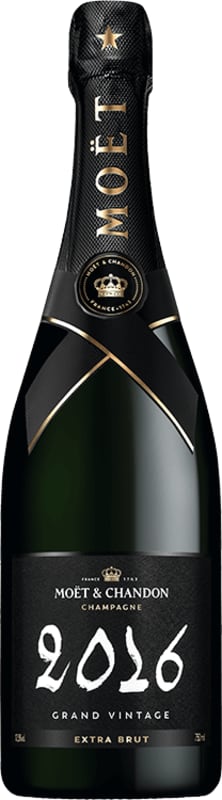


Winemaker Notes
Slightly golden yellow with vibrant green reflections. Initial fleeting aromas are brown and dry: toasted bread, grains and hazelnut. The secondary aromas are softer: gingerbread, marzipan, barley sugar. Finally, the most persistent background notes are fruity and floral: plum, mirabelle, quince, orange blossom and aniseed. A serene, round palate. Sensations enfold effortlessly, akin to a fading scene in a movie or a gentle wave rolling over smooth sand before softly retreating. The initial round, supple attack effortlessly transitions into a structured core-like sensation, culminating in a finish reminiscent of the sweet, tangy freshness of a clementine or pomelo.
Blend: 48% Chardonnay, 34% Pinot Noir, 18% Meunier
Professional Ratings
-
Decanter
Grand Vintage 2016 sums up the year's strong suits very neatly – beautiful ripeness without heaviness, compact build and fine ageworthiness. It's a characteristically clean-cut, snappy vintage from Moët, with aromas of fresh baguette, satsuma, sweet red apple and strawberry, all framed with the toasty sourdough aromas typical of the house. There's some concentration and vinosity lurking here, even with the house's delicate style and pinpoint, meringue-soft mousse. This seems destined to be one of the top Moët vintages of late.
-
James Suckling
Lovely salinity to this Champagne, which has notes of Asian pears, aniseed, preserved lemons, chalk and biscuits. It’s mineral and seamless, with transparency and brightness. Fine bubbles. 48% chardonnay, 34% pinot noir and 18% meunier. 5g/L dosage. Disgorged March 2023. Drink now or hold.





Learn about Moet & Chandon: its history, the brand and it's iconic Moet Imperial Brut Champagne.
History of Moet & Chandon
Moet & Chandon was founded as Moet et Cie in 1743 by Claude Moet. At the end of the 18th century, Claude's grandson Jean-Remy Moet took over the business and introduced Champagne and the Moet brand to the rest of the world. It wasn't until 1833, when Jean-Remy’s son-in-law, Pierre-Gabriel Chandon de Briailles, joined the business that the House was renamed Moet & Chandon.
The Moet & Chandon Brand
Since its founding, Moet & Chandon has been the Champagne of success and glamour. The important figures of the era, from the Marquise de Pompadour to Napoleon, quickly fell in love with the House’s effervescent wine. Renowned for its achievements and legendary pioneering spirit, Moet & Chandon is synonymous with both cherished traditions and modern pleasures and has helped celebrate life’s most triumphant moments for more than 270 years.
Moet Imperial Brut
Moet Imperial Brut is the House's iconic champagne bottle. Created in 1869, it embodies the unique Moet & Chandon style; a style that distinguishes itself by its bright fruitiness, seductive palate, and elegant maturity.
Moet & Chandon Pronunciation
mow-ett ay shahn-don

Representing the topmost expression of a Champagne house, a vintage Champagne is one made from the produce of a single, superior harvest year. Vintage Champagnes account for a mere 5% of total Champagne production and are produced about three times in a decade. Champagne is typically made as a blend of multiple years in order to preserve the house style; these will have non-vintage, or simply, NV on the label. The term, "vintage," as it applies to all wine, simply means a single harvest year.

Associated with luxury, celebration, and romance, the region, Champagne, is home to the world’s most prized sparkling wine. In order to bear the label, ‘Champagne’, a sparkling wine must originate from this northeastern region of France—called Champagne—and adhere to strict quality standards. Made up of the three towns Reims, Épernay, and Aÿ, it was here that the traditional method of sparkling wine production was both invented and perfected, birthing a winemaking technique as well as a flavor profile that is now emulated worldwide.
Well-drained, limestone and chalky soil defines much of the region, which lend a mineral component to its wines. Champagne’s cold, continental climate promotes ample acidity in its grapes but weather differences from year to year can create significant variation between vintages. While vintage Champagnes are produced in exceptional years, non-vintage cuvées are produced annually from a blend of several years in order to produce Champagnes that maintain a consistent house style.
With nearly negligible exceptions, . These can be blended together or bottled as individual varietal Champagnes, depending on the final style of wine desired. Chardonnay, the only white variety, contributes freshness, elegance, lively acidity and notes of citrus, orchard fruit and white flowers. Pinot Noir and its relative Pinot Meunier, provide the backbone to many blends, adding structure, body and supple red fruit flavors. Wines with a large proportion of Pinot Meunier will be ready to drink earlier, while Pinot Noir contributes to longevity. Whether it is white or rosé, most Champagne is made from a blend of red and white grapes—and uniquely, rosé is often produce by blending together red and white wine. A Champagne made exclusively from Chardonnay will be labeled as ‘blanc de blancs,’ while ones comprised of only red grapes are called ‘blanc de noirs.’