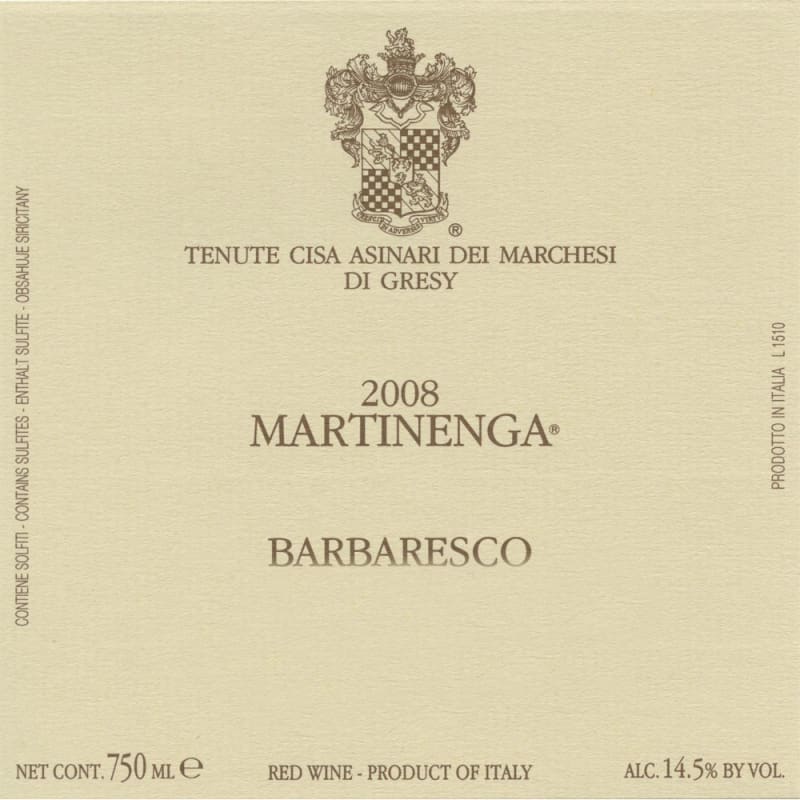

Winemaker Notes
Professional Ratings
-
Robert Parker's Wine Advocate
The 2008 Barbaresco Martinenga fleshes out nicely with time in the glass. Sweet dark cherries, licorice, spices and leather are some of the notes that emerge from the glass. I very much like the way the 2008 has developed over the last year. I will not at all be surprised if it continues to improve in bottle as it is fresher and more vibrant than the 2009. The 2008 is a gorgeous wine that captures the very best of the house style. Anticipated maturity: 2015-2028.
-
Wine & Spirits
Evolving across the palate from earthy notes of autumn leaves and porcini toward the brighter fragrance of roses, this is a sunny Barbaresco held to a tight line of flavor. Red cherries and spice form the core of that flavor, with brisk tannins defining the edges. Open this six to eight years from the vintage to enjoy it at optimal maturity.
-
Wine Enthusiast
Located directly under the celebrated Rabajà cru, Martinenga is an exceptional, amphitheater-shaped vineyard that revels in sunny exposures and well-draining soils. It’s the perfect spot for the world’s best winemaking and this youthful expressions shows wonderful quality and elegance. The long finish is accented by cassis, cedar and cola-like flavors.


Responsible for some of the most elegant and age-worthy wines in the world, Nebbiolo, named for the ubiquitous autumnal fog (called nebbia in Italian), is the star variety of northern Italy’s Piedmont region. Grown throughout the area, as well as in the neighboring Valle d’Aosta and Valtellina, it reaches its highest potential in the Piedmontese villages of Barolo, Barbaresco and Roero. Outside of Italy, growers are still very much in the experimentation stage but some success has been achieved in parts of California. Somm Secret—If you’re new to Nebbiolo, start with a charming, wallet-friendly, early-drinking Langhe Nebbiolo or Nebbiolo d'Alba.

A wine that most perfectly conveys the spirit and essence of its place, Barbaresco is true reflection of terroir. Its star grape, like that in the neighboring Barolo region, is Nebbiolo. Four townships within the Barbaresco zone can produce Barbaresco: the actual village of Barbaresco, as well as Neive, Treiso and San Rocco Seno d'Elvio.
Broadly speaking there are more similarities in the soils of Barbaresco and Barolo than there are differences. Barbaresco’s soils are approximately of the same two major soil types as Barolo: blue-grey marl of the Tortonion epoch, producing more fragile and aromatic characteristics, and Helvetian white yellow marl, which produces wines with more structure and tannins.
Nebbiolo ripens earlier in Barbaresco than in Barolo, primarily due to the vineyards’ proximity to the Tanaro River and lower elevations. While the wines here are still powerful, Barbaresco expresses a more feminine side of Nebbiolo, often with softer tannins, delicate fruit and an elegant perfume. Typical in a well-made Barbaresco are expressions of rose petal, cherry, strawberry, violets, smoke and spice. These wines need a few years before they reach their peak, the best of which need over a decade or longer. Bottle aging adds more savory characteristics, such as earth, iron and dried fruit.