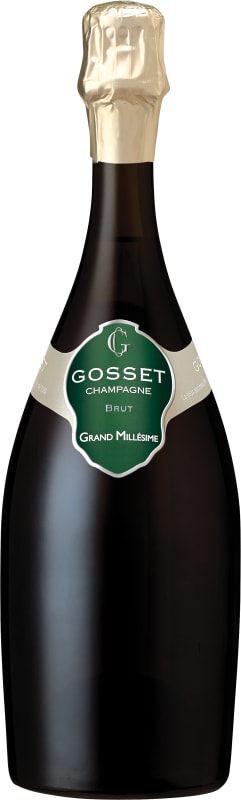


Winemaker Notes
Blend: 67% Chardonnay, 33% Pinot Noir
Professional Ratings
-
Robert Parker's Wine Advocate
Since Gosset makes a point of commercializing wines only when they deem them ready, the 2012 Grand Millésime Brut will be released at the end of this year, while the 2010 and 2008 continue to wait in the wings. The wine is still quite tightly wound after its recent disgorgement, unfurling in the glass with a youthful bouquet of warm biscuits, apple, lemon and peach that picks up a more pronounced smoky top note as the wine sits in the glass. On the palate, it's medium to full-bodied, broad and powerful, with a deep and concentrated core, incisive acids and a precise, saline finish. This is a muscular vintage of the Grand Millésime that seems likely to evolve slowly.
Rating: 94+ -
Wine & Spirits
Jean-Pierre Mareigner made this wine and bottled it in 2013; Odilon de Varine, who took over as cellarmaster in 2016, disgorged the vintage in 2019. It’s two-to-one chardonnay to pinot noir, though the fruit ripeness of the pinot noir contributes more than its fair share of plum and red-blushed peach to the savory depths of flavor. As it opens, the brisk yellow-apple flavors develop intensity, the pure flavor of fruit picked fresh, the incipient scent of apple blossoms.
-
James Suckling
This offers spiced berry-biscuit aromas and a toasted hazelnut and brioche edge. Berry pastry, too. The palate has a suave, sleek and smooth texture. Finely honed and finishes dry. Flavor and focus here.
-
Wine Enthusiast
A blend of two-thirds Chardonnay with one-third Pinot Noir, this beautifully balanced wine is poised between richness and intense crispness. Its apple and ripe pear fruits are now softening and beginning to meld into the taut texture. Still a little young, this wine will repay aging. Wait to drink it until 2022.
-
Wine Spectator
Crisp and minerally up front, this is finely meshed and mouthwatering, lightly chalky in texture and offering flavors of ripe black currant, lemon pith and pastry dough. Floral and spice notes play on the lasting finish. Drink now through 2029.





Founded in Aÿ in 1584 by Pierre Gosset, Champagne Gosset is the oldest wine house in Champagne. For more than four centuries, the family has preserved its house style, a true reflection of the terroir; a textured wine that shows purity, precision and persistence.
Champagne Gosset’s reputation for quality starts in the vineyard, where it sources over 200 unique lots of grapes almost entirely from premier cru and grand cru vineyards in the Côte des Blancs, Grande Vallée de la Marne and Montagne de Reims. Long-term relationships with growers that date back several generations, allow the winemaking team to direct activity in the vineyards.
Champagne Gosset’s winemaking utilizes all the grapes and terroir have to offer and minimizes other inputs. Gosset carefully avoids malolactic fermentation, thus preserving the malic acid present in the grapes. Grower lots are kept separate until it is time to blend the cuvées, and vinification temperatures are managed carefully to preserve delicate aromatics. During assemblage, all the lots are tasted blind – there are no recipes. Similarly, dosage for each lot is selected during blind trials. Non-vintage wines are cellared for at least three years, vintage wines at least seven and 10 for the CELEBRIS cuvées.
After 17 generations, Champagne Gosset’s philosophy continues to produce dynamic, age-worthy cuvées.

Representing the topmost expression of a Champagne house, a vintage Champagne is one made from the produce of a single, superior harvest year. Vintage Champagnes account for a mere 5% of total Champagne production and are produced about three times in a decade. Champagne is typically made as a blend of multiple years in order to preserve the house style; these will have non-vintage, or simply, NV on the label. The term, "vintage," as it applies to all wine, simply means a single harvest year.

Associated with luxury, celebration, and romance, the region, Champagne, is home to the world’s most prized sparkling wine. In order to bear the label, ‘Champagne’, a sparkling wine must originate from this northeastern region of France—called Champagne—and adhere to strict quality standards. Made up of the three towns Reims, Épernay, and Aÿ, it was here that the traditional method of sparkling wine production was both invented and perfected, birthing a winemaking technique as well as a flavor profile that is now emulated worldwide.
Well-drained, limestone and chalky soil defines much of the region, which lend a mineral component to its wines. Champagne’s cold, continental climate promotes ample acidity in its grapes but weather differences from year to year can create significant variation between vintages. While vintage Champagnes are produced in exceptional years, non-vintage cuvées are produced annually from a blend of several years in order to produce Champagnes that maintain a consistent house style.
With nearly negligible exceptions, . These can be blended together or bottled as individual varietal Champagnes, depending on the final style of wine desired. Chardonnay, the only white variety, contributes freshness, elegance, lively acidity and notes of citrus, orchard fruit and white flowers. Pinot Noir and its relative Pinot Meunier, provide the backbone to many blends, adding structure, body and supple red fruit flavors. Wines with a large proportion of Pinot Meunier will be ready to drink earlier, while Pinot Noir contributes to longevity. Whether it is white or rosé, most Champagne is made from a blend of red and white grapes—and uniquely, rosé is often produce by blending together red and white wine. A Champagne made exclusively from Chardonnay will be labeled as ‘blanc de blancs,’ while ones comprised of only red grapes are called ‘blanc de noirs.’