
Winemaker Notes
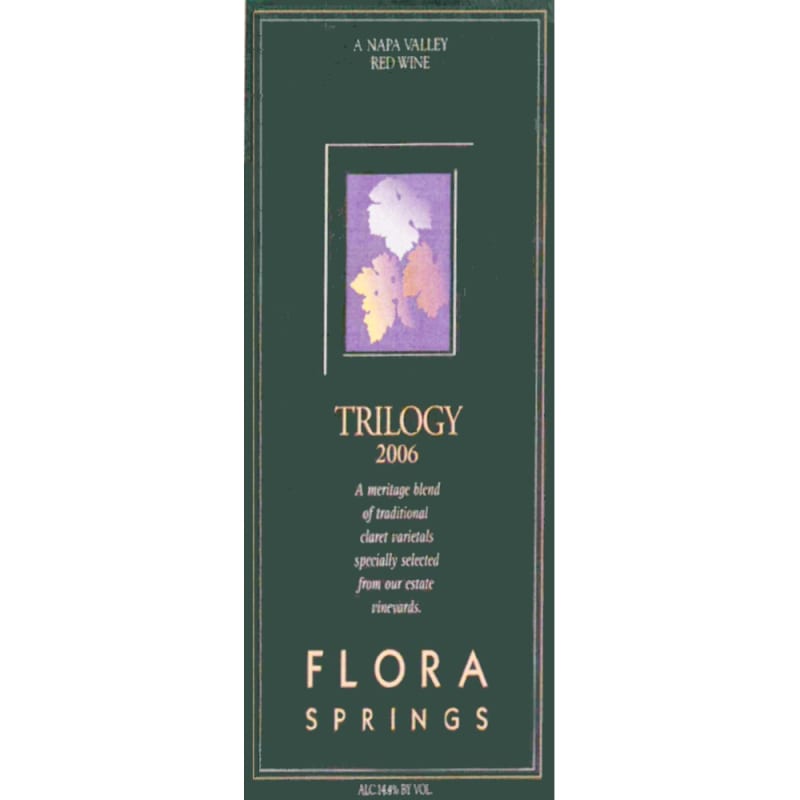
Flora Springs has built its legacy on beautiful and complex wines that can be enjoyed either as young and vibrant or as cellared and graceful. The 2006 exhibits all the classic Trilogy attributes with a lovely cassis and cherry bouquet, as well as huge black fruit flavors that envelop the palate. Each varietal is vital to the outcome - the Cabernet exhibits black cherry and dark cocoa character, while the Merlot carries these flavors to the back of the palate where the Cabernet Franc adds notes of coffee and toffee to the finish. Unrelenting with power and grace, the 2006 Trilogy, our 22nd vintage, beautifully marries the complexity and elegance of our earlier vintages with the sheer bravado of our favorites from the late 90's.
Professional Ratings
-
Robert Parker's Wine Advocate
The outstanding 2006 Trilogy (73% Cabernet Sauvignon, 20% Merlot, and the rest Cabernet Franc and Petit Verdot) is a large production cuvee of 6,500 cases. Revealing lots of roasted herb, cedar, black currant, and sweet cherry notes, an endearing, medium to full-bodied texture, exceptional elegance, purity, and length, stunning balance, and ripe tannins (no easy task in a vintage such as 2006), it should drink well for 10-15 years.
One of the most impressive portfolios from Flora Springs that I have tasted has emerged from their extensive vineyard holdings. Flora Springs' single vineyard offerings are all 100% Cabernet Sauvignon with somewhat limited availability production ranges from 370-400 cases of each.


Undoubtedly proving its merit over and over, Napa Valley is a now a leading force in the world of prestigious red wine regions. Though Cabernet Sauvignon dominates Napa Valley, other red varieties certainly thrive here. Important but often overlooked include Merlot and other Bordeaux varieties well-regarded on their own as well as for their blending capacities. Very old vine Zinfandel represents an important historical stronghold for the region and Pinot noir is produced in the cooler southern parts, close to the San Pablo Bay.
Perfectly situated running north to south, the valley acts as a corridor, pulling cool, moist air up from the San Pablo Bay in the evenings during the hot days of the growing season, which leads to even and slow grape ripening. Furthermore the valley claims over 100 soil variations including layers of volcanic, gravel, sand and silt—a combination excellent for world-class red wine production.