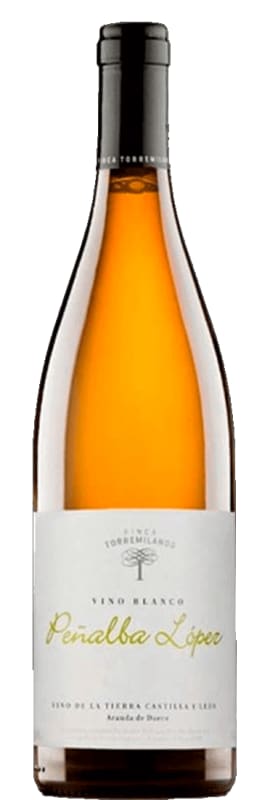


Winemaker Notes
Selection of grapes from our vineyards of Finca Torremilanos. Chardonnay (20 years old) in the subzone of Valdecañal (northeast of the hill of Torremilanos) with east orientation and soil of limes and clays with sand on the surface. Albillo (80 years old) in Torremilanos. Viura (180 years old) of the Rubial vineyard in Fuentenebro at an altitude of 1000 meters.
In Finca Torremilanos we enjoy different microclimates marked by the Atlantic-Mediterranean confluence and the composition of the terrain is diverse due to the erosion and sedimentation of the Douro River. Average age: over 70 years.
Blend: 60% Chardonnay, 30% Viura,10% Albillo
Professional Ratings
-
Robert Parker's Wine Advocate
The white 2019 Peñalba López Vino Blanco is still sold as Vino de la Tierra de Castilla y León, as it's a blend of Albillo Mayor, Albillo Real, Viura and Chardonnay; but it's a full-fledged Ribera del Duero otherwise, as it was produced with grapes from their estate vineyards in the Finca Torremilanos. Like all of their wines, it's certified organic and bio dynamic. It fermented and matured in oak barrels for 17 months, a much longer élevage than before. It has moderate alcohol and very good acidity coupled with some creamy hints, white flowers, pollen and spices. It was bottled without added sulfites, which gives it a somewhat wild profile, and it has character and something intriguing about it, with a tasty palate, long and tasty. It was bottled in February 2021.


In the heart of Ribera del Duero, close to the town of Aranda, lies the Torrmilanos estate, home of Bodegas Penalba Lopez. Winemaking at the estate dates back to 1903 but it was not until 1975 when it was acquired by the Penalba Lopez family who increased the acreage under Temrpanillo- the region's best grape variety-that it approached the 200 hectares of vineyars that now cover the hillsides surrounding the winery.
The visually stunning, sympathetic architecture of the winery and the facilities it offers guarantee the quality and long aging potential of the wines. But even with the best grape variety and the most advanced winery one other factor is still required to help realize the fullest potential of the estate-the climage. In the Ribera del Duero the extremes of hot and cold help to embrace the fruit quality so that the wines can compete with the best in the world.

White grapes are used in two famous types of Spanish wine, Sherry and Cava, but we will limit this discussion to still whites. Let’s begin with perhaps the best known and most highly regarded internationally, Albariño . Produced in the region of Rías Baixas, just above Portugal in northwestern Spain, Albariño typically sees no or little oak and is medium to medium-plus in body. Aroma and flavor notes often include citrus and peach, often with subtle floral notes and a suggestion of sea spray, giving the wine a zesty feel. Often bottled as a single varietal, Albariño is sometimes blended with other indigenous grapes like Loureira and Treixadura. Try one of these Spanish whites from Forjas del Salnes.
Let’s look at a few other Spanish white wines. Godello also hails from northwestern Spain and presents a profile of grapefruit, minerality and a slight smoky quality. Enjoy a bottle from Bodegas Avancia. The region of Rueda, northwest of Madrid, is home to Verdejo , which makes refreshing, un-oaked white wines whose herbal vibrancy recalls Sauvignon Blanc . Protos makes a tasty version. Up north in the Basque region, we find the wine called Txakoli (sometimes called Txakolina). Pronounced “sha-ko-LEE,” it’s made from a local grape called Hondurrabi Zuri and is light, fresh, citrusy, dry … and with razor sharp acidity that makes it a fantastic partner with local seafood and tapas. Ameztoi Gertariako is a good Spanish white wine producer to check out.
The Penedѐs region, best known for the oceans of delicious Cava it sends to the world, also produces still Spanish whites, sometimes from international varieties like Chardonnay , and often from the same grapes used for Cava. These include Parellada, Xarel-lo and Macabeo. Avaline produces a fine example of Penedes white. Finally, we visit the Rioja region. While it is historically and internationally famous for its reds, Rioja also produces fine Spanish white wines. These are usually based on Viura (the local name for Macabeo) and make good everyday sippers, although some aged versions can be stunningly complex. A good place to start is the white Rioja from Bodegas Muga.
As you can see, Spanish white wines offer a vast opportunity for exploration!