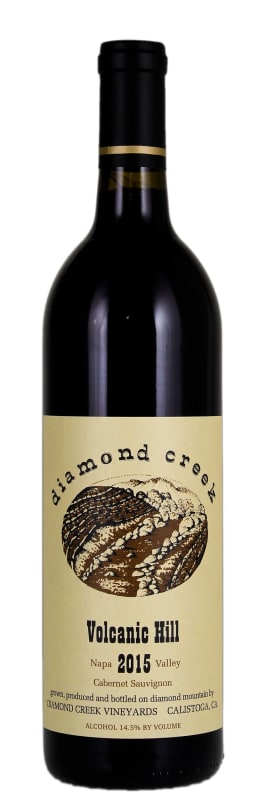


Winemaker Notes
Professional Ratings
-
Robert Parker's Wine Advocate
Deep garnet-purple colored, the 2015 Cabernet Sauvignon Volcanic Hill opens with dusty soil, cloves and fragrant earth scents with a core of red and black cherry preserves, plum pudding, blackcurrant cordial and mocha with touches of cedar chest and potpourri. Very big, rich and decadently fruited, it fills the mouth with powerful fruit and a taut frame of fine-grained tannins plus great freshness, finishing long and perfumed.
Rating: 96+ -
Vinous
The 2015 Cabernet Sauvignon Volcanic Hill is a huge, flamboyant wine. Winemaker Phil Steinschreiber certainly did not hold back. Inky, deep and voluptuous, the 2015 offers up copious super-ripe fruit slathered in 100% new oak, with some lots seeing new barrels again in the second year of aging. Inky blue fruit, dark chocolate, menthol, vanillin and cloves make a strong statement before incisive Volcanic Hill tannins pull it all together on the close.
-
James Suckling
Aromas of hot pumice, flowers, spices and hints of blackberries. Full-bodied, round and very fruit-forward; yet it holds back. Lovely to drink now and even better in the future.
-
Wine Spectator
Strikingly complex and well-defined by firm tannins and loamy earth notes, yet the core of herb-laced dark berry, spice, mocha and espresso flavors should make for an alluring drink in the near future. Best from 2022 through 2033.


A noble variety bestowed with both power and concentration, Cabernet Sauvignon enjoys success all over the globe, its best examples showing potential to age beautifully for decades. Cabernet Sauvignon flourishes in Bordeaux's Medoc where it is often blended with Merlot and smaller amounts of some combination of Cabernet Franc, Malbecand Petit Verdot. In the Napa Valley, ‘Cab’ is responsible for some of the world’s most prestigious, age-worthy and sought-after “cult” wines. Somm Secret—DNA profiling in 1997 revealed that Cabernet Sauvignon was born from a spontaneous crossing of Cabernet Franc and Sauvignon Blanc in 17th century southwest France.

Diamond Mountain is the northernmost mountain appellation in the Mayacamas Range, on the northwest side of the valley floor, above the town of Calistoga. Defined mainly by elevation, vineyards are planted at 400 to 2,200 feet.
Diamond Mountain vineyards receive plenty of sunshine at these elevations and are typically above the coastal fog line. But given its western proximity, the area still easily cools down from early morning and late afternoon Pacific Ocean breezes. The AVA (American Viticultural Area) covers 5,000 acres but just over 500 acres are under vine.
Diamond Mountain soils, mainly weathered, red sedimentary rock and decomposed, volcanic ash, are infertile, quick-draining and produce small, thick-skinned grapes, bursting with chewy tannins.
Cabernet Sauvignon, Merlot, Cabernet Franc, Malbec, Petit Verdot and Zinfandel have great success here.
Like other sub-appellations in Napa Valley, the Diamond Mountain area had no shortage of pioneer winemakers. Rudy von Strasser led the effort for Diamond Mountain to acquire AVA status in 1999.