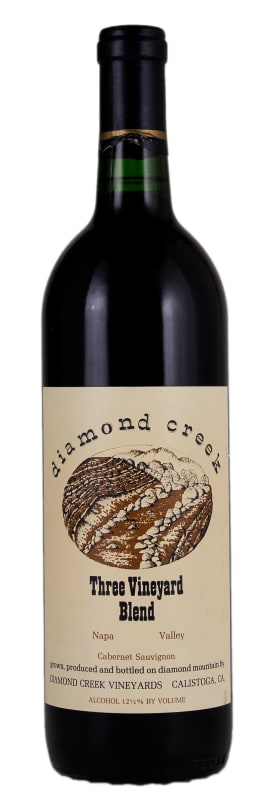


Winemaker Notes
he three vineyards produce a small amount of long-lived wines that are elegant with great depth and richness, honored and cherished by connoisseurs the world over.
Professional Ratings
-
Robert Parker's Wine Advocate
The 2013 Cabernet Sauvignon Three Vineyard Blend is composed of 90% Cabernet Sauvignon, 4% Merlot, 4% Malbec and 2% Petit Verdot coming from Volcanic Hill (70%), Red Rock Terrace (25%) and Gravelly Meadow (5%). It was aged for 22 months in French oak, 22% new.
Deep garnet in color, it struts out of the glass with flamboyant blueberry pie, baked plums, black cherries, baker's chocolate and rose oil scents with hints of cinnamon stick and rare beef. Full-bodied, rich, concentrated and powerful in the mouth, it delivers beautiful floral accents, lifting all that opulent fruit and supported by velvety tannins, finishing long with amazing energy. 300 cases were made.
-
Wine Spectator
Distinctive, with a breezy floral and herbaceous side thanks to the vibrant display of bay leaf, sassafras and savory details, melding with a denser, grippier-edged side, featuring a racy, iron-supported core of gently mulled red currant and black cherry fruit. As this knits through the finish, the interplay increases the overall volume of both elements, while pulling them together at the same time, ending with a flourish of fruit and minerality. Drink now through 2038.
-
James Suckling
Lots of terra-cotta and crushed stones with plums and hints of pine needles. Full to medium body with lovely tannins and a savory and fruity finish. Some pumice and flint. Austerity with brightness. This was a blend of the three vineyards of the estate: Red Rock, Gravelly Meadow and Volcanic Hill. Only made in a handful of years with the last year in 2013 and 2019 coming soon. A blend of 90% cabernet sauvignon, 4% merlot, 4% malbec, and 2% petit verdot.
-
Wine & Spirits
Al Brounstein always insisted on bottling his three estate vineyards separately. Phil Steinschriber quietly made a blend of the three as an experiment in a few vintages. When Nicole Carter, now in charge of the estate, tasted the 2013 with him, she decided to release a limited amount of the wine. It’s a beautiful, supple cabernet from a great vintage, a sunny grand vin with generous plum-rich fruit and mineral tannins.


A noble variety bestowed with both power and concentration, Cabernet Sauvignon enjoys success all over the globe, its best examples showing potential to age beautifully for decades. Cabernet Sauvignon flourishes in Bordeaux's Medoc where it is often blended with Merlot and smaller amounts of some combination of Cabernet Franc, Malbecand Petit Verdot. In the Napa Valley, ‘Cab’ is responsible for some of the world’s most prestigious, age-worthy and sought-after “cult” wines. Somm Secret—DNA profiling in 1997 revealed that Cabernet Sauvignon was born from a spontaneous crossing of Cabernet Franc and Sauvignon Blanc in 17th century southwest France.

Diamond Mountain is the northernmost mountain appellation in the Mayacamas Range, on the northwest side of the valley floor, above the town of Calistoga. Defined mainly by elevation, vineyards are planted at 400 to 2,200 feet.
Diamond Mountain vineyards receive plenty of sunshine at these elevations and are typically above the coastal fog line. But given its western proximity, the area still easily cools down from early morning and late afternoon Pacific Ocean breezes. The AVA (American Viticultural Area) covers 5,000 acres but just over 500 acres are under vine.
Diamond Mountain soils, mainly weathered, red sedimentary rock and decomposed, volcanic ash, are infertile, quick-draining and produce small, thick-skinned grapes, bursting with chewy tannins.
Cabernet Sauvignon, Merlot, Cabernet Franc, Malbec, Petit Verdot and Zinfandel have great success here.
Like other sub-appellations in Napa Valley, the Diamond Mountain area had no shortage of pioneer winemakers. Rudy von Strasser led the effort for Diamond Mountain to acquire AVA status in 1999.