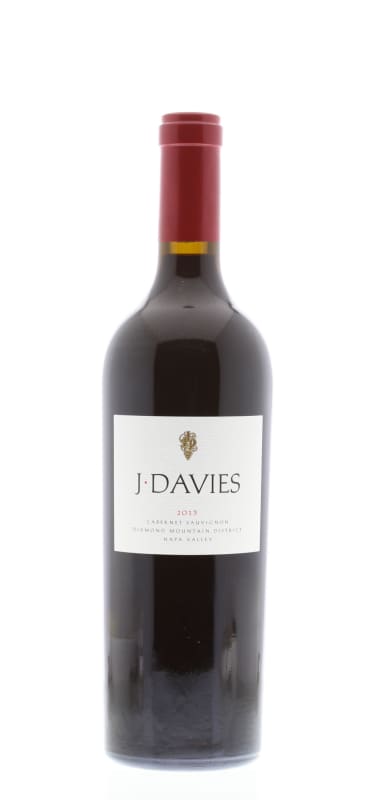


Winemaker Notes
Professional Ratings
-
Decanter
Muted black fruit and sweet raspberry aromas in an elegant, cool-climate style. Herbal hints mix with cooked red berry compote. Powerful but spicy and vigorous, with a light touch and a long, zesty finish.
-
Wine Spectator
Combines a dense, intense core of loamy earth, black licorice, anise and savory blackberry with a measure of finesse and charm. Never loses focus or stops being chewy, ending with a long, full finish. Drink now through 2030. 2,425 cases made.
-
Wine Enthusiast
Gentle tannins and a streak of black pepper stand out in this well-crafted, powerful wine. It offers up pillowy texture and just enough grip to remain seamless and compelling on the palate. Moderate acidity adds structure and brightness to the concentrated black fruit.
-
Robert Parker's Wine Advocate
The 2013 Cabernet Sauvignon J. Davies exhibits floral and black and red currant notes, background oak and earth, medium to full body, beautiful purity and a harmonious, well-balanced mouthfeel and length. Tannins are well integrated and the wine drinkable now as well as lasting and evolving for another 15 or more years.


A noble variety bestowed with both power and concentration, Cabernet Sauvignon enjoys success all over the globe, its best examples showing potential to age beautifully for decades. Cabernet Sauvignon flourishes in Bordeaux's Medoc where it is often blended with Merlot and smaller amounts of some combination of Cabernet Franc, Malbecand Petit Verdot. In the Napa Valley, ‘Cab’ is responsible for some of the world’s most prestigious, age-worthy and sought-after “cult” wines. Somm Secret—DNA profiling in 1997 revealed that Cabernet Sauvignon was born from a spontaneous crossing of Cabernet Franc and Sauvignon Blanc in 17th century southwest France.

Diamond Mountain is the northernmost mountain appellation in the Mayacamas Range, on the northwest side of the valley floor, above the town of Calistoga. Defined mainly by elevation, vineyards are planted at 400 to 2,200 feet.
Diamond Mountain vineyards receive plenty of sunshine at these elevations and are typically above the coastal fog line. But given its western proximity, the area still easily cools down from early morning and late afternoon Pacific Ocean breezes. The AVA (American Viticultural Area) covers 5,000 acres but just over 500 acres are under vine.
Diamond Mountain soils, mainly weathered, red sedimentary rock and decomposed, volcanic ash, are infertile, quick-draining and produce small, thick-skinned grapes, bursting with chewy tannins.
Cabernet Sauvignon, Merlot, Cabernet Franc, Malbec, Petit Verdot and Zinfandel have great success here.
Like other sub-appellations in Napa Valley, the Diamond Mountain area had no shortage of pioneer winemakers. Rudy von Strasser led the effort for Diamond Mountain to acquire AVA status in 1999.