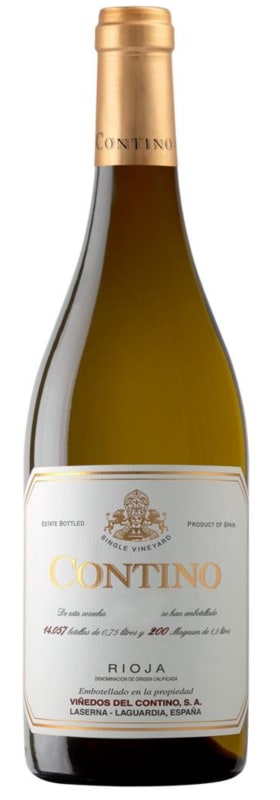


Winemaker Notes
Blend: 80% Viura, 20% Garnacha Blanca
Professional Ratings
-
James Suckling
A delicious, creamy white with aromas of apricots, baked peaches, hazelnuts, white chocolate and nougat. It’s medium-to full-bodied with a ripe and creamy palate. Lovely buttery pastry and nougat character, with a fresh finish.
-
Robert Parker's Wine Advocate
The white 2020 Blanco is a little closed, young, clean and tender with subtle oak. They produced a little bit more in 2020, and the wine has less oak and less buttery sensations, a change that started with the 2017 vintage, which seems to have found its style harvesting earlier to retain freshness; it has 13.04% alcohol and a low pH 3.23 and matured in larger oak containers, 500-liter oak barrels and some concrete for 12 months. It's floral and expressive, a blend of Viura with 20% Garnacha Blanca that they still consider work in progress but moving in the direction they want to go.



Contino, the first Rioja château 1973, impelled by CVNE and the owners of the 62-hectare property located in the Rioja Alavesa. The history of the property dates from the 16th century, and is reflected in its name. The “contino” was the officer in charge of a guard corps of a hundred soldiers who protected the royal family "de contino” (continuously) from the times of the Catholic Monarchs onwards. According to the tradition, Saint Gregory, the patron saint of vineyards, passed through the lands of this same Rioja property, giving rise to the use of his figure in the logo of this winery, and to the use of his name for some of the plots now planted with vines. The wine produced on this property, fruity and elegant, is heir to the best Rioja tradition. It is made with an individualised grape harvesting system in which only grapes from the same vineyards that surround the old manor house are used. Their origin in the various plots is noted. The perfect combination of soils, Atlantic-Mediterranean climate and refined technique have made Contino, more than 30 years after the first vintage, a reference product both in and outside Spain. The 62 hectares of Laserna vineyards in Laguardia are protected by the hill called the Cerro de la Mesa, which gives this land a characteristic orientation and mesoclimate. The hand-cut grapes are transported along a short road to the outbuildings so as to avoid damaging their qualities.

Commonly found as a single varietal white or blended with Malavasia and Grenache Blanc, Viura is a vital, leading white grape of Rioja. It also thrives in the lower elevations of the Penedes, where it takes the name Macabeo and adds aromatic and fruity notes to the traditional Cava blend with Parellada and Xarel-lo. Somm Secret—Called Macabeu in France, this versatile grape is prevalent in Roussillon where it makes still, sparkling, dry and sweet wines.

Highly regarded for distinctive and age-worthy red wines, Rioja is Spain’s most celebrated wine region. Made up of three different sub-regions of varying elevation: Rioja Alta, Rioja Alavesa and Rioja Oriental. Wines are typically a blend of fruit from all three, although specific sub-region (zonas), village (municipios) and vineyard (viñedo singular) wines can now be labeled. Rioja Alta, at the highest elevation, is considered to be the source of the brightest, most elegant fruit, while grapes from the warmer and drier Rioja Oriental produce wines with deep color and higher alcohol, which can add great body and richness to a blend.
Fresh and fruity Rioja wines labeled, Joven, (meaning young) see minimal aging before release, but more serious Rioja wines undergo multiple years in oak. Crianza and Reserva styles are aged for one year in oak, and Gran Reserva at least two, but in practice this maturation period is often quite a bit longer—up to about fifteen years.
Tempranillo provides the backbone of Rioja red wines, adding complex notes of red and black fruit, leather, toast and tobacco, while Garnacha supplies body. In smaller percentages, Graciano and Mazuelo (Carignan) often serve as “seasoning” with additional flavors and aromas. These same varieties are responsible for flavorful dry rosés.
White wines, typically balancing freshness with complexity, are made mostly from crisp, fresh Viura. Some whites are blends of Viura with aromatic Malvasia, and then barrel fermented and aged to make a more ample, richer style of white.