

Winemaker Notes
Professional Ratings
-
James Suckling
An impressive red with aromas of black cherries complemented by hints of graphite and fresh herbs. The palate is juicy and medium- to full-bodied, featuring fine-grained tannins and a long finish. Drink or hold.
-
Vinous
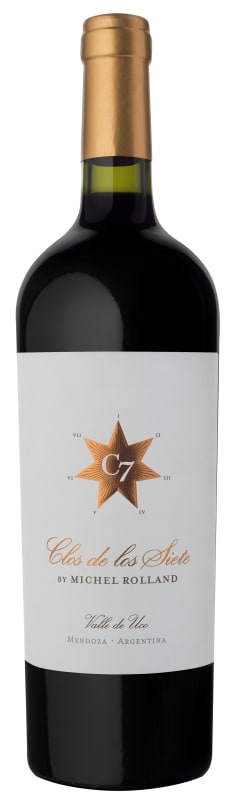
The 2022 Clos de los Siete by Michel Rolland, sourced from Campo Los Andes, comprises 63% Malbec, 18% Merlot, 9% Syrah, 5% Cabernet Sauvignon, 4% Cabernet Franc and 1% Petit Verdot. This garnet-hued wine offers delicate aromas of black fruit, herbs and balsamic hints. Indulgent, smooth and broad on the palate, it exhibits fresh energy and an enticing mild concentration, representing a modern twist on a classic. Crafted two decades ago as a collaborative blend from multiple wineries, Clos de los Siete by Michel Rolland continues to showcase astonishing craftsmanship, producing nearly a million bottles per year.





C7 is the ultimate blend crafted by world renowned Master Blender, Michel Rolland. Michel discovered a special plot of land in Argentina, located at the foot of the Andes Mountains in the Uco Valley. With six other friends, Michel created the vineyard of 7, Clos de los Siete. Intrigued by its unique combination of high altitude, well drained soils, optimal aspect and dry climate, Michel was certain this land would be optimal for growing a variety of Bordeaux grapes, particularly Malbec.
Having worked with over 150 wineries across 13 countries, Michel is now the most famous consulting winemaker in the world. Today, we celebrate 20 years of Michel having founded C7 and planting his first vines in the Uco Valley.

With hundreds of red grape varieties to choose from, winemakers have the freedom to create a virtually endless assortment of blended red wines. In many European regions, strict laws are in place determining the set of varieties that may be used, but in the New World, experimentation is permitted and encouraged resulting in a wide variety of red wine styles. Blending can be utilized to enhance balance or create complexity, lending different layers of flavors and aromas. For example, a red wine blend variety that creates a fruity and full-bodied wine would do well combined with one that is naturally high in acidity and tannins. Sometimes small amounts of a particular variety are added to boost color or aromatics. Blending can take place before or after fermentation, with the latter, more popular option giving more control to the winemaker over the final qualities of the wine.
How to Serve Red Wine
A common piece of advice is to serve red wine at “room temperature,” but this suggestion is imprecise. After all, room temperature in January is likely to be quite different than in August, even considering the possible effect of central heating and air conditioning systems. The proper temperature to aim for is 55° F to 60° F for lighter-bodied reds and 60° F to 65° F for fuller-bodied wines.
How Long Does Red Wine Last?
Once opened and re-corked, a bottle stored in a cool, dark environment (like your fridge) will stay fresh and nicely drinkable for a day or two. There are products available that can extend that period by a couple of days. As for unopened bottles, optimal storage means keeping them on their sides in a moderately humid environment at about 57° F. Red wines stored in this manner will stay good – and possibly improve – for anywhere from one year to multiple decades. Assessing how long to hold on to a bottle is a complicated science. If you are planning long-term storage of your reds, seek the advice of a wine professional.

With a winning combination of cool weather, high elevation and well-draining alluvial soils, it is no surprise that Mendoza’s Uco Valley is one of the most exciting up-and-coming wine regions in Argentina. Healthy, easy-to-manage vines produce low yields of high-quality fruit, which in turn create flavorful, full-bodied wines with generous acidity.
This is the source of some of the best Malbec in Mendoza, which can range from value-priced to ultra-premium. Cabernet Sauvignon, Cabernet Franc and Chardonnay also perform well here.