


Winemaker Notes
Renowned as one of the world’s most elegant wines, the character of Château Haut-Bailly is a series of unlikely paradoxes. It is as complex as it is balanced: deliberate and discrete, powerful and gentle, immediate and timeless. Each vintage is unique and true to itself just as each vintage is consistent and true to the unquestionable character of Haut-Bailly.
Professional Ratings
-
Jeb Dunnuck
From healthy yields and a blend of 58% Cabernet Sauvignon, 34% Merlot, 4% Petit Verdot, and the rest Cabernet Franc aged 16 months in 50% new French oak, the 2023 Château Haut-Bailly is an ultra-classy Haut-Bailly with its layered, round, seamless elegance. Ripe black cherries, currants, leafy tobacco, spring flowers, and graphite all emerge from this beauty, and it's medium to full-bodied, round, and remarkably complete and flawlessly balanced on the palate. It has fine tannins, integrated acidity, and a great finish. Gorgeous all the way, it will benefit from 4-5 years of bottle age and cruise over the following three decades.
-
James Suckling
A near perfect example of this wine. Amazing aromas of oyster shells, iodine, stones, smoke, blueberries, blackberries, ash and graphite. Medium-bodied with firm and racy tannins on the center palate, giving tension and stature. The phenolics are thick and silky in texture. Persistent finish that suggests greatness. 58% cabernet sauvignon, 34% merlot, 4% cabernet franc and 4% petit verdot.
-
Vinous
The 2023 Haut-Bailly was picked from September 11 to 29 at 40.5hL/ha. It is being raised in 50% new oak for a planned 14 months, plus another three in vats. Véronique Sanders told me that there is 6% vin de presse in the blend this year. This has a beguiling bouquet that instantly switches on a metaphorical neon sign that announces you are in the presence of a very serious wine. Extremely pure and delineated, the nose presents aromas of blackberry mixed with wild strawberry, cedar and light sous-bois. It's much more classical in style compared to the 2022. The palate is medium-bodied with fine-grained tannins that frame the blackberry, raspberry, cedar and graphite-infused fruit. It boasts more grip and persistency on the finish than its peers, with a residual subtle pinch of black pepper. This ranks as one of the standout wines in Pessac-Léognan, perhaps in Bordeaux itself. Outstanding. –Neal Martin
Barrel Sample: 96-98 -
Decanter
Such pretty aromatics, gorgeous florally on the nose - roses and peonies, blackcurrant leaf, cranberries and cherries with some plum and black chocolate too. Soft and smooth, sumptuous like Haut-Bailly usually is. Juicy and plump for the vintage, it keeps its defined frame thanks to fine tannins with slightly sharp edges but it also has some softness with ripe fruit and lots of freshness. This is a real success, slightly hot on the finish and a little toasted but this has finesse and complexity with layered of flavour and texture. Stylish and confident. 3.75ph. 6% press wine. 55% grand vin production. Ageing 14-15 months, 50% new oak. 4% Petit Verdot completes the blend.
Barrel Sample: 96 -
Robert Parker's Wine Advocate
A blend of 58% Cabernet Sauvignon (harvested from the 20th to the 29th of September), 34% Merlot, 4% Cabernet Franc and 4% Petit Verdot, the 2023 Haut-Bailly offers up aromas of mulberries, cassis, dark wild berries, pencil lead, licorice and spices, followed by a medium to full-bodied, concentrated and rich palate that is both layered and seamless, its deep mid-palate animated by lively acids, concluding with long, mineral, penetrating finish. Although it displays a darker, more brooding profile character than in previous years, it remains highly representative of its terroir and will benefit from some patience. It's being matured in 50% new oak.
Barrel Sample: 94-96


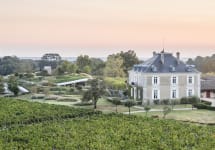
The vineyard of Haut-Bailly as we know it today began to take shape when the Goyanèche and then the Daitze family acquired and unified the best vine growing plots in the 1530s. The estate remained in the Daitze Family until 1630 when it was purchased by Firmin Le Bailly and Nicolas de Leuvarde, wealthy Parisian bankers and lovers of Graves wines.
Following substantial investments, the property continued to be passed down the Bailly family line until 1736, when Irishman Thomas Barton took the helm. His strong business network allowed him to spread word about the quality of Chateau Haut-Bailly at a time when French ‘claret' was beginning its rise to stardom in England and Ireland.
Throughout the 18th century powerful, well-connected and ambitious owners drove Haut-Bailly to new heights, including Christophe Lafaurie de Monbadon and his son Laurent who went on to become Mayor of Bordeaux in 1805.
In 1872, Alcide Bellot des Minières acquired the estate and constructed the imposing, stone chateau building that remains to this day. He pioneered a precise, science-driven approach to viticulture, becoming a figure of legend widely known as the 'King of Vintners'. Thanks to Alcide's incredible drive, Haut-Bailly experienced a remarkable golden age, commanding the same prices as the First Growths: Lafite, Latour, Margaux and Haut-Brion.
The purchase of Haut-Bailly in 1955 by Daniel Sanders, a Belgian negociant, opened up a new era. Daniel and his son, Jean, recomposed the vineyard, renovated the winery and took pains to select only grapes from the best vines for their grand vin. They succeeded in giving the wines a unique style and reputation, and Haut-Bailly recovered its image as a great wine on the international marketplace.
In July 1998 Chateau Haut-Bailly was purchased by American Robert G. Wilmers, chairman and CEO of the M&T Bank based in Buffalo, New York. A lifelong lover of Bordeaux Grands Crus, Bob was behind every strategic decision, ensuring that Haut-Bailly followed a path of progression and continuity whilst remaining ever-respectful of its heritage.
After Mr. Wilmers purchased the property, he first asked Jean Sanders to stay on board, and then Véronique Sanders, fourth generation, to serve as general manager, overseeing a far-reaching investment programme to modernise the vineyards, cellars, offices, and chateau itself.
For Bob and his wife Elisabeth, Haut-Bailly went well beyond a financial investment: it was a joint passion. Following the sad passing of Bob in December 2017, his family has taken over and will continue in his footsteps. Together with the management team, they are committed to continuing Bob’s work in the same spirit and energy as in the past twenty years. The many recently initiated and future projects will be pursued.
With the 2021 vintage, Chateau Haut-Bailly debuted a contemporary, custom-built winery which was completed at the end of 2020. The building allows them to carry out precision work in optimal conditions thanks to the space, natural light and technical innovation which are at the heart of the project.

One of the world’s most classic and popular styles of red wine, Bordeaux-inspired blends have spread from their homeland in France to nearly every corner of the New World. Typically based on either Cabernet Sauvignon or Merlot and supported by Cabernet Franc, Malbec and Petit Verdot, the best of these are densely hued, fragrant, full of fruit and boast a structure that begs for cellar time. Somm Secret—Blends from Bordeaux are generally earthier compared to those from the New World, which tend to be fruit-dominant.

Recognized for its superior reds as well as whites, Pessac-Léognan on the Left Bank claims classified growths for both—making it quite unique in comparison to its neighboring Médoc properties.
Pessac’s Chateau Haut-Brion, the only first growth located outside of the Médoc, is said to have been the first to conceptualize fine red wine in Bordeaux back in the late 1600s. The estate, along with its high-esteemed neighbors, La Mission Haut-Brion, Les Carmes Haut-Brion, Pique-Caillou and Chateau Pape-Clément are today all but enveloped by the city of Bordeaux. The rest of the vineyards of Pessac-Léognan are in clearings of heavily forested area or abutting dense suburbs.
Arid sand and gravel on top of clay and limestone make the area unique and conducive to growing Sémillon and Sauvignon blanc as well as the grapes in the usual Left Bank red recipe: Cabernet Sauvignon, Merlot, Cabernet Franc and miniscule percentages of Petit Verdot and Malbec.
The best reds will show great force and finesse with inky blue and black fruit, mushroom, forest, tobacco, iodine and a smooth and intriguing texture.
Its best whites show complexity, longevity and no lack of exotic twists on citrus, tropical and stone fruit with pronounced floral and spice characteristics.