

Winemaker Notes
Professional Ratings
-
Robert Parker's Wine Advocate
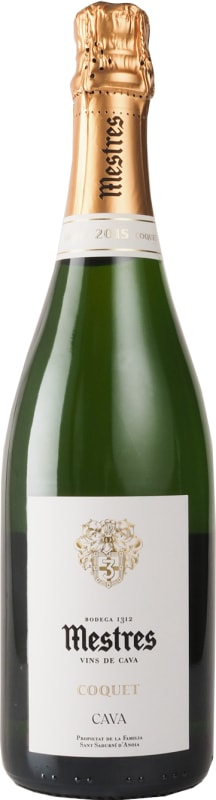
The 2017 Coquet Gran Reserva Brut Nature was released with no less than 48 months in bottle with lees, but all bottles have the disgorgement date on the back label and the last bottles can have up to 54 months. 2017 was a dry vintage (the last of three: 2015, 2016, 2017), and the wine reflects it, within their levels of freshness, with 12% alcohol, a pH of 3.1 and 5.65 grams of acidity. They look for a house style, a structure and small bubbles, and this entry-level bottling is more complex and older than the great majority of Cava wines. This is their only wine that does not spend time in barrel, but the wine in bottle is aged under cork, which makes a difference when you are talking about long aging in bottle; it might not be worth it for a short élevage, but it does for a long one. The disgorgement of the bottles is all by hand and without freezing the lees. This is a superb entry-level wine that is also released in magnum (the current vintage for the magnums is 2016). It's clean and intense, with very small bubbles, pungent flavors, dry, serious and elegant. 50,354 bottles produced. The bottle I tasted was disgorged in April 2022.


Representing the topmost expression of a Champagne house, a vintage Champagne is one made from the produce of a single, superior harvest year. Vintage Champagnes account for a mere 5% of total Champagne production and are produced about three times in a decade. Champagne is typically made as a blend of multiple years in order to preserve the house style; these will have non-vintage, or simply, NV on the label. The term, "vintage," as it applies to all wine, simply means a single harvest year.

What is Cava?
Spain adopted the word, cava, which technically means ‘cellar’ in Catalan, to describe their sparkling wines made using the traditional method. While this style was first created outside of Spain in the 1600s, its birthplace inside of Spain came in 1872 when Jose Raventós of Codorníu first produced traditional method sparkling wine in the town of San Sadurní d’Anoia. Uniquely, the Cava denomination isn’t restricted to one geographical area but rather, it spans eight total wine regions. However, about 90% of Spain’s total production of Cava, Spanish sparkling wine happens within Catalonia, and about 75% is produced within the borders of San Sadurní d’Anoia, inside the smaller Catalan region of Penedès. In 2019, Spain registered nearly 38,000 hectares of vineyards for Cava production, compared to just under 34,000 in Champagne.
How is Cava sparkling wine made?
Cava, like many other sparkling wines of the world is made using the traditional method, or "Champagne method," or método tradicional in Spanish, in which the second fermentation (the one that makes the bubbles) takes place inside the bottle. With this method, spent yeast cells remain in contact with the wine during bottle aging, giving it a creamy mouthful, a toasted bread or brioche quality and in many cases, the capacity to age.
What are the Cava wine grapes?
The mainstay Cava grape varieties include Macabeo, Parellada, and Xarel-lo. Macabeo, also known as Viura, lends pleasant aromatics to the blend, while Parellada adds acidity and finesse. Xarel-lo is the grape that gives body, earth and greengage characteristics to Cava. Occasionally Chardonnay is used as a blending grape or sole variety in making Cava wine. Governmental inclusion approval was awarded in 1986 but still, Chardonnay makes up only a fraction of total vineyard area. For rosé, in Spanish called rosado, the local Trepat and Garnacha can be used, along with Pinot Noir (first permitted in 1998 for rosado and in 2007 for white Cavas).
Cava Tasting Profile
Since Cava is a sparkling wine produced on the Mediterranean where temperatures are warmer and there is more sunshine compared with Champagne, you can expect that Cava sparkling wine will generally have a gentler acid profile compared with its French counterpart. Furthermore, especially when the indigenous varieties are used, common Cava flavors will include citrus peel, fennel, wildflower, lemon blossom and flint or saline. Most Cava is produced in the Brut style, so dry, with a slightly rounder finish that balances brightness with brioche notes and supple fruit. Brut Nature or Zero Dosage examples are bone dry, whereas Extra-Dry Cava will be slightly sweet and a Demi-Sec Cava will have the highest sweetness level.
Cava Pairings
One of the best things about pairing Cava wine is you can drink it on its own or with just about any food! But if you want to focus on bringing out Cava's uniquely brilliant bouquet and citrus notes, rich or seafood-centric dishes are perfect food pairings for Cava. Try Cava with butter poached lobster, seafood risotto, puff pastry and caramelized onions or fried chicken.