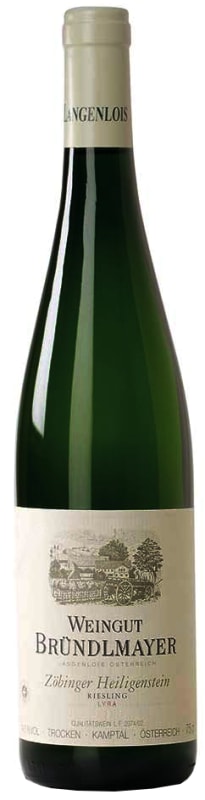


Winemaker Notes
Professional Ratings
-
Robert Parker's Wine Advocate
Pure, fresh and crystalline, with a dash of lemon perfume, sandstone flavors and good concentration starts the 2014 Riesling Heiligenstein Lyra 1ÖTW on the nose. Medium-bodied but dense and very mineral, this is a pure, finesse-full and refreshing Heiligenstein with a lot of tension, structure and salt. This is one of the highlights of this vintage along the Danube. Very long, intense and complex, but always fresh and vibrant.
Rating: 93+ -
Decanter
Tight but juicy lime and green apple flavours linger on an intense and long finish, joined by a touch of honey and stoniness. This 'premier cru' should age really well thanks to the zesty acidity, fruit intensity and residual sugar (five grams per litre).


Riesling possesses a remarkable ability to reflect the character of wherever it is grown while still maintaining its identity. A regal variety of incredible purity and precision, this versatile grape can be just as enjoyable dry or sweet, young or old, still or sparkling and can age longer than nearly any other white variety. Somm Secret—Given how difficult it is to discern the level of sweetness in a Riesling from the label, here are some clues to find the dry ones. First, look for the world “trocken.” (“Halbtrocken” or “feinherb” mean off-dry.) Also a higher abv usually indicates a drier Riesling.

Climbing north and slightly east of the Kremstal region, Kamptal has very little vineyard area bordering the Danube River (unlike Wachau and Kremstal, whose vineyards run along it). The region takes its name from the river called Kamp, which traverses it north and south. Kamptal’s densely planted vineyards represent eight percent of Austria’s total.
The area experiences wide diurnal temperature variations like the Wachau but with less rain and more frost. Its vast geologic diversity makes it suitable for various experimentations with other varieties besides Grüner Veltliner and Riesling, such as Chardonnay, Pinot Blanc (Weissburgunder), Sauvignon Blanc, Pinot Noir, St. Laurent and Zweigelt.
But the region is probably most noted for the beautiful and expansive terraced Heiligenstein, arguably one of the world’s top Riesling sites, as well as some of Austria’s most extraordinary Grüner Veltliner vineyards. Kamptal’s soils, which are mostly loess and sand with some gravel and rocks, make it suitable for Grüner Veltliner, so much so that actually half of the zone is planted to that grape.