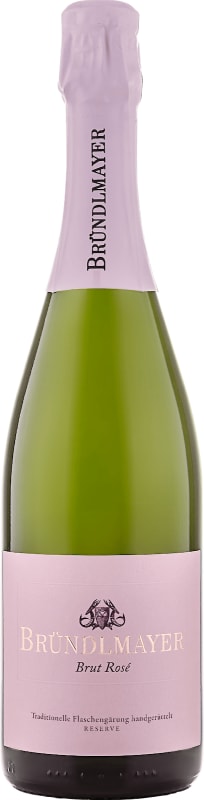


Winemaker Notes
Light salmon hue with red-golden reflections. A fine persistent mousse, delicate but very animated. The fruit & spice aroma gives undertones of cherries and wild strawberries, a bit of citrus and caramel and yeast notes. Fruity and creamy with an underlying complexity on the palate; also elegant acidity and a minerally extract. Remarkably harmonious structure.
Professional Ratings
-
James Suckling
So fresh and vibrant, with fine raspberry aromas. Very bright and elegant on the barely medium-bodied palate. So animating and refreshing in the long, very clean finish, thanks to the lively mousse. A cuvee of 40% zweigelt, 30% sankt laurent and 30% pinot noir. Based on the 2020 vintage, with 20% reserve wines.
-
Robert Parker's Wine Advocate
Disgorged after three years sur lattes in April this year, Bründlmayer's NV Brut Rosé Reserve is an assemblage of separately fermented Blauburgunder (a.k.a. Pinot Noir), Zweigelt and St. Laurent. Predominantly based on the 2018 harvest, the wine has a bright salmon color and opens with a clear and intense yet pure and very elegant bouquet of red fruit aromas with floral as well as whole-grain bread notes. Round and intense on the palate, this is a mouth-filling, rich and fruity but pure, fresh and elegant, well-structured and saline-finishing rosé Brut that doesn't taste as light as the stated alcohol volume of 11.5% might persuade, but it reflects the 2018 vintage on a very high level. Best after 2022.
-
Wine Enthusiast
Firm and elegant, with fine mousse and a nice smoky note framing the core of white cherry and pomegranate. A touch of smoke and a lively texture makes it interesting.


A term typically reserved for Champagne and Sparkling Wines, non-vintage or simply “NV” on a label indicates a blend of finished wines from different vintages (years of harvest). To make non-vintage Champagne, typically the current year’s harvest (in other words, the current vintage) forms the base of the blend. Finished wines from previous years, called “vins de reserve” are blended in at approximately 10-50% of the total volume in order to achieve the flavor, complexity, body and acidity for the desired house style. A tiny proportion of Champagnes are made from a single vintage.
There are also some very large production still wines that may not claim one particular vintage. This would be at the discretion of the winemaker’s goals for character of the final wine.

Climbing north and slightly east of the Kremstal region, Kamptal has very little vineyard area bordering the Danube River (unlike Wachau and Kremstal, whose vineyards run along it). The region takes its name from the river called Kamp, which traverses it north and south. Kamptal’s densely planted vineyards represent eight percent of Austria’s total.
The area experiences wide diurnal temperature variations like the Wachau but with less rain and more frost. Its vast geologic diversity makes it suitable for various experimentations with other varieties besides Grüner Veltliner and Riesling, such as Chardonnay, Pinot Blanc (Weissburgunder), Sauvignon Blanc, Pinot Noir, St. Laurent and Zweigelt.
But the region is probably most noted for the beautiful and expansive terraced Heiligenstein, arguably one of the world’s top Riesling sites, as well as some of Austria’s most extraordinary Grüner Veltliner vineyards. Kamptal’s soils, which are mostly loess and sand with some gravel and rocks, make it suitable for Grüner Veltliner, so much so that actually half of the zone is planted to that grape.