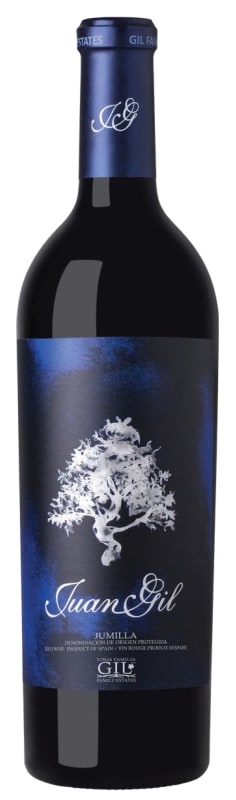


Winemaker Notes
Juan Gil Blue Label is a blend of hand-selected grapes from older parcels, averaging 75 years with low yields. Parcels are fermented separately in stainless steel tanks and aged 18 months in new French and American oak barrels separately before blending. The wine is a red cherry color with garnet rim and powerful aroma of black fruits, roasted and balsamic notes. Complex and well-structured, unctuous and rounded, pleasant mouth-feel and very persistent with roasted, cocoa and spice hints. Balanced and harmonious, tasty, long and elegant finish marked by the sweetness from noble tannins of very ripe fruits, displaying its potential for bottle aging.
Vegan-Friendly
Professional Ratings
-
Robert Parker's Wine Advocate
Since 2022, there's also a Cuvée À with a blue label, and that wine is partly aged in amphorae, but this is the regular 2023 Blue Label, matured 100% in French and American oak barrels of different sizes—220, 300, 500 and 600 liters—but some years ago, they reduced the toast and looked for coopers who made barrels that marked the wine less. This was produced with a blend of 60% Monastrell, 30% Cabernet Sauvignon and 10% Syrah aged for 18 months in barrel. It's spicy, toasty and smoky, with notes of vanilla and cinnamon, ripe berry fruit and Mediterranean herbs. It's ripe at 15% alcohol (which is slightly lower than in 2022), with a pH of 3.75, 5.7 grams of acidity and 2.7 grams of residual sugar. It's medium- to full-bodied with abundant, fine-grained tannins and abundant oak-related flavors. Rating: 92+
-
Vinous
The 2023 Blue Label combines 60% Monastrell, 30% Cabernet Sauvignon and 10% Syrah from Jumilla. It was aged 18 months in French and American oak barrels. Intensely oaky on the nose, with vanilla and toasted notes, it is also dominated on the palate by wood, smoke and gripping tannins. This recalls a style from another era.





Bodegas Juan Gil is the Gil Family Estate's flagship winery, founded in 1916 by Juan Gil Giménez. Over 107 years, the winery has been consolidated and improved, applying technological advancements to the traditional knowledge passed down through the years. Today the 4th and 5th generations of the Gil family run the winery and group. Located in Southeastern Spain, about 60 miles from the Mediterranean coast, the region experiences a continental climate which is quite extreme: summers are hot with intense sun and winter is long and cold. Diurnal temperature fluctuations are also extreme and rainfall is limited to about 12 inches per year. The vineyards are planted between 2,000 and 2,800 feet above sea level on sandy and rocky limestone soils that are very poor in nutrients, but have a great capacity to hold what little rain does fall. Organic and dry farming is quite typical in Jumilla due to these conditions. Jumilla is known for Monastrell, with over 80% of vineyards planted with it. The Gil family's vineyards are between 40 and 100 years old with very low yields (aprox. 2,200 lb/ac). Monastrell is a thick-skin grape that thrives in the harsh conditions of the climate and terrain of Jumilla, leading to wines with great structure and intense color and complex aromas.
All of the Gil family's estate vineyards are dry-farmed without the use of any pesticides or herbicides and the winery is fully solar powered and "Zero-Waste" (by product is composted, water recycled). The addition of sulfites is kept to the bare minimum to conserve the wines and no other additives are used. The Gil family's commitment to sustainable farming and winemaking doesn't stop there; they are also Gold members of the International Wineries for Climate Action, an international organization which holds the ambitious goal of reaching Net Zero emissions by 2050, all of which requires investments in renewable energy, further shifting agricultural and business practices to reduce their carbon footprint, as well as instilling a culture of sustainability across all aspects of their business.

With hundreds of red grape varieties to choose from, winemakers have the freedom to create a virtually endless assortment of blended red wines. In many European regions, strict laws are in place determining the set of varieties that may be used, but in the New World, experimentation is permitted and encouraged resulting in a wide variety of red wine styles. Blending can be utilized to enhance balance or create complexity, lending different layers of flavors and aromas. For example, a red wine blend variety that creates a fruity and full-bodied wine would do well combined with one that is naturally high in acidity and tannins. Sometimes small amounts of a particular variety are added to boost color or aromatics. Blending can take place before or after fermentation, with the latter, more popular option giving more control to the winemaker over the final qualities of the wine.
How to Serve Red Wine
A common piece of advice is to serve red wine at “room temperature,” but this suggestion is imprecise. After all, room temperature in January is likely to be quite different than in August, even considering the possible effect of central heating and air conditioning systems. The proper temperature to aim for is 55° F to 60° F for lighter-bodied reds and 60° F to 65° F for fuller-bodied wines.
How Long Does Red Wine Last?
Once opened and re-corked, a bottle stored in a cool, dark environment (like your fridge) will stay fresh and nicely drinkable for a day or two. There are products available that can extend that period by a couple of days. As for unopened bottles, optimal storage means keeping them on their sides in a moderately humid environment at about 57° F. Red wines stored in this manner will stay good – and possibly improve – for anywhere from one year to multiple decades. Assessing how long to hold on to a bottle is a complicated science. If you are planning long-term storage of your reds, seek the advice of a wine professional.

Famous for the robust and earthy, black-fruit dominated, Monastrell (known as Mourvedre in France), Jumilla is an arid and hot region in southeastern Spain. Its vine yields tend to be torturously low but this can create wines of exceptional intensity and flavor. Quality combined with accessible price points give the region great recognition on international markets far and wide.
The reds from Jumilla are heady and spicy, packed with fruit and show aromas of dried licorice and herbs. If you like Syrah, Grenache or Pinot noir, a red wine from Jumilla would be a perfect next choice!