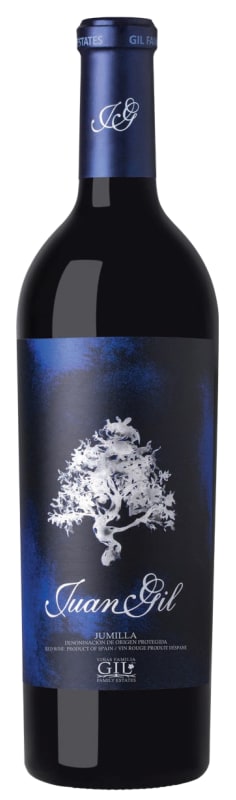


Winemaker Notes
Brilliant red in the glass. A light roasted aroma complemented by fresh berries. Savory notes of earth and black tea balanced with a rich core of black fruits. Round tannins, good acidity.
The Monastrell vineyards used to produce this wine are situated at an elevation of 2,800 feet above sea level with an average vine age of 55 years. They are situated on chalky and sandy hillside soils with excellent drainage, allowing them to ripen in optimal conditions. The production does not exceed one ton per acre. The Cabernet and Syrah vineyards are located at 2,300 feet above sea level with an average vine age of 15 years. The fermentation is carried out separately in small open tank fermenters. The wine is then aged for 18 months in new French and American oak barrels.
Blend: 60% Monastrell, 30% Cabernet Sauvignon & 10% Syrah
Dry-farmed, no pesticides or herbicides, hand-harvested, Vegan.
Professional Ratings
-
Robert Parker's Wine Advocate
I also tasted the 2019 Juan Gil (blue label), the wine formerly known as 18 Months, the time it spends in barrel. They use 100% new oak that is a mixture of French and American. The wine is ripe, oaky and heady (15.5% alcohol), but I felt a change in the oak, which seemed more integrated. When I asked Miguel Gil, he told me they had changed the toast, using less toasted barrels, from medium+ to medium, and that shows in the wine. They still believe this wine should have new oak to give it aging potential. They have also introduced optical sorting of the grapes and eliminate the raisins (by shape) and the unripe grains (by color), and that adds precision and cleanliness. 30,000 bottles were produced. It was bottled in June 2021. Rating: 92+
-
Wine Enthusiast
Deep ruby to the eye, this wine has a bouquet of black currant and mocha. It is smooth at first sip, and then opulent tannins fill the mouth, offering a backdrop for flavors of cherry, raspberry, milk chocolate and menthol that slowly recede into a soft, minty finish.
-
Wine Spectator
A sleek and layered red, featuring a concentrated range of blackberry coulis, fig cake and mocha notes, with aromatic accents of candied violet, dried thyme and minerals. Balanced and fresh, with juicy acidity and sculpted tannins that create a firm impression on the spiced finish. Monastrell, Cabernet Sauvignon and Syrah. Best from 2024.





Bodegas Juan Gil is the Gil Family Estate's flagship winery, founded in 1916 by Juan Gil Giménez. Over 107 years, the winery has been consolidated and improved, applying technological advancements to the traditional knowledge passed down through the years. Today the 4th and 5th generations of the Gil family run the winery and group. Located in Southeastern Spain, about 60 miles from the Mediterranean coast, the region experiences a continental climate which is quite extreme: summers are hot with intense sun and winter is long and cold. Diurnal temperature fluctuations are also extreme and rainfall is limited to about 12 inches per year. The vineyards are planted between 2,000 and 2,800 feet above sea level on sandy and rocky limestone soils that are very poor in nutrients, but have a great capacity to hold what little rain does fall. Organic and dry farming is quite typical in Jumilla due to these conditions. Jumilla is known for Monastrell, with over 80% of vineyards planted with it. The Gil family's vineyards are between 40 and 100 years old with very low yields (aprox. 2,200 lb/ac). Monastrell is a thick-skin grape that thrives in the harsh conditions of the climate and terrain of Jumilla, leading to wines with great structure and intense color and complex aromas.
All of the Gil family's estate vineyards are dry-farmed without the use of any pesticides or herbicides and the winery is fully solar powered and "Zero-Waste" (by product is composted, water recycled). The addition of sulfites is kept to the bare minimum to conserve the wines and no other additives are used. The Gil family's commitment to sustainable farming and winemaking doesn't stop there; they are also Gold members of the International Wineries for Climate Action, an international organization which holds the ambitious goal of reaching Net Zero emissions by 2050, all of which requires investments in renewable energy, further shifting agricultural and business practices to reduce their carbon footprint, as well as instilling a culture of sustainability across all aspects of their business.

With hundreds of red grape varieties to choose from, winemakers have the freedom to create a virtually endless assortment of blended red wines. In many European regions, strict laws are in place determining the set of varieties that may be used, but in the New World, experimentation is permitted and encouraged resulting in a wide variety of red wine styles. Blending can be utilized to enhance balance or create complexity, lending different layers of flavors and aromas. For example, a red wine blend variety that creates a fruity and full-bodied wine would do well combined with one that is naturally high in acidity and tannins. Sometimes small amounts of a particular variety are added to boost color or aromatics. Blending can take place before or after fermentation, with the latter, more popular option giving more control to the winemaker over the final qualities of the wine.
How to Serve Red Wine
A common piece of advice is to serve red wine at “room temperature,” but this suggestion is imprecise. After all, room temperature in January is likely to be quite different than in August, even considering the possible effect of central heating and air conditioning systems. The proper temperature to aim for is 55° F to 60° F for lighter-bodied reds and 60° F to 65° F for fuller-bodied wines.
How Long Does Red Wine Last?
Once opened and re-corked, a bottle stored in a cool, dark environment (like your fridge) will stay fresh and nicely drinkable for a day or two. There are products available that can extend that period by a couple of days. As for unopened bottles, optimal storage means keeping them on their sides in a moderately humid environment at about 57° F. Red wines stored in this manner will stay good – and possibly improve – for anywhere from one year to multiple decades. Assessing how long to hold on to a bottle is a complicated science. If you are planning long-term storage of your reds, seek the advice of a wine professional.

Famous for the robust and earthy, black-fruit dominated, Monastrell (known as Mourvedre in France), Jumilla is an arid and hot region in southeastern Spain. Its vine yields tend to be torturously low but this can create wines of exceptional intensity and flavor. Quality combined with accessible price points give the region great recognition on international markets far and wide.
The reds from Jumilla are heady and spicy, packed with fruit and show aromas of dried licorice and herbs. If you like Syrah, Grenache or Pinot noir, a red wine from Jumilla would be a perfect next choice!