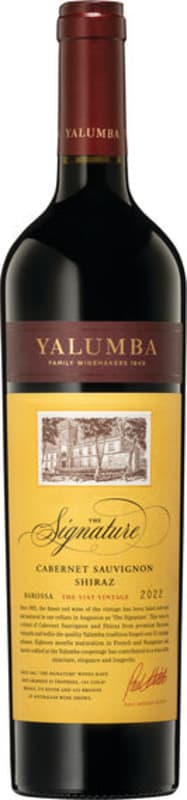


Winemaker Notes
A beautiful, deep, dense red in color. Well defined aromatics reflect the cool season. Perfumed red and purple berries, red licorice, blackcurrant and black cherries with cedar, mint and subtle herbaceous notes. Inviting and appealing freshness with hints of bay leaf and toasted spice layers along the palate. Full bodied, rich and concentrated with fine, flowing tannins and lovely texture in perfect harmony.
Blend: 51% Cabernet Sauvignon, 49% Shiraz
Professional Ratings
-
Robert Parker's Wine Advocate
The 2022 The Signature Cabernet Sauvignon Shiraz is so pretty—floral, red fruited and fine. This is a beautiful iteration of this wine. Ironically, there's a coastal freshness about it—kelp, brine, crushed shells—given it is nowhere near the coast. It's capacious and mineral and so fresh. The tannins are fine and neat, and the wine has incredible focus and line through the long finish. It's very impressive, potentially one of my favorite releases of this wine to date. It has wholly Barossa fruit this vintage. 14.5% alcohol, sealed under natural cork.
-
Australian Wine Companion
Yalumba's famous Signature cabernet sauvignon and shiraz blend has a strong pedigree when it comes to cellaring and the 2022 release will certainly carry on long into the future. The fruit density and purity here are impressive. Blackberry, doris plum and black cherry tones, their flow elegant and graceful across the palate with hints of spice, cedar, tobacco, pencil shavings, roasting meats, dried herbs and olive tapenade. Fine-grained tannins are in abundance and there is an extended finish that rolls on and on. It's a super release.
-
James Suckling
Savory aromas of blackcurrants, cedar, tobacco leaves, ferrous earth and bitter chocolate. The palate is full-bodied with firmly framed tannins, a long, persisting finish and lingering notes of blackberries, blood plums and walnuts. A serious wine that is built to last for years in the bottle. Drink or hold.
-
Vinous
This beautifully composed 2022 The Signature delivers excellent fruit definition and youthful complexity, opening up with blackberry, blackcurrant and new leather lined with dried mint, buttressed by impressive oak. It has great overall shape with firm, structural tannins and compact yet powerful layers of flavors balanced and holding true over a finish of exceptional length.
-
Decanter
The remarkable consistency of The Signature over decades stands as a testament to Yalumba’s ability to keep finding superb Cabernet in the Barossa each year, even when this variety has a notoriously fickle temperament in dry vintages. The low-cropping 2022 vintage provided intense flavours, giving this wine rich character and a stern demeanour. Uncharacteristically, it shows more assertive Shiraz personality in its youth, offering dark power and deep, grinding bass notes through the mid-palate. The comforting warmth of savoury-edged Barossa Cabernet Sauvignon remains a significant contributor however. Its sturdy tannin profile suggests it will change with age in the cellar, when its Cabernet influence is likely to make a rich savoury mid-palate come into bloom.
-
Wine Spectator
This opulent red is distinctive, with violet, black olive, sandalwood and fresh rose petal notes. Whiffs of green cardamom complement the rich flavors of blackberry and huckleberry, showing additional accents of star anise, bittersweet chocolate and black licorice. The tannins are concentrated but fully integrated, giving length and plushness. Cabernet Sauvignon and Shiraz.


With hundreds of red grape varieties to choose from, winemakers have the freedom to create a virtually endless assortment of blended red wines. In many European regions, strict laws are in place determining the set of varieties that may be used, but in the New World, experimentation is permitted and encouraged resulting in a wide variety of red wine styles. Blending can be utilized to enhance balance or create complexity, lending different layers of flavors and aromas. For example, a red wine blend variety that creates a fruity and full-bodied wine would do well combined with one that is naturally high in acidity and tannins. Sometimes small amounts of a particular variety are added to boost color or aromatics. Blending can take place before or after fermentation, with the latter, more popular option giving more control to the winemaker over the final qualities of the wine.
How to Serve Red Wine
A common piece of advice is to serve red wine at “room temperature,” but this suggestion is imprecise. After all, room temperature in January is likely to be quite different than in August, even considering the possible effect of central heating and air conditioning systems. The proper temperature to aim for is 55° F to 60° F for lighter-bodied reds and 60° F to 65° F for fuller-bodied wines.
How Long Does Red Wine Last?
Once opened and re-corked, a bottle stored in a cool, dark environment (like your fridge) will stay fresh and nicely drinkable for a day or two. There are products available that can extend that period by a couple of days. As for unopened bottles, optimal storage means keeping them on their sides in a moderately humid environment at about 57° F. Red wines stored in this manner will stay good – and possibly improve – for anywhere from one year to multiple decades. Assessing how long to hold on to a bottle is a complicated science. If you are planning long-term storage of your reds, seek the advice of a wine professional.

Historically and presently the most important wine-producing region of Australia, the Barossa Valley is set in the Barossa zone of South Australia, where more than half of the country’s wine is made. Because the climate is very hot and dry, vineyard managers work diligently to ensure grapes reach the perfect levels of phenolic ripeness.
The intense heat is ideal for plush, bold reds, particularly Shiraz on its own or Rhône Blends. Often Shiraz and Cabernet partner up for plump and powerful reds.
While much less prevalent, light-skinned varieties such as Riesling, Viognier or Semillon produce vibrant Barossa Valley whites.
Most of Australia’s largest wine producers are based here and Shiraz plantings date back as far as the 1850s or before. Many of them are dry farmed and bush trained, still offering less than one ton per acre of inky, intense, purple juice.