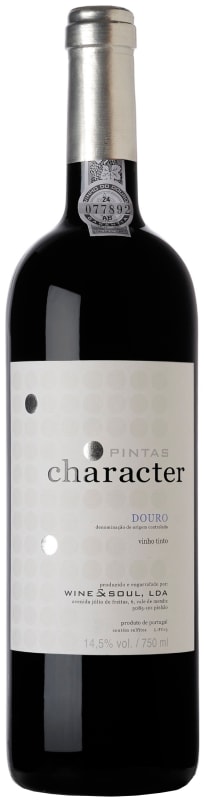


Winemaker Notes
Rich and powerful, this wine shows notes of raspberry, black cherry and plums. On the palate it is fresh and velvety with well integrated tannins and a long, persistent finish.
Professional Ratings
-
Jeb Dunnuck
One of the few non-Spanish wines in the lineup from Casa del Vino, the 2015 Douro Pintas Character is 100% Touriga Nacional that spent 18 months in oak. Deep ruby-colored with notes of blueberries, violets, spring flowers, and cedarwood, this beauty is ripe and plump on the palate, with a juicy, mouthfilling texture that keeps you coming back to the glass. It has plenty of density and enough tannin to keep it drinking nicely for at least 7-8 years, although I love its purity and upfront nature today.
-
Wine Enthusiast
Old vines and stone-lagar fermentation result in a powerful wine that acts as a second wine to the producer's top wine, Pintas. Rich tannins are integrating well with the black-plum and blackberry fruits. Spice, pepper and juicy acidity come together well. Drink from 2022
-
Wine & Spirits
Jorge Serodio Borges and Sandra Tavares da Silva make two old-vine field blends from their vineyards in the Pinhão Valley’s Vale Mendiz, the epicenter of the Douro region. Pintas Character comes from a 1970 planting, a field blend of 30 varieties, the parcel adjacent to the 1930 planting of more than 35 varieties that produces Pintas. Both wines ferment in stone lagares; Pintas ages for 22 months in oak, 70 percent new, while Character ages 18 months in oak, 50 percent new. In 2015, Character jumps out of the starting gate with the most beautiful scent of the Douro, this wine charged with a wild-strawberry perfume, scents of savory herbs and a brisk delicacy that makes all of its power feel nonchalant. Complex and accessible as a young wine, this will age with grace.
-
Robert Parker's Wine Advocate
The 2015 Pintas Character is a field blend (more than 30 different grapes but mostly Touriga Franca, Tinta Roriz and Touriga Nacional) aged for 18 months in 50% new French oak. It comes in at 14% alcohol. Not quite bottled when I first saw it, it is now in bottle and in the USA. It is a very different style than the regular Manoella this issue, its "second wine" competitor (however, this is not a selection of lesser grapes or barrels, just a different terroir), but a big step up as they both show today. This is a great "Character," one of the producer's best yet. It has the structure and intensity of an upper-level bottling, plenty of depth and a big, gripping finish. It seems fairly pure and transparent too, for a wine of this type. This still has some developmental questions to answer in the cellar. If it has an issue, it could use more expressive fruit. That may come in time. In the meanwhile, it is very promising and a fine value.
-
Wine Spectator
Firm but elegant, with a singed herb aroma weaving through graphite, boysenberry and currant flavors in this supple, full-bodied red. Peppery spice and zesty elements are matched with black tea and underbrush aromas on the long finish. Offers full, integrated tannins. Drink now through 2023.


With hundreds of red grape varieties to choose from, winemakers have the freedom to create a virtually endless assortment of blended red wines. In many European regions, strict laws are in place determining the set of varieties that may be used, but in the New World, experimentation is permitted and encouraged resulting in a wide variety of red wine styles. Blending can be utilized to enhance balance or create complexity, lending different layers of flavors and aromas. For example, a red wine blend variety that creates a fruity and full-bodied wine would do well combined with one that is naturally high in acidity and tannins. Sometimes small amounts of a particular variety are added to boost color or aromatics. Blending can take place before or after fermentation, with the latter, more popular option giving more control to the winemaker over the final qualities of the wine.
How to Serve Red Wine
A common piece of advice is to serve red wine at “room temperature,” but this suggestion is imprecise. After all, room temperature in January is likely to be quite different than in August, even considering the possible effect of central heating and air conditioning systems. The proper temperature to aim for is 55° F to 60° F for lighter-bodied reds and 60° F to 65° F for fuller-bodied wines.
How Long Does Red Wine Last?
Once opened and re-corked, a bottle stored in a cool, dark environment (like your fridge) will stay fresh and nicely drinkable for a day or two. There are products available that can extend that period by a couple of days. As for unopened bottles, optimal storage means keeping them on their sides in a moderately humid environment at about 57° F. Red wines stored in this manner will stay good – and possibly improve – for anywhere from one year to multiple decades. Assessing how long to hold on to a bottle is a complicated science. If you are planning long-term storage of your reds, seek the advice of a wine professional.

The home of Port—perhaps the most internationally acclaimed beverage—the Douro region of Portugal is one of the world’s oldest delimited wine regions, established in 1756. The vineyards of the Douro, set on the slopes surrounding the Douro River (known as the Duero in Spain), are incredibly steep, necessitating the use of terracing and thus, manual vineyard management as well as harvesting. The Douro's best sites, rare outcroppings of Cambrian schist, are reserved for vineyards that yield high quality Port.
While more than 100 indigenous varieties are approved for wine production in the Douro, there are five primary grapes that make up most Port and the region's excellent, though less known, red table wines. Touriga Nacional is the finest of these, prized for its deep color, tannins and floral aromatics. Tinta Roriz (Spain's Tempranillo) adds bright acidity and red fruit flavors. Touriga Franca shows great persistence of fruit and Tinta Barroca helps round out the blend with its supple texture. Tinta Cão, a fine but low-yielding variety, is now rarely planted but still highly valued for its ability to produce excellent, complex wines.
White wines, generally crisp, mineral-driven blends of Arinto, Viosinho, Gouveio, Malvasia Fina and an assortment of other rare but local varieties, are produced in small quantities but worth noting.
With hot summers and cool, wet winters, the Duoro has a maritime climate.