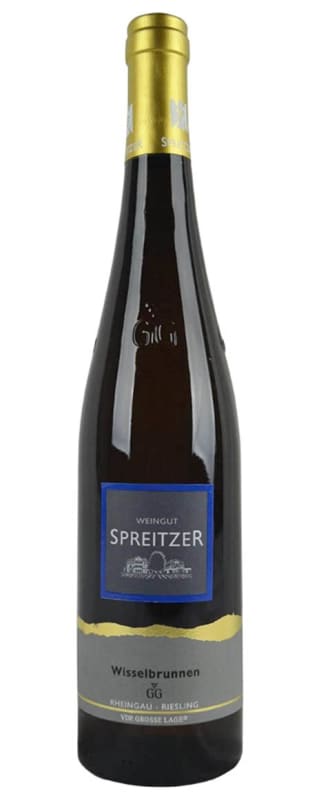


Winemaker Notes
The Hattenheimer Wisselbrunnen Grosses Gewachs vineyard's soil consists mainly of quartzite, loess and marl. These components combined with aging in neutral wooden barrels create a herbaceous, mineral, fine-grained Riesling with a salty purity.
Professional Ratings
-
Vinous
The 2021 Riesling Hattenheimer Wisselbrunnen Grosses Gewächs was grown on deeper soils with quartzite veins running through the vineyard. Once again, there is a touch of topicality alongside a note of sun-warmed boxwood. The palate is, in a way, drying and dusty but beautifully pithy, with a citrus depth. It is the length that gets you, the balanced, juicy zestiness. The interesting thing here is that the charms do not show immediately. This only comes to you on the finish but remains all the more present with zesty length. (Bone-dry)
-
Wine Spectator
A seductive, well-crafted version, with a lacy, lifted quality to its elderflower blossom flavors, followed by a fleshy palate of peach, persimmon and melon. A roasted agave note and a salty mineral vein give this an appealing margarita quality. Succulent acidity and an earthy, herbaceous vein make for the weighty, persistent finish. Drink now through 2035.


Riesling possesses a remarkable ability to reflect the character of wherever it is grown while still maintaining its identity. A regal variety of incredible purity and precision, this versatile grape can be just as enjoyable dry or sweet, young or old, still or sparkling and can age longer than nearly any other white variety. Somm Secret—Given how difficult it is to discern the level of sweetness in a Riesling from the label, here are some clues to find the dry ones. First, look for the world “trocken.” (“Halbtrocken” or “feinherb” mean off-dry.) Also a higher abv usually indicates a drier Riesling.

Practically one long and bucolic hillside along the northern bank of the Rhein River, the Rheingau stretches the entirety of the river’s east to west spread from Hocheim to Rüdesheim.
Variations in elevation, soil types, and proximity to the Rhine cause great diversity in Rheingau Riesling. Some of the better Rieslings in warmer years come from the cooler and breezier sites at higher elevations. In cooler years, sites closer to the river may perform better.
In the village of Rüdesheim, slopes are steep and soils are stony slate with quartzite; Rieslings are rich and spicy, intense in stone fruit and show depth and character with age. World class Rieslings come from farther east on the river through Geisenheim, Johannisberg, Winkel, Oestrich and past Erbach as well, where soils of loess, sand, and marl alternate. Long-living, floral-driven and mineral-rich Rieslings come from the best of these sites.
Rheingau growers became early activists in promoting the dry style of Riesling, low yields and the classification of top vineyards, or Erstes Gewächs (first growths). Proximity to the metropolitan markets of Mainz, Wiesbaden, and Frankfurt keeps Rheingau in high reputation. While dry wines are the style here, Rheingau isn’t short of some amazing Auslesen, Beerenauslesen, and Trockenbeerenauslesen.
Rheingau doesn’t mess with many other grapes—in fact 79% of its total area is dedicated to Riesling. But it produces some fine Pinot noir, especially concentrated in Assmannshausen, a bit farther west from Rüdesheim.